IN Brief:
- Paua has added commercial fleet access to 652 charging connectors at 13 Stagecoach Chargd depot sites.
- The arrangement shares existing bus charging equipment rather than establishing 652 newly built chargers.
- Charging sessions remain dependent on site access, connector compatibility and available capacity around bus operations.
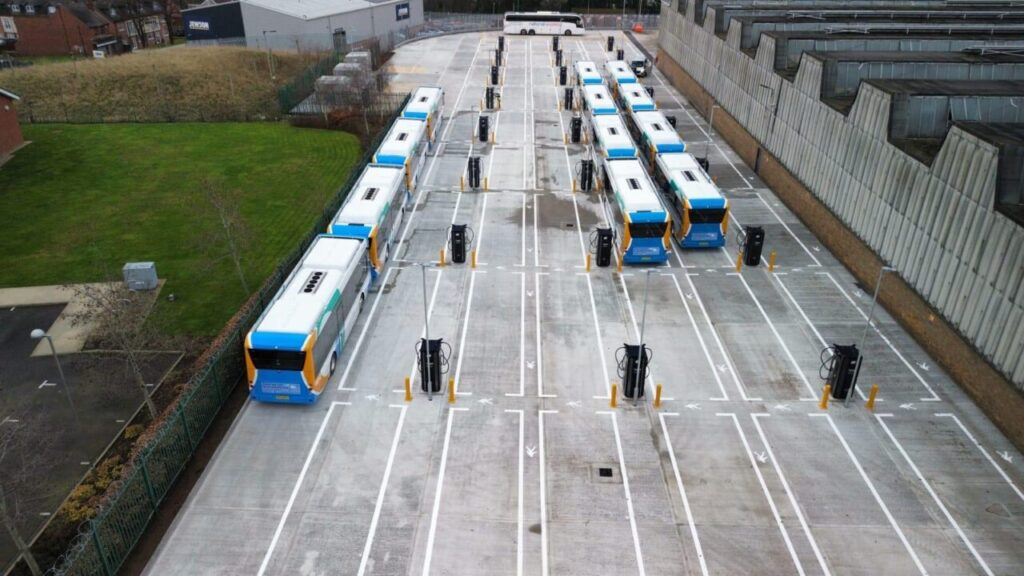
Paua has added access to 652 electric vehicle charging connectors across 13 Stagecoach Chargd bus depots for approved commercial fleet operators. The arrangement gives selected businesses another route to depot-based electricity supply, using infrastructure originally established for buses. It does not make the depots unrestricted public charging stations, nor does the published connector total establish how many charging spaces can be used simultaneously by third-party vehicles.
Stagecoach launched its Chargd business-to-business charging proposition earlier in 2026, opening spare capacity at depots with substantial electrical connections and charger installations. Paua is extending that arrangement through its existing fleet charging and payment services. Customers already using the platform for public, home or workplace charging may therefore have access to selected semi-private depot facilities, subject to approval and the operating conditions of each location.
The 652 connectors are spread across 13 sites rather than concentrated at one charging hub. Connector count is a measure of physical interfaces, not the electrical demand that the depots can accommodate at any one moment. Individual vehicles must fit the site and charger configuration, and sessions have to work around bus operations. Neither partner has published one uniform charging power, a standard booking window or a guaranteed simultaneous charging allocation across all participating locations.
Depot charging has a different electrical load profile from a small public charging site. Buses and commercial vehicles may arrive in groups, stay for scheduled periods and draw substantial power over several hours. The installation must distribute electricity among multiple chargers while staying within its connection capacity and the limits of transformers, switchgear and local cables. Charge management can sequence sessions or allocate power dynamically, although the precise control arrangements at each participating depot have not been disclosed in the new agreement.
Third-party charging has to be scheduled around the vehicles for which Stagecoach built its depot infrastructure. The electrical connection, internal switchgear and chargers were designed to accommodate the operator’s own service patterns; external demand can be added only where space and available electrical power permit it. Allocating spare capacity to an additional fleet may improve asset utilisation, but it cannot increase the connection’s import limit. A busy evening return of buses could therefore leave less capacity for an outside operator than a quieter period.
Stagecoach said in July that its Chargd service was live at Inverness, Cambridge, Oxford, Stockton, Ash Grove in London and Dover, with nine further depots planned for later in 2026. Paua now identifies 13 accessible sites under its partnership, but it has not supplied a definitive connector-by-connector operating schedule for all of them. The earlier Stagecoach list should not be treated as an exact list of depots that every Paua customer can book today.
The commercial users of such a network may include van, truck, utility and public sector fleets whose vehicles operate away from a single central depot. For those operators, charging cannot always be confined to the company’s own premises, particularly when routes, operating shifts or temporary contracts change. Sharing a suitably located charging hub can reduce reliance on ad hoc public charging, although vehicle dimensions, turnaround time and route deviation remain relevant when a driver is assigned to a particular depot.
The electricity engineering challenge becomes sharper as heavier commercial vehicles enter the charging market. A high-energy battery can require a long charging session at a modest power level, while rapid turnaround creates a much higher peak load. At any depot, that distinction affects simultaneous vehicle capacity and the overall demand seen by the grid connection. The availability of hundreds of connectors across a national portfolio says little about local peak demand unless the power and scheduling characteristics of the individual locations are also understood.
Operators planning to rely on shared depot charging will need to check access permissions, connector compatibility, site dimensions, usable power and vehicle turnaround time. The agreed price and payment arrangements are also operational inputs, especially when energy costs must be allocated across drivers and routes. Paua provides a consolidated fleet charging platform, but this new partnership announcement does not establish identical tariffs or service rules at every depot. Route plans should be based on confirmed local availability rather than the headline national connector count.
Stagecoach demonstrated third-party access to Chargd charging facilities at its Cambridge depot in July, before the new Paua arrangement brought more sites into one fleet access channel. The current development concerns access and charging administration rather than installation of another 652 connectors. It builds on charging infrastructure already serving buses, with outside vehicles using available space and electrical capacity under separate commercial arrangements.
The next evidence of scale will be the number of sites and charging sessions that external fleets can reliably use without disrupting Stagecoach’s own buses. Charger ratings, depot access hours and load management arrangements will determine that usable capacity. The partnership extends access to existing electrical infrastructure; no claim has been made that 652 new chargers were constructed as a result of the Paua agreement.