IN Brief:
- Nuclea completed its acquisition of selected Moltex technology and intellectual property assets on 17 November.
- The portfolio includes a proposed 300–500 MWe SSR-W reactor and the associated WATSS used-fuel process.
- The preliminary Canadian vendor design review is not a construction licence or proof of commercial operation.
Nuclea Energy has completed its acquisition of selected Moltex Energy assets, including intellectual property relating to a molten salt reactor and a used nuclear fuel recycling process. Its Canadian subsidiary closed the transaction on 17 November, with completion announced the following day. The acquired portfolio covers proposed technologies rather than a licensed operating reactor or an established commercial fuel-processing plant.
The assets include the Stable Salt Reactor Wasteburner, or SSR-W, and the Waste To Stable Salt process, known as WATSS. Nuclea intends the two systems to form an integrated fuel cycle in which selected material recovered from used nuclear fuel is processed into fuel suitable for the proposed reactor. Such integration would require separate development of treatment processes, controlled fuel specifications and a generating station able to use the resulting material; bringing the intellectual property under one owner does not resolve those engineering tasks.
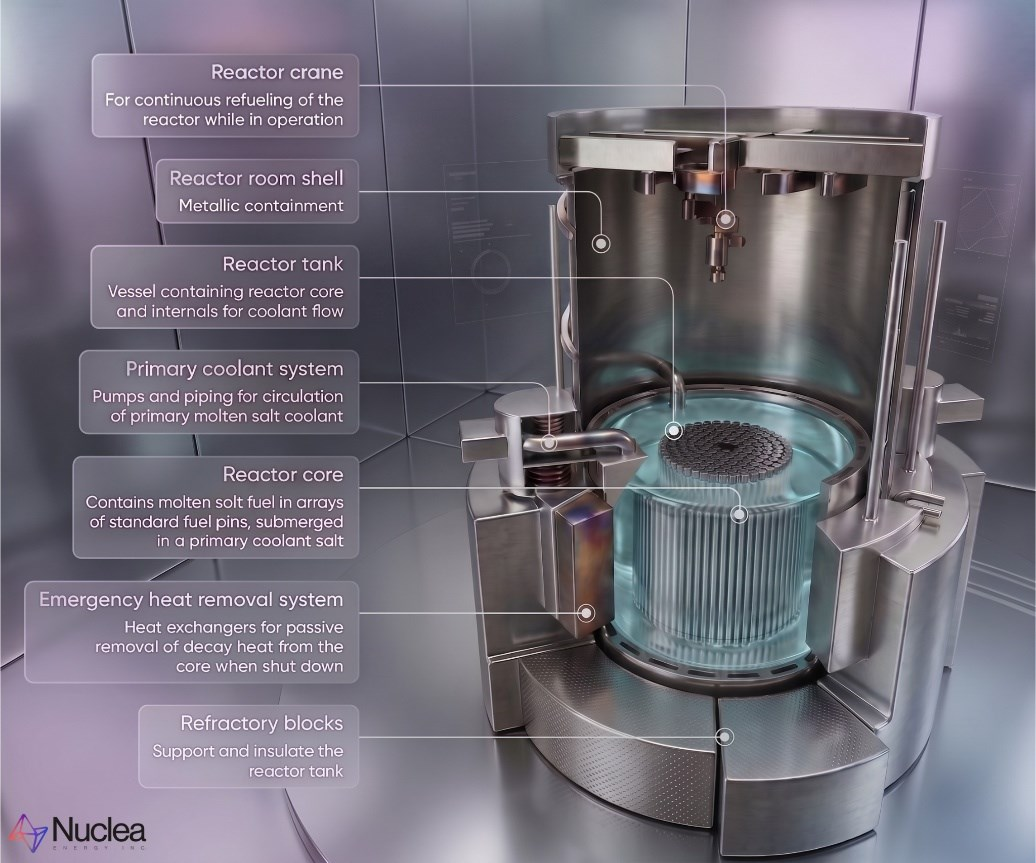
Nuclea describes SSR-W as a fast-spectrum molten salt reactor with a planned electrical output of 300–500 MWe. The developer says its proposed design would operate near atmospheric pressure, unlike the highly pressurised primary cooling circuits used by conventional light-water reactors. Lower operating pressure may alter some mechanical containment demands, but it cannot remove nuclear safety obligations. Shutdown arrangements, removal of residual heat, fuel chemistry and accident analysis will still need to be substantiated for the eventual design.
WATSS is intended to prepare material recovered from used nuclear fuel for further use in an appropriate reactor. A recycling concept of this type entails more than separating potentially useful material: it must establish process chemistry, accountancy, radiological protection, waste streams and the specifications of the fuel ultimately loaded into a reactor. The source material describes the technology’s intended role, not a completed industrial fuel supply chain capable of supporting a fleet of SSR-W plants.
Moltex agreed the transaction in August after developing its technology portfolio over more than a decade. The November closing is a distinct corporate milestone because Nuclea now owns the specified assets and can set priorities for further work. Its pre-existing Morpheus concept is a lead-cooled microreactor intended for smaller or remote electricity applications, quite different in scale from the proposed SSR-W station. The acquisition broadens Nuclea’s development options without demonstrating the performance of either reactor system.
That combination spans several very different reactor classes. A smaller lead-cooled unit intended for remote locations faces a different design and commercial environment from a hundreds-of-megawatts molten salt station supplying a transmission network. Different fuels, heat-transfer media and plant-scale requirements mean there is no automatic shortcut from development work on one design to certification of another. The acquisition gives Nuclea additional options for its pipeline, but those options must each be taken through their own technical and regulatory processes.
The SSR-W concept has completed Phase 1 of the Canadian Nuclear Safety Commission’s Vendor Design Review, according to Nuclea and earlier Moltex records. That preliminary review provides feedback on a developer’s design and regulatory approach; it does not grant a construction licence, a site permit or permission to operate a reactor. Further regulatory engagement and project-specific applications would be required before a station based on SSR-W could be built in any chosen jurisdiction.
The proposed use of recycled fuel adds further licensing interfaces because the fuel-production route, transport, handling and reactor systems have to be evaluated together. Reactor operation depends on reliable material specifications and traceable quality assurance across the fuel cycle. Chemical and thermal performance must also be demonstrated under both normal and fault conditions. No commercial plant capacity, procurement timetable or fuel throughput target has been verified as achieved through the acquisition announcement.
Nuclea is separately pursuing a proposed business combination with NorthStrive Acquisition Corp I. That securities transaction has its own conditions, including shareholder and financing requirements, and has not been completed by the closing of the Moltex purchase. The company has identified future development and capital requirements for its expanded technology portfolio, but neither financing nor regulatory progress should be assumed from the completed asset transfer alone.
A 300–500 MWe SSR-W generating station would need a substantial electrical connection, auxiliary power, protection systems and an agreed programme for delivering power to the grid. The accompanying WATSS facility would bring its own requirements for material control, radiological protection, industrial process equipment and waste handling. Integrating those installations would be a project-level licensing and engineering exercise, not an automatic result of acquiring the patents and design information.
The acquisition puts the reactor design and fuel-treatment intellectual property in the same corporate portfolio, while leaving the decisive engineering tests ahead. Nuclea will need evidence of the proposed fuel route’s performance, a more mature reactor design and the regulatory approvals associated with any demonstration or commercial project. Neither the transaction nor the completed preliminary design review establishes that SSR-W and WATSS can yet produce electricity from recycled fuel at industrial scale.