IN Brief:
- NKT has delivered three cable baskets containing more than 600 tonnes of 525kV HVDC cable for the ElbX river crossing.
- Continuous cable sections exceeding five kilometres will eliminate intermediate joints inside the tunnel beneath the River Elbe.
- Cable pulling, connection to the wider SuedLink system, and electrical commissioning remain outstanding.
NKT has delivered specially engineered 525kV high-voltage direct current (HVDC) cables for the ElbX crossing beneath Germany’s River Elbe, completing a demanding manufacturing and transport operation within the SuedLink transmission programme.
The delivery comprises three continuous cable sections, each exceeding five kilometres in length. Designed specifically for the tunnel crossing, the cables will be installed without intermediate joints, reducing the number of electrical interfaces within a confined section of the transmission route.
NKT manufactured the sections at its high-voltage cable factory in Karlskrona, Sweden, before specialist logistics company deugro transported them to the construction area near Wewelsfleth in northern Germany. The three cable baskets contained more than 600 tonnes of HVDC cable.
ElbX forms part of SuedLink, a major German electricity transmission development intended to transport renewable generation from northern Germany towards industrial and population centres in the south. TenneT Germany is responsible for the northern section, including the crossing beneath the Elbe.
The river crossing presents a particular engineering challenge because the cables must pass through a dedicated tunnel rather than being installed along a conventional open trench route. Access restrictions, the length of the crossing, and the limited space available for cable installation influenced the decision to use continuous manufactured sections.
High-voltage cable joints provide the electrical and mechanical connection between separate cable lengths. Their installation requires careful preparation of conductors, insulation systems, screening components, and protective assemblies to maintain the cable’s designed electrical characteristics.
These interfaces must be installed and tested under controlled conditions. Although properly manufactured and installed joints are established components of transmission systems, each introduces an additional location requiring appropriate quality assurance and long-term asset management.
Eliminating intermediate joints inside the ElbX tunnel removes the need to carry out those assembly operations within the crossing. It also reduces the number of connection points that would otherwise have to be accommodated in the underground installation.
The decision introduced substantial manufacturing and transport requirements. Conventional onshore cable drums could not accommodate the specified lengths, so NKT developed an alternative arrangement using specially designed cable baskets capable of carrying the completed sections without interrupting their continuity.
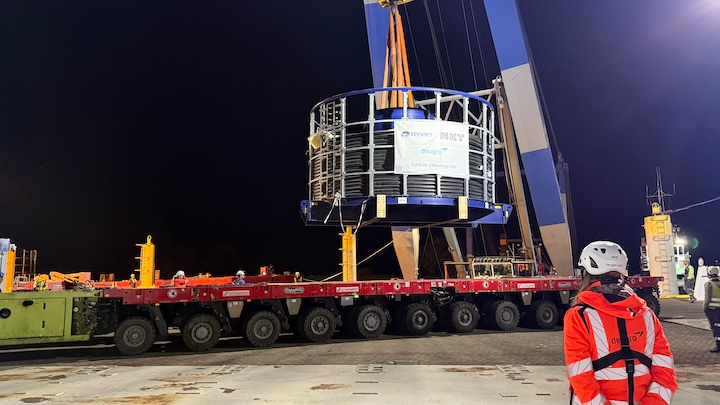
Each loaded basket measured approximately 8.52 metres by 8.52 metres by 4.80 metres and weighed up to 226 tonnes. The dimensions and mass restricted the available transport routes and required heavy-lift equipment, marine transport, and specialised road vehicles.
Preserving the condition of the cable during loading and transportation was central to the operation. High-voltage cables must be handled within their specified mechanical limits, including permissible bending and pulling conditions, to avoid damage that could compromise their insulation or long-term performance.
Transport planning therefore had to consider the cables as engineered electrical assets rather than conventional heavy cargo. The lifting arrangements, basket design, supporting structures, and handling procedures needed to maintain the integrity of the continuous lengths throughout the journey.
At Karlskrona, deugro arranged for a dedicated coaster vessel to remain alongside the manufacturing facility for approximately two and a half weeks. The vessel provided temporary floating storage while the cable sections were progressively manufactured and loaded into their transport baskets.
As each basket was completed, the factory’s gantry crane transferred it onto the coaster. Once all three baskets were ready, the cargo was moved directly from the coaster to a chartered heavy-lift vessel equipped with two cranes rated at 150 tonnes each.
The heavy-lift vessel transported the equipment to Brunsbüttel in Germany, completing the marine passage in approximately 24 hours. Further transport planning was required for the final movement towards the ElbX construction site.
A road-only journey was rejected after assessments identified constraints involving ground conditions, infrastructure restrictions, and the load-bearing capacity of sections of the proposed routes. The alternative combined inland water transport with a shorter heavy-haul road movement.
From Brunsbüttel, tugboats moved the cable baskets by pontoon to Peters Werft in Wewelsfleth. A floating crane then lifted the equipment onto self-propelled modular transporters, which carried the baskets to the designated installation staging area.
Weather conditions, tidal windows, water levels, and quay loading limits influenced the transport sequence. These factors had to be coordinated with the availability of lifting equipment and the requirements for handling the cable baskets without exposing them to unacceptable mechanical loads.
The operation demonstrates how electrical design decisions can determine the construction logistics of major transmission projects. Manufacturing longer cable sections reduces the number of joints required along a route, but increases the size and mass of individual transport units and limits the equipment available for moving them.
That relationship becomes particularly demanding for HVDC projects involving long cable sections, constrained access, and underground structures. Transport engineering must be considered alongside cable design, installation equipment, civil construction, and the available space for handling and pulling the finished product.
The completed delivery establishes the availability of the cable sections for installation. It does not constitute completion of the ElbX crossing, which still requires the cables to be pulled through the tunnel and connected to the wider transmission system.
The installation phase will involve positioning the cables using specialised equipment while controlling the mechanical forces applied during pulling. Terminations and connections must subsequently be completed and tested before the crossing can form part of the operational electricity transmission route.
Successful completion will provide a jointless cable section beneath one of the more challenging geographical obstacles on SuedLink. The manufacturing and transport work has removed a substantial delivery constraint, with the remaining programme centred on installation, electrical integration, and commissioning.