IN Brief:
- CMBlu and Imperial Irrigation District propose a 10 MW/100 MWh SolidFlow battery at Pilot Knob in California.
- A $7.2 million grant supports the initial 1 MW/10 MWh phase rather than the entire proposed installation.
- Further expansion, grid integration arrangements and an operational timetable have not been confirmed.
CMBlu Energy and California’s Imperial Irrigation District (IID) are planning a 10 MW/100 MWh long-duration battery at the utility’s Pilot Knob hydroelectric plant in Winterhaven. The Echo Sands Community Resilience project would use CMBlu’s non-lithium SolidFlow technology to provide up to ten hours of energy discharge, with the initial installation representing only one tenth of the proposed capacity.
A $7.2 million grant approved by the California Energy Commission supports the first 1 MW/10 MWh phase. The partners envisage expanding the scheme to 10 MW/100 MWh, but have not announced financing for that additional capacity, a construction start date or a target for commercial operation. Installation of the first stage remains the immediate funded development, rather than the completion of the entire project.
IID operates both water and electricity infrastructure in the Imperial Valley and serves customers in Imperial County and parts of Riverside and San Diego counties. Echo Sands is intended to strengthen supplies for the Fort Yuma Quechan Indian Tribe and neighbouring communities, including during extreme heat and disruptive events. Its proposed position at an existing hydroelectric facility provides an identifiable utility site, although the operating relationship between the battery and generating plant has not been specified.
The funding is awarded through the Community Energy Reliability and Resilience Investment programme, or CERRI, which supports grid hardening and projects intended to improve local energy resilience. Both phases have the same stated ten-hour discharge duration: the initial installation is rated at 1 MW/10 MWh, compared with the eventual 10 MW/100 MWh design. Equipment integration and operating experience from the smaller phase could inform subsequent expansion, although the partners have not described a fixed sequence of engineering milestones.
A 10 MW power rating describes the maximum nominal instantaneous discharge, while 100 MWh specifies the stored energy available over time. Dividing energy capacity by power produces the stated ten-hour duration at full rated output. The amount actually delivered to customers would be influenced by state-of-charge limits, conversion losses, auxiliary demand and the dispatch instructions issued by IID. Those operating characteristics have not yet been demonstrated at Echo Sands.
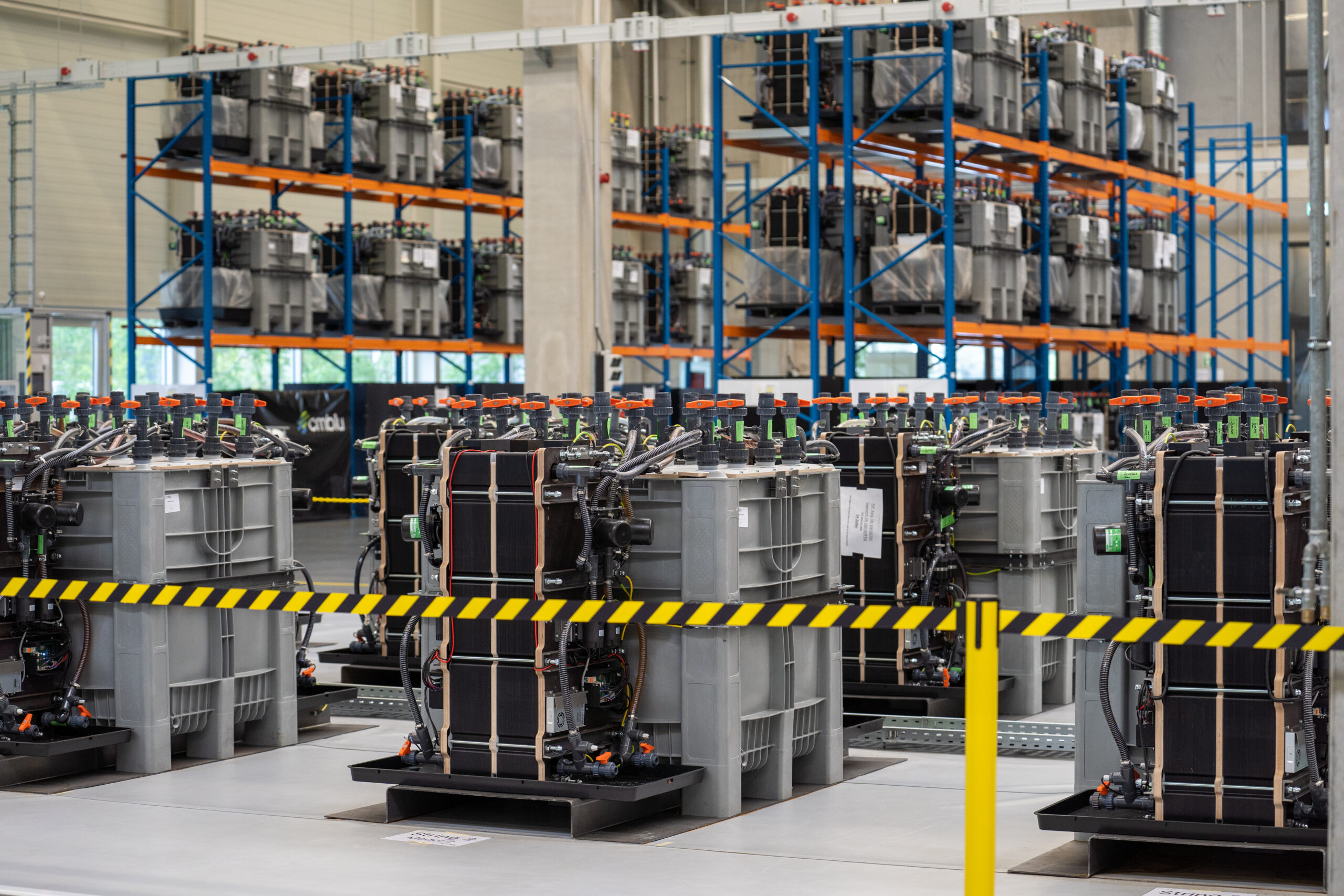
SolidFlow uses organic solid energy-storage materials together with circulating liquid electrolyte. Electrochemical reactions in the battery stacks move charge between the storage materials and the electrical system, while the arrangement separates the equipment providing conversion power from much of the material determining energy capacity. This configuration offers a route to longer discharge times without increasing stack capacity in direct proportion to stored energy. CMBlu says the system avoids lithium and vanadium and uses non-flammable materials; independently measured efficiency and lifetime results for this installation have not been released.
The ability to size energy storage and power conversion differently is particularly relevant where a utility needs supply over several hours rather than a short burst of output. Pumps circulate electrolyte, conversion equipment interfaces with the network and controls coordinate charging, discharging and protective responses. Each subsystem introduces losses and maintenance requirements. The ten-hour rating therefore establishes a design objective, while operating data from the first 1 MW stage will be needed to assess performance under IID’s actual dispatch conditions.
Connection engineering will determine the services Echo Sands can provide alongside Pilot Knob’s hydroelectric generation. The project announcement does not specify the grid connection design, protection settings, inverter controls or whether battery dispatch will be coordinated with the hydroelectric plant. Those details affect response speed, fault behaviour and the conditions under which storage may export power. A shared location alone does not make the two assets an automatically controlled hybrid generating system.
Imperial Valley experiences severe summer heat, raising the importance of supply arrangements that can accommodate changing load and local disturbances. Stored electricity could be shifted into a later demand period or used as an additional resource when the connected network is under strain. Supplying customers during a complete network outage would also require suitable switching, protection and islanding controls; battery capacity by itself cannot guarantee that a disconnected area remains energised.
Giovanni Damato, president of CMBlu Energy, said: “Reliable power matters most when communities are under the greatest strain.” Paul Rodriguez, IID’s deputy power department manager, welcomed the California Energy Commission’s selection of the utility for CERRI funding. The project partners have also named Campesinos Unidos, Pacific Northwest National Laboratory, the Electric Power Research Institute and CleanTech Strategies, without publishing a detailed division of their responsibilities.
The proposed installation would give IID experience of a storage chemistry outside the lithium-ion technologies used across most current grid-scale battery projects. In January 2026, CMBlu and Uniper agreed a separate conditional framework covering at least 5 GWh of potential SolidFlow installations. That agreement has no disclosed financing or procurement connection to Echo Sands, but provides context for the manufacturer’s effort to deploy the technology at larger scale.
IID and CMBlu will first need to implement the grant-backed 1 MW/10 MWh stage, complete its electrical integration and verify performance during extended discharge. No timetable or investment commitment has yet been disclosed for the remaining 9 MW/90 MWh. Echo Sands is consequently a funded initial project with a defined expansion ambition, rather than an operational 100 MWh asset.