IN Brief:
- CS Wind Offshore has dispatched the first Nordlicht I transition pieces from Aalborg.
- Each structure weighs approximately 362 tonnes and will be installed by DEME.
- The 980MW project will use 68 Vestas V236-15MW turbines and enter operation in 2028.
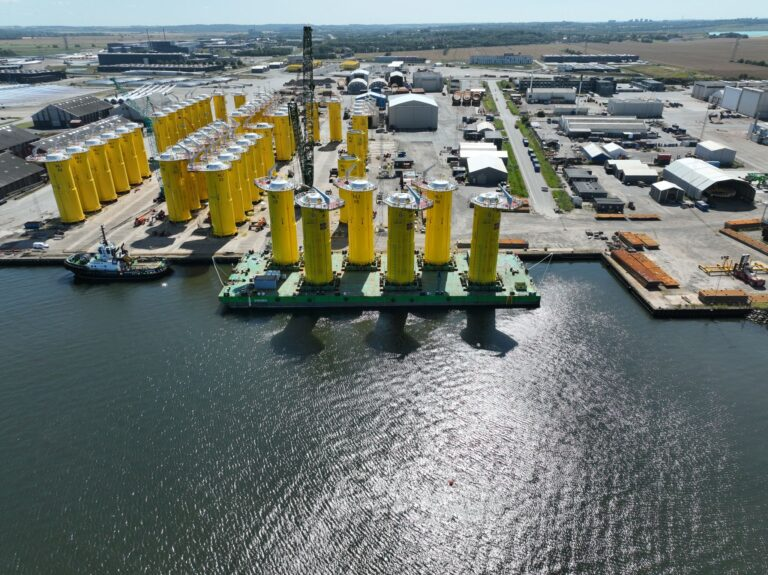
CS Wind Offshore has dispatched the first transition pieces for Vattenfall’s 980MW Nordlicht I offshore wind farm from its manufacturing site at the Port of Aalborg.
Each structure weighs approximately 362 tonnes, and DEME will transport the components to the project area in the German North Sea before installing them onto monopile foundations around 85km north of Borkum.
Transition pieces form the structural and electrical interface between each monopile and turbine tower. They commonly accommodate access systems, cable entry points, secondary steelwork, internal platforms, lifting arrangements, corrosion protection equipment, and parts of the turbine’s electrical route.
Vattenfall and BASF, its project partner at the time, awarded foundation contracts to EEW Special Pipe Constructions and CS Wind Offshore in January 2025. EEW is supplying monopiles, while CS Wind is producing transition pieces for Nordlicht I and the subsequent Nordlicht II development.
DEME installed the first Nordlicht I monopile on 1 July, and the sequence now moves through repeated foundation transport, positioning, installation, survey, transition piece connection, and preparation for later turbine work.
Across the completed Nordlicht cluster, 112 Vestas V236-15.0MW turbines are planned. Nordlicht I will use 68 machines and is scheduled for commercial operation in 2028, while the 630MW Nordlicht II project is expected to use 44 turbines and enter operation in 2029.
Together, the two wind farms are expected to provide approximately 1.6GW and generate around 6TWh of electricity annually. Construction on Nordlicht II is due to begin in 2027.
Vestas’ Nordlicht I order includes a five year service and warranty agreement followed by an operational support arrangement extending for 25 years. The long service period reflects the importance of availability, remote diagnostics, planned maintenance, and major component strategy throughout the operating life of the turbines.
Foundation interfaces govern offshore sequencing
Transition piece delivery forms one stage in a tightly linked offshore construction programme. Monopiles, secondary steel, scour protection, array cables, offshore substations, export systems, and turbines must reach the site in a sequence that matches vessel availability, port capacity, and weather conditions.
A delay in one component can affect several later operations. A monopile cannot receive its transition piece until installation tolerances and surveys have been accepted, while turbine erection cannot proceed until the foundation, internal systems, cable routes, and access arrangements are ready.
Quayside logistics are equally demanding because structures weighing hundreds of tonnes require reinforced storage areas, specialised transporters, lifting equipment, sea fastening, and clear routes between fabrication halls, inspection points, and installation vessels.
Manufacturing tolerances must also account for the offshore alignment and connection method. Bolted, grouted, and slip joint arrangements impose different requirements for dimensional control, surface preparation, load transfer, and installation procedure.
Electrical interfaces continue through the foundations. Array cables enter each structure through engineered routes and must be protected against bending, movement, abrasion, and environmental exposure, while earthing, lightning protection, corrosion monitoring, auxiliary power, communications, and turbine controls remain coordinated across several supplier packages.
The 15MW turbine rating reduces the number of foundations required for a given wind farm capacity compared with earlier machines, but individual components become larger and heavier. Vessel crane capacity, port strength, transport frames, lifting studies, and offshore handling procedures must develop accordingly.
DEME is delivering foundation work across several European projects, including 69 monopiles and associated steelwork for the Zeevonk development in the Dutch North Sea.
Overlapping programmes place pressure on specialised vessels and experienced marine teams. Installation schedules must accommodate weather risk, environmental restrictions, maintenance periods, and transit between projects, leaving limited tolerance for late component deliveries.
Standardisation can reduce part of the manufacturing and installation risk across Nordlicht I and II. Both projects use the same turbine platform and related foundation packages, allowing tooling, procedures, documentation, and workforce experience to carry into the second phase.
Site specific conditions still require controlled variation because water depth, soil profile, wave loading, cable approach, foundation penetration, and installation noise differ across an offshore area. Component design and the work required at each position must respond to those conditions without undermining the wider production sequence.
Quality records are as important as the structures themselves. Material certificates, weld inspections, coatings, dimensional surveys, nondestructive testing, lifting documentation, and final handover information must remain traceable through manufacture, transport, installation, and operation.
The first Aalborg shipment moves Nordlicht I from factory production into repeated offshore delivery. Progress will now depend on ports, vessels, component manufacturers, and installation teams maintaining a consistent sequence across 68 turbine positions before the project advances to array cables and turbine erection.