IN Brief:
- RenewableUK identifies 8.7GW/14.1GWh of operational UK battery storage, including 1.1GW/2.2GWh commissioned during 2026.
- A further 9.1GW/19GWh is under construction, while the active development pipeline comprises 2,372 projects.
- The database uses modelled power or energy capacity where specifications are unavailable, so some pipeline figures are estimates rather than confirmed equipment ratings.
Operational battery energy storage capacity in the UK has reached 8.7GW, with associated energy capacity of 14.1GWh, according to RenewableUK’s latest EnergyPulse assessment. The organisation also identifies approximately 9.1GW/19GWh of installations under construction, reflecting continued development activity alongside growth in the number of commissioned assets.
The figures, published on 21 October, cover electricity storage installations at different stages of delivery. RenewableUK records 2,372 active battery projects, an increase of 432 since September 2025, and reports that UK battery storage capacity has grown by 21% over the same comparison period.
During 2026, approximately 1.1GW of battery power capacity and 2.2GWh of associated energy capacity have entered operation. Over the longer period beginning on 1 September 2025, commissioning totals approximately 1.5GW/2.8GWh, while construction has started on projects representing 4.1GW/9.2GWh.
These measures describe overlapping periods and different stages of project delivery. The batteries commissioned during 2026 form part of the longer commissioning total, while construction starts should not be added to operating capacity before the relevant installations have passed their electrical and commercial acceptance requirements.
The distinction between power and energy capacity is essential when assessing the size of the storage fleet. A battery’s MW rating describes the rate at which it can exchange electricity with the network, while its MWh rating describes the energy available for storage and subsequent discharge under specified operating conditions.
Dividing energy capacity by power capacity gives an indicative discharge duration at rated output. A 100MW battery with 200MWh of usable energy could theoretically maintain full output for two hours, although its actual operation would also depend on state of charge, conversion losses and equipment limits.
RenewableUK’s operational figures should not be used to assign a single discharge duration to every battery in service. The fleet contains installations with different power ratings, energy capacities and technical configurations, while individual systems may be operated for different electricity market and network purposes.
The organisation also cautions that some figures in its development database are modelled. Where a project’s MW capacity is unavailable, EnergyPulse may estimate power capacity from its physical footprint. Where energy capacity is not disclosed, it applies duration assumptions based on the reported or estimated power rating.
For projects rated at 50MW or below, the methodology generally assumes one hour of storage when the MWh rating is unknown. Larger projects are assigned a two-hour duration. These conventions allow consistent pipeline estimates, but the final installed energy capacity may differ from the modelled figure.
The qualification becomes increasingly important as developers propose batteries with longer discharge durations. EnergyPulse estimates that 50% of projects in its pipeline have a one-hour duration, 34% have a two-hour duration and 16% have a duration of at least four hours.
Among projects submitted for planning over the past decade with a stated or modelled duration of four hours or more, approximately 66% were submitted during 2025 or 2026. The distribution suggests growing interest in configurations capable of sustaining output over longer periods, although it does not establish the performance of projects that have yet to be constructed.
Longer discharge duration can make storage suitable for shifting electricity between periods separated by several hours. A battery may absorb electricity when generation is relatively abundant and subsequently discharge when market conditions or system requirements change, provided its operating strategy and network connection permit that activity.
Increasing energy capacity without a corresponding increase in power rating extends the period over which the battery can discharge, rather than increasing its maximum instantaneous output. Conversely, a battery designed for high power over a shorter period may be better suited to duties requiring rapid changes in electrical output.
The appropriate configuration depends on the intended commercial and technical services. Electricity trading, frequency response, capacity obligations and other potential activities impose different demands on response time, available energy, telemetry and control systems. Participation also depends on market qualification and applicable contractual conditions.
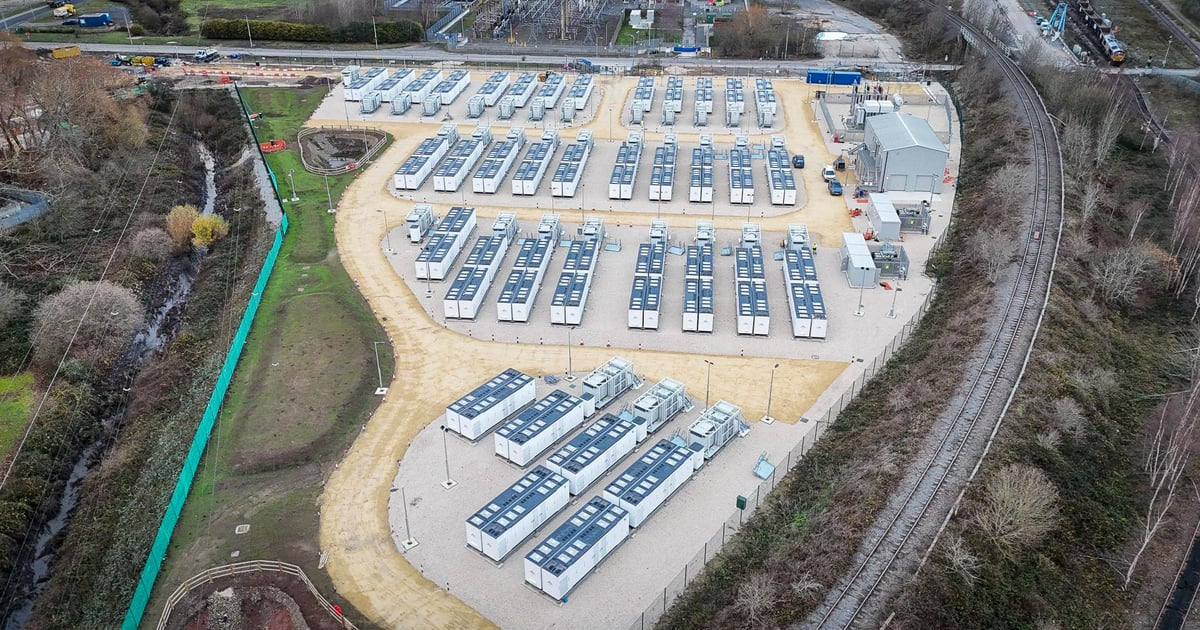
Several substantial installations entered the operating fleet during 2026. RenewableUK identifies Coalburn at 500MW/1,000MWh, Kilmarnock South at 300MW/600MWh and Ferrybridge at 150MW/300MWh among the additions, illustrating the contribution of individual large projects to the national totals.
Coalburn’s commercial operation began in August, while Ferrybridge entered full operation in March. Their inclusion in the operating fleet is distinct from projects that have secured planning permission, financing or construction contracts but have not yet completed commissioning.
RenewableUK identifies Monk Fryston, rated at 320MW/640MWh, and Carrington, rated at 680MW/1,360MWh, among installations under construction. The organisation forecasts completion towards late 2026 and during 2027 respectively, although those dates remain project schedules rather than confirmed operational milestones.
The development pipeline also contains larger proposals. There are 89 projects rated at 500MW or above, including the consented 500MW/2,000MWh Abbotshaugh development and the 500MW/6,000MWh Hagshaw long duration storage scheme. Their differing MWh ratings demonstrate that projects with the same power capacity can have markedly different intended operating characteristics.
Larger installations place substantial demands on the electrical infrastructure connecting them to the network. Transformers, switchgear, protection equipment, converters and associated controls must be rated for the battery’s permitted import and export capability, while the connection must accommodate charging demand as well as electricity discharge.
The network impact depends on the location and operating conditions of each installation. Charging can increase electricity demand at its connection point, while discharge can increase power exported onto the network. Both activities must remain within the applicable connection limits and any restrictions imposed by the surrounding infrastructure.
Battery storage can provide flexibility, but it cannot independently remove every network constraint. An installation connected behind a restricted transmission corridor may face limits on when it can import or export electricity, even where its batteries and power conversion equipment are technically capable of operating at higher output.
Regional development data shows how individual projects influence capacity concentrations. Essex has the largest operational battery power capacity at 612MW, supported by installations including Thurrock at 300MW/600MWh and Dollymans at 99.9MW/100MWh.
South Yorkshire leads capacity under construction at approximately 1,489MW, compared with 904MW in the Scottish Borders and 767MW in Greater Manchester. The South Yorkshire total is strongly influenced by the 1,400MW/3,100MWh Thorpe Marsh development, rather than indicating a uniform concentration of numerous smaller projects.
Smaller batteries are also prominent in planning submissions. RenewableUK identifies approximately 115 projects rated at 0.2MW or below among submissions during 2026, representing around 23% of that year’s total. Many use a proposed 0.2MW/0.8MWh configuration, although their combined power capacity contributes comparatively little to the national pipeline.
The resulting market includes batteries intended for different connection levels and operating duties. A large installation connected to high-voltage infrastructure requires different network arrangements and asset management practices from a smaller battery installed on a local distribution connection, even though both store electricity for later use.
RenewableUK’s figures show increasing operational capacity and a substantial programme of projects under construction. The conversion of that pipeline into usable storage will depend on equipment delivery, completed grid connections, testing and commissioning, while the distinction between confirmed specifications and modelled values will remain important as individual projects progress.