IN Brief:
- Thorlux was founded in Birmingham in 1936 and celebrates its 90th anniversary this year.
- More than 90% of its luminaires are manufactured in the Midlands.
- The company is investing in advanced production while targeting net-zero emissions by 2040.
Thorlux Lighting is marking its 90th anniversary with charity events and the reopening of a refreshed visitor and application centre at its Redditch manufacturing headquarters.
Frederick William Thorpe established the business in 1936, initially manufacturing vitreous-enamelled steel reflectors in a small factory in Small Heath, Birmingham. The company moved to Hall Green in 1939, Kings Norton in 1963, and its current Redditch base in 1989.
Thorlux has since become the largest company within the FW Thorpe Group, producing luminaires, lighting controls, and emergency-lighting systems for commercial, industrial, transport, healthcare, education, and infrastructure applications.
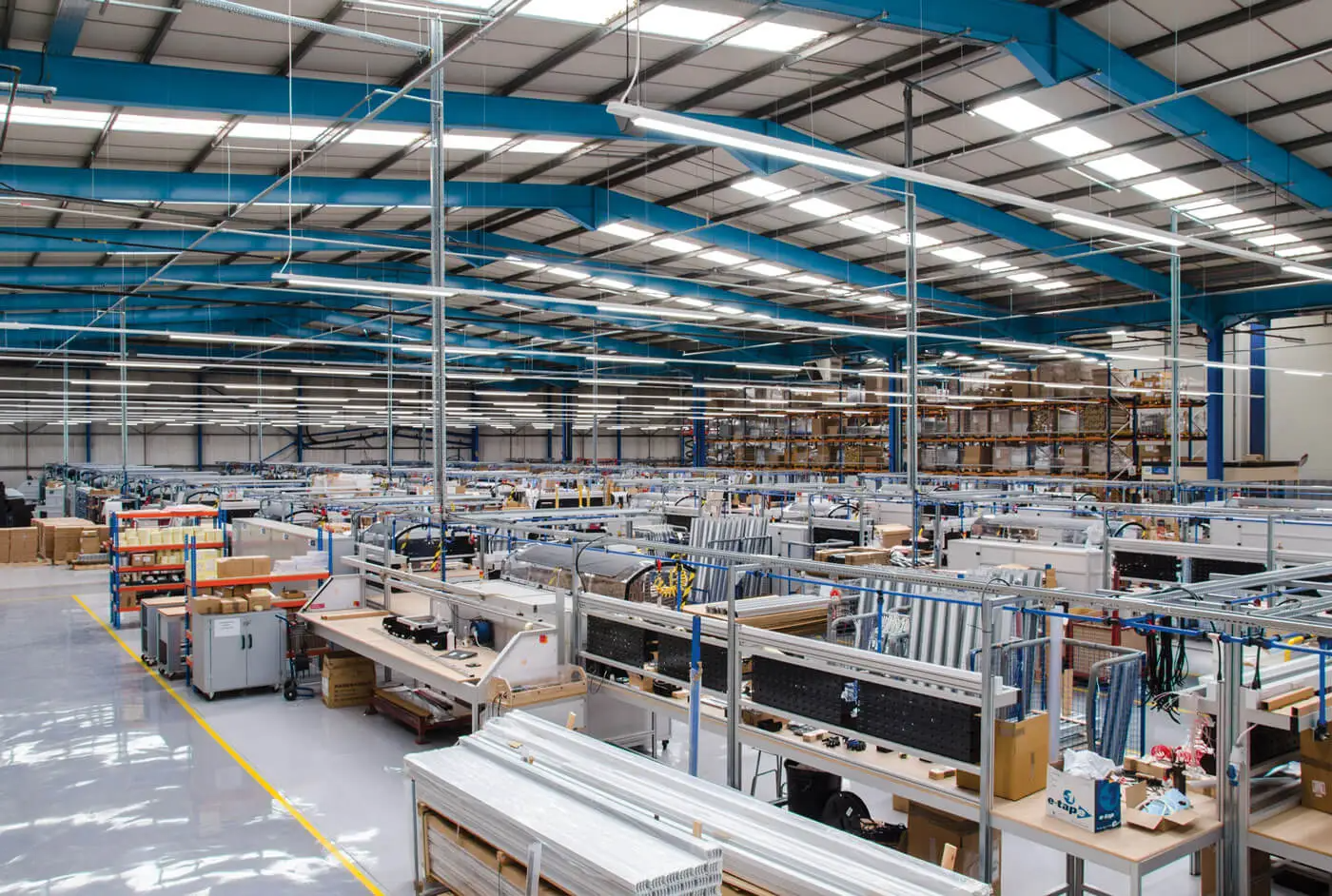
More than 90% of its products are manufactured in the Midlands, where over 500 people are employed. The Redditch operation includes design, testing, metalworking, electronics, assembly, controls development, and supporting production functions within a factory covering approximately 16,882m².
The refreshed Thorlux Application Centre places a spinning lathe used since the 1930s at the centre of the visitor space. The machine provides a physical connection with the company’s early manufacturing methods, when metal-forming and finishing processes were central to reflector production.
An expanded Emergency Lighting Experience has also been added, creating a controlled power-failure and escape scenario in which visitors can observe how emergency luminaires, signs, controls, and changes in visibility affect evacuation conditions.
Emergency-lighting performance is difficult to assess through product data alone. Position, spacing, mounting height, escape-route geometry, open-area requirements, high-risk tasks, duration, battery condition, and maintenance all influence the effectiveness of the installed system.
A realistic demonstration environment can show how those factors interact when normal lighting fails. It can also illustrate how poor sign placement, unsuitable light distribution, obstructions, or inadequate maintenance can compromise an otherwise compliant design.
The centre forms part of wider investment in advanced manufacturing technology at Redditch. Modern luminaire production combines sheet-metal fabrication, coatings, optics, LED modules, electronic drivers, sensors, communications, batteries, software, and automated testing.
Keeping those capabilities within one manufacturing operation can shorten the route between product design, engineering changes, production trials, testing, and quality control. It also allows mechanical, electronic, optical, and software teams to work around the same product platform.
UK lighting manufacture has changed substantially during Thorlux’s history. The sector has moved from reflector-based fittings for conventional lamps through fluorescent systems and into integrated LED luminaires with digital controls.
Energy performance now depends on optics, drivers, sensing, scheduling, daylight response, and building-management integration as much as the efficiency of the light source. Lighting has consequently become a combined electrical, electronic, controls, and software discipline.
Longer LED life has also altered maintenance requirements. Lamp replacement is less frequent, but drivers, batteries, sensors, seals, controls, firmware, and communications remain serviceable components with finite operating lives.
Product design increasingly has to account for access, replaceability, diagnostics, and the continuing availability of compatible components. A luminaire may remain mechanically sound long after an electronic driver or communications module requires replacement.
Thorlux has developed more than 115 product ranges spanning industrial, commercial, architectural, and emergency-lighting applications. Its control systems allow luminaires to respond to occupancy, daylight, schedules, and central management, reducing operating hours where full output is unnecessary.
Connected lighting introduces further engineering requirements. Networks must remain reliable, commissioning settings need to be recorded, and building operators require appropriate access without weakening cyber security.
An installation expected to remain in service for many years also needs a support strategy covering software, gateways, sensors, replacement devices, and system compatibility. Changes to building use or IT infrastructure can affect lighting controls long after the original installation has been completed.
Standards, connected lighting, emergency systems, and sustainability now sit within the same technical agenda. These themes also shape the LIA TECH-X programme, where product design, compliance, controls, and environmental performance are being considered together.
Thorlux is working towards net-zero greenhouse-gas emissions by 2040 under a validated group target. The programme sits alongside energy-efficient product development, operational improvements, manufacturing investment, and efforts to reduce embodied impacts across materials and components.
Retaining production in the Midlands reduces some transport distances and provides closer oversight of manufacturing, although domestic production remains connected to an international supply chain.
LEDs, semiconductors, electronic components, batteries, optical materials, and raw metals remain exposed to global capacity, pricing, and regulatory change. UK manufacturing therefore depends on both local production capability and resilient international sourcing.
A long-established factory must repeatedly reinvest if it is to remain competitive. Production equipment, testing laboratories, digital systems, workforce skills, and building services all require renewal as products and standards change.
The ability to redesign luminaires around new light sources, controls, efficiency requirements, and compliance regimes has been central to the company’s continuity across several technology cycles.
Training and knowledge transfer are becoming equally important. Lighting now crosses electrical installation, photometry, electronics, controls, emergency compliance, building performance, and software, creating a wider technical base than the traditional manufacture of fittings and reflectors.
Visitor and demonstration facilities provide a practical way to connect these disciplines. Engineers, consultants, installers, and clients can observe the behaviour of products and systems under controlled conditions rather than relying solely on catalogues, drawings, or calculation outputs.
“90 years is a major milestone for Thorlux,” said Mark Stevenson, Marketing Lead at Thorlux. “As a proud UK manufacturer, it is important to reflect on our accomplishments so far – from pioneering energy-saving controls to relighting the clock faces of Big Ben – while keeping our eyes on the future. The best is still to come!”
The anniversary programme will continue through the summer and includes charitable activities involving employees and the wider business. Historical equipment within the refreshed centre records the company’s manufacturing origins, while the adjoining emergency and controls demonstrations reflect the direction in which luminaire technology has developed.
Ninety years after its first steel reflectors were produced in Birmingham, Thorlux remains a substantial UK lighting manufacturer. Its next phase will be shaped by efficient production, serviceable products, digital controls, emergency-system performance, lower operational emissions, and the retention of skilled manufacturing and engineering capability in the Midlands.