IN Brief:
- Ansell Lighting has introduced a 240W floodlight engineered around the geometry and glare constraints of padel courts.
- Exa C combines precision optics, an integrated visor, magnetic aiming, and marine-grade corrosion-resistant construction.
- The product reflects growing demand for application-specific exterior lighting rather than general-purpose high-output floodlights.
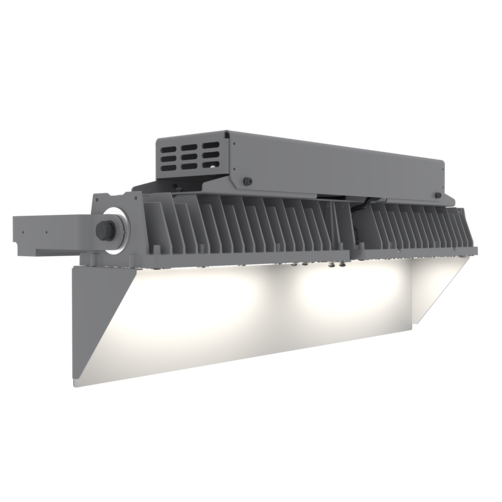
Ansell Lighting has introduced Exa C, a 240W exterior floodlight developed specifically for padel courts and other tightly constrained sports-lighting installations.
Precision lenses control beam distribution across the playing surface, while an integrated visor reduces direct glare and limits light spill beyond the court. The fitting provides a 4,000K colour temperature and a stated efficacy of 165lm/W.
Manufactured from low-density marine-grade aluminium alloy, the housing is protected by an AkzoNobel anti-corrosion powder coating and carries IP66 ingress protection with IK10 impact resistance. Its specified operating-temperature range extends from −30°C to 50°C.
Ansell lists an L80 life of 165,000 hours, a colour-rendering index of 70, SDCM 3 colour consistency, and a combined 62° by 108° beam specification. A magnetic aiming device is incorporated to assist alignment during installation, with adaptors available for 60mm and 76mm poles.
Padel-court geometry places luminaires close to the playing enclosure and within sightlines used to track a fast-moving ball. Excessive brightness at steep viewing angles can impair visibility even where measured horizontal illuminance is adequate, making optical control more important than maximising undirected lumen output.
Transparent walls introduce further constraints because light can pass beyond the playing area, reflect from glazing, or produce bright images within a player’s field of vision. Nearby homes, roads, and other facilities may also impose planning or environmental limits on upward and outward spill.
An integrated visor provides a physical cut-off, while asymmetric optics direct more output towards the required surface. Together, those elements can reduce the need to tilt a general-purpose floodlight steeply, an arrangement that often increases visible source intensity and directs more light beyond the intended area.
Correct aiming remains essential because relatively small changes in angle can affect uniformity, glare, and boundary spill, particularly where only a limited number of luminaires serve each court. The magnetic aiming aid can make initial alignment faster and more repeatable, but final commissioning still requires measurement against the completed lighting design.
Mounting height, pole setback, court orientation, surface reflectance, and surrounding obstructions all influence the result. A luminaire’s nominal beam and output cannot independently guarantee compliance, while designs should use maintained rather than initial illuminance values to account for lumen depreciation, dirt, and environmental exposure.
The anti-corrosion treatment broadens the product’s suitability for coastal and exposed sites. Corrosion can affect housings, fasteners, brackets, seals, and thermal performance long before the LED source reaches its rated life. Cable glands, pole interfaces, and dissimilar metals must also be selected and installed in a manner that preserves the environmental performance of the complete assembly.
Related modular sports-lighting equipment uses selectable optics, drivers, and controls for larger outdoor venues, while Exa C addresses a narrower geometry where compact mounting and glare control dominate. Both approaches reflect a move away from treating high-output floodlights as interchangeable across substantially different applications.
Controls can reduce both energy use and environmental impact because court bookings create known occupancy periods. Lighting can be scheduled, dimmed, or switched off when facilities are unused, provided the control arrangement accounts for safe access, emergency requirements, warm-up behaviour, and repeated short booking intervals.
Product data, photometric files, accessories, and declarations are available through the Exa C product page. The design combines optical control, installation geometry, durability, and commissioning within an application-specific package rather than relying on output alone.