IN Brief:
- 50Hertz has secured approval for a new Mühlenbeck substation and the initial converter installation.
- The site design includes 15 transformers and three converters across planned stages of construction.
- SuedOstLink+ and NordOstLink retain separate approval and delivery programmes, with construction of the initial hub expected in 2027.
50Hertz has received permission to build a substation and the first converter installation at Mühlenbeck in Mecklenburg-Western Pomerania, creating an approved starting point for a major electricity transmission junction in northern Germany. The permit follows an application submitted to the regional environmental authority in November 2025. Plans for the site include a substation with 15 transformers and, in the longer-term scheme, three converters serving high-voltage direct-current connections. The operator expects initial major construction to begin in early 2027.
The site lies close to the Güstrow–Krümmel 380kV overhead route, southwest of Schwerin, where existing alternating-current infrastructure can be connected with planned long-distance direct-current transmission. 50Hertz identifies SuedOstLink+ and NordOstLink as the principal HVDC schemes using the location, with additional overhead circuits also envisaged in its network plans. The junction will develop in stages as those separate schemes receive their approvals and reach construction. The new permit applies to the initial substation and converter, rather than the entire future connection arrangement.
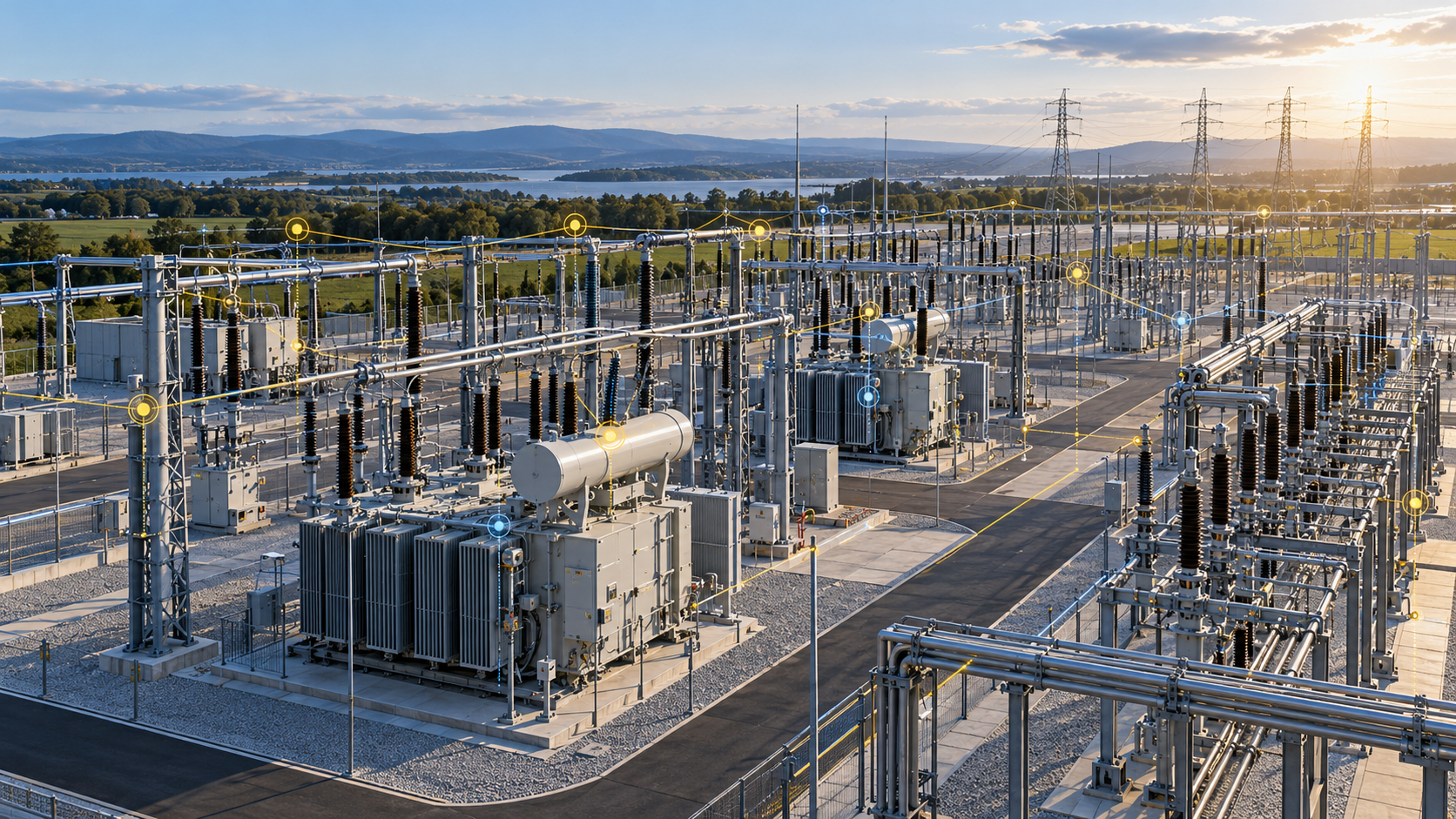
The permitted facilities perform different electrical functions. Transformers step voltage up or down between alternating-current circuits so power can move between extra-high-voltage transmission and regional distribution networks. Converter stations exchange power between alternating current and direct current, enabling the planned HVDC cables to connect with the surrounding AC system. Both must be coordinated through protection, switching and control equipment, but a transformer cannot substitute for a converter. The physical layout must also accommodate safe clearances, cable entrances, access for maintenance and the interfaces with later phases.
SuedOstLink+ is planned to carry electricity on an underground direct-current route from the Mühlenbeck area towards the Magdeburg region and onward through connected projects. The associated converter will connect the DC system to the AC network at the northern end. NordOstLink requires two other converters planned opposite the main substation across the road, with overhead connections back into the grid hub. Each route has its own approval and construction programme, making the eventual delivery of transfer capacity dependent on more than completion of the first building works at Mühlenbeck.
Germany’s electricity system has to accommodate high volumes of wind generation produced in northern and coastal areas while some of the country’s largest industrial loads are further south and west. Transmission links can transport electricity between those regions, but the delivery capability of a route depends on how its terminals are connected to the surrounding grid. A converter with inadequate local substation capacity would not resolve the wider network constraint, while additional alternating-current capacity without the planned long-distance route would serve a different purpose. The hub is designed around both requirements.
The regional permission does not authorise every line, converter or expansion envisaged for Mühlenbeck. 50Hertz’s project documentation identifies the additional Güstrow–Krümmel circuits and a possible connection towards Perleberg as schemes still progressing through their own planning processes. The distinction is material because transmission capacity is governed by the complete electrical route, including terminals, conductors and switching points. An approved hub can be constructed in phases without the full future network configuration being ready to carry power.
WEMAG Netz is separately involved in the regional network interfaces that will allow electricity to move beyond 50Hertz’s extra-high-voltage system. The arrangements combine 380kV alternating-current lines and regional circuits up to 110kV with the proposed HVDC connections operating at a different voltage and current type. Transformers handle the AC voltage changes, while the converters connect the direct-current schemes. Coordination of fault protection, control settings and commissioning sequences will be necessary where equipment and networks owned by different operators meet at the same site.
50Hertz has associated approximately €2bn of investment with the development of the Mühlenbeck grid hub, according to contemporary project reporting. The project has already required preparatory authorisations for work such as an access road and ground preparation, which can proceed separately from the newly approved installation. Work on a substation of this scale involves foundations, cable entries, transformers, switchgear, converter systems and connections to external circuits, with sequencing dependent on the approved construction stages and equipment supply. The expected early-2027 start concerns construction, not an imminent operational connection.
Construction is expected to move from preparatory works into major installation during 2027, followed by the placement and testing of transformers, switchgear and converter equipment. Each asset will have to pass electrical and protection checks before it can be energised and integrated with connected circuits. Future transfer capability will depend on the completion of SuedOstLink+, NordOstLink and other approved network elements, not simply on the substation construction date. The new permit establishes the first authorised installation at a junction planned to handle substantially different power flows over the coming decade.