IN Brief:
- Nexans has inaugurated a new 53 metre high voltage cable manufacturing tower at Charleroi in Belgium.
- The facility supports 525kV HVDC land cables using copper conductors up to 3,000mm² and future HVAC cables with aluminium conductors up to 3,500mm².
- The tower forms part of a €90m investment programme expanding European manufacturing for offshore wind connections, interconnectors and transmission networks.
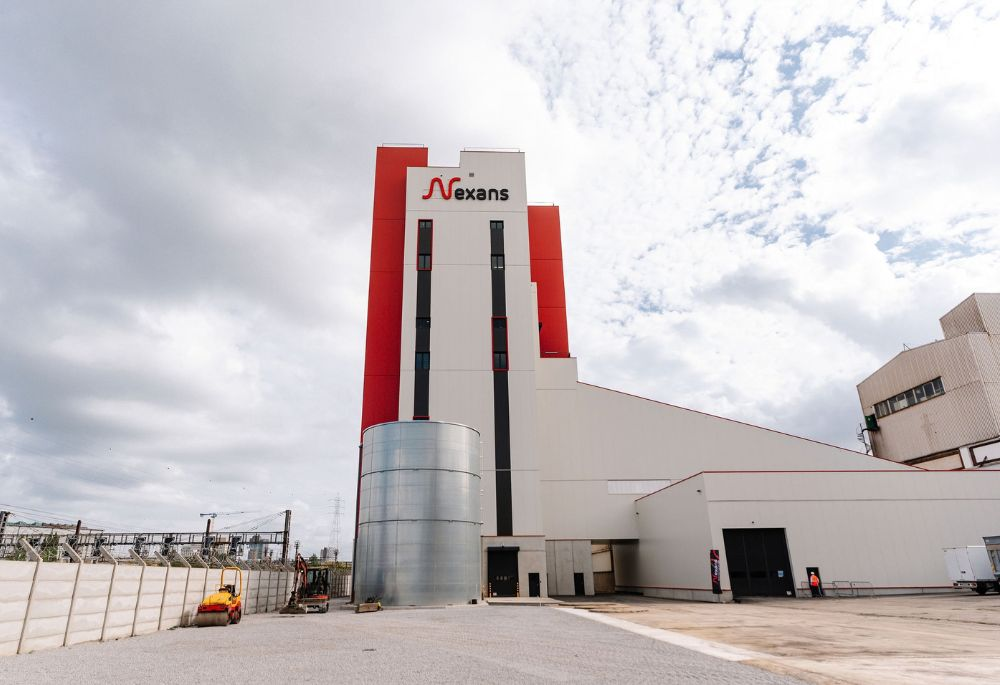
Nexans has inaugurated a 53 metre high voltage cable manufacturing tower at its Charleroi plant in Belgium, completing a major part of a €90m investment programme intended to increase European production capacity for transmission infrastructure, offshore wind connections and interconnectors.
The new tower supports industrial production of 525kV HVDC land cable systems using copper conductors with cross sectional areas of up to 3,000mm². Nexans is also preparing the plant for future high voltage AC cable systems with aluminium conductors reaching 3,500mm².
Larger conductor sections can carry more current while reducing resistance for a given material and route. Cable design still has to balance conductivity against thermal performance, mechanical handling, insulation thickness and the practical limits imposed by manufacturing and installation.
The 53 metre structure is part of the insulation manufacturing process rather than an electricity transmission tower. High voltage land cables require thick, precisely controlled insulation around the conductor, and vertical production helps those layers remain concentric as they are applied before subsequent manufacturing stages.
Manufacturing accuracy becomes increasingly important at 525kV because local defects or uneven electrical stress inside the insulation can become critical once the cable is energised. Production equipment has to control conductor position, material quality and contamination continuously along very large cable sections.
Nexans announced the wider €90m programme in 2024, covering facilities in Charleroi and Erembodegem in Belgium and Calais in France. Construction of the Charleroi tower was one of the principal measures intended to increase manufacturing capacity for the next generation of European land transmission systems.
The investment is closely linked to offshore wind and interconnection demand. Electricity arriving from an offshore cable still has to travel across land to converter stations, substations and the wider transmission network, so terrestrial high voltage cable production can constrain project delivery even when sufficient subsea manufacturing capacity is available.
HVDC is increasingly used for large long distance transfers because it avoids some of the reactive power and capacitive charging constraints associated with long AC cable routes. Converter stations at each end change electricity between AC and DC so it can enter the surrounding synchronous networks.
Operating at 525kV allows a given amount of power to be transferred at lower current than would be required at a lower voltage, reducing resistive losses and conductor heating. Higher voltage also increases the demands placed on insulation design and factory quality control.
The Charleroi expansion supports copper conductor HVDC systems up to 3,000mm², while planned HVAC capability will extend to aluminium conductors up to 3,500mm². Copper offers high conductivity within a smaller section, while aluminium is lighter and generally requires a larger area to achieve comparable electrical performance.
Material selection depends on the complete cable system rather than conductivity alone. Large conductors also become increasingly difficult to process, transport, terminate and install, meaning factory capability is only one limit in the delivery chain.
Nexans’ original investment programme was linked to European grid projects including TenneT schemes such as BalWin 3, LanWin 4 and LanWin 2. These projects require terrestrial high voltage infrastructure alongside offshore cables and converter stations to move renewable generation into the continental network.
The Charleroi programme also includes manufacturing and testing upgrades outside the tower. Completed cables have to undergo high voltage testing to demonstrate insulation integrity before long production lengths are accepted for project installation.
European transmission construction is increasing demand for cable at the same time as offshore wind, interconnectors and domestic grid reinforcement compete for similar manufacturing capacity. Qualified production lines and test facilities require specialist equipment and cannot be expanded as quickly as a project pipeline can be announced.
The new tower therefore represents industrial capacity that was committed in 2024 and has now moved into operation rather than a response to one newly awarded cable project. Charleroi has manufactured high voltage cable for more than a century, and the additional equipment increases its role within Nexans’ European transmission network.
Logistics remain part of that manufacturing problem because larger conductors produce heavier finished cables. Drum capacity, road limits, vessels and handling equipment can restrict the continuous lengths that can be transported efficiently, while the Charleroi site can use the Sambre waterway for multimodal deliveries on major projects.
The tower itself adds no transmission capacity to Europe’s electricity system. It increases the industrial capacity required to manufacture the cables from which future circuits will be built. With 525kV HVDC systems moving deeper into transmission programmes, production volume and successful project deliveries will determine how much additional grid capacity the new Charleroi equipment ultimately enables.