IN Brief:
- L&T's Renewables and Electronic Products & Systems businesses jointly secured the Gujarat order.
- The installation will provide 300 MW of power and 900 MWh of storage capacity.
- The company has classified the contract within its ₹10 billion to ₹25 billion order band.
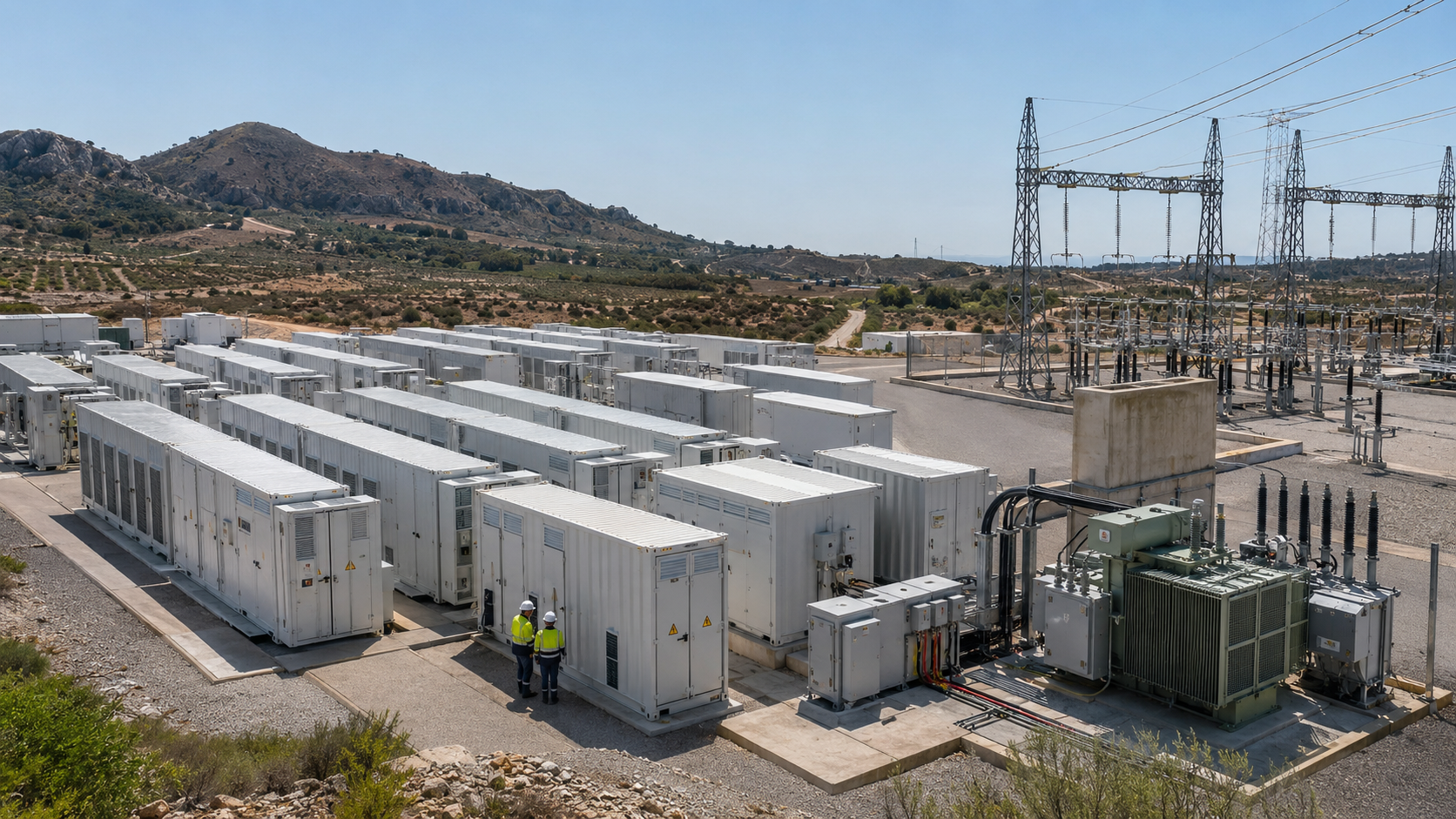
Larsen & Toubro has secured an order to develop a 300 MW battery energy storage system with 900 MWh of energy capacity at Khavda in Gujarat, India, expanding its utility-scale storage construction portfolio in one of the country’s largest renewable generation development areas.
The contract was awarded jointly to L&T’s Renewables business and L&T Electronic Products & Systems (LTEPS). The engineering group classifies the award as significant, a designation covering orders valued between ₹10 billion and ₹25 billion. Neither the exact contract price nor the customer and anticipated commissioning date has been disclosed.
The installation will incorporate liquid cooling, with the company identifying equipment power density, thermal management, safety, and operating life as objectives of the selected technology. Its specified power and energy ratings correspond to three hours of nominal discharge at 300 MW.
L&T’s award follows extensive procurement activity at Khavda, where large solar and wind projects are creating demand for additional storage and electrical transmission infrastructure. Separate procurement exercises in the area include a 1.1 GW/3.3 GWh storage tender from NTPC Green Energy and contracts for two 300 MW/900 MWh blocks reported earlier in November. L&T has not identified its award as part of any of those specific programmes, and the available order information does not establish whether they overlap.
The three-hour configuration provides a defined relationship between the installation’s power rating and energy capacity. At full specified output, 900 MWh corresponds to 300 MW supplied for three hours, before accounting for the precise capacity definition and operating conditions adopted for the project. Lower discharge rates can extend delivery duration, while simultaneous commitments to other grid services may limit the available power.
At a development of this scale, the management of battery temperature influences both the performance of individual storage units and the aggregate availability of the installation. Heat is generated during charging and discharging through internal cell resistance and electrochemical processes. The rate of heat production depends on the current, cell chemistry, temperature, and operating state of the battery.
Liquid cooling can transfer heat from densely arranged battery modules through circulating coolant and heat exchange equipment. The objective is to maintain temperatures within the operating range specified by the equipment manufacturer while reducing differences in temperature between individual cells. Those differences can contribute to uneven cell ageing, limiting the performance of a battery string even when most of its cells remain capable of delivering their original capacity.
Cooling performance must be coordinated with the battery management system, which monitors cell conditions and may restrict charge or discharge power when operating limits are approached. The cooling equipment itself also requires auxiliary electricity and regular maintenance. Pump energy consumption, heat exchanger performance, and ambient conditions therefore influence the installation’s net electrical efficiency as well as its ability to maintain rated output.
Liquid cooling does not replace the other protection and safety systems required by a large battery facility. Electrical fault detection, appropriate isolation, battery monitoring, and fire detection and mitigation measures remain part of the wider design. The specific chemistry, cooling arrangement, converter supplier, and fire safety configuration for L&T’s Khavda project have not been published.
The allocation of the order across two L&T businesses reflects the combination of project delivery and electrical systems integration necessary for this type of asset. The battery equipment must operate in conjunction with bidirectional power converters, transformers, switchgear, collection circuits, and supervisory plant controls capable of coordinating the output of multiple independently managed storage units.
India’s wider storage procurement policy is also developing. Earlier this month, proposed mandatory electricity storage procurement highlighted the potential for additional requirements associated with new government renewable generating projects from July 2027. Those proposals remain separate from the latest L&T award, but illustrate the emerging demand for storage equipment and integration capabilities.
The 900 MWh rating does not establish the installation’s usable energy at the connection point. Contractual testing may specify different measurement boundaries, including the DC battery terminals or the AC connection, with conversion and auxiliary losses affecting the energy delivered across those boundaries.
The next stage of L&T’s project will require detailed engineering and procurement before the battery units and their associated electrical and thermal management systems can be installed and tested. The company has not disclosed a delivery deadline or the contractual requirements governing available discharge energy and performance throughout the installation’s operating life.