
IN Brief:
- Enfinity Global has placed 535MW of solar capacity into operation across eighteen Italian plants.
- The Lazio and Emilia-Romagna portfolio is expected to generate almost 1TWh of electricity annually.
- A further authorised pipeline, including around 600MW of storage, points towards increasingly integrated solar and flexibility portfolios.
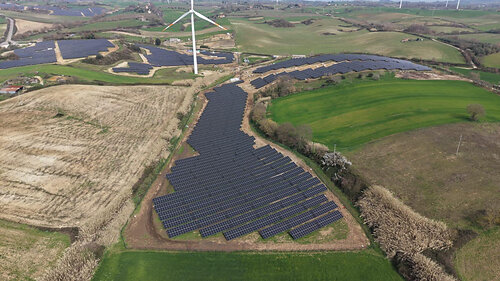
Enfinity Global has reached 535MW of operating solar capacity in Italy after commissioning eighteen plants across Lazio and Emilia-Romagna during the past three years.
Together, the projects are expected to produce almost one terawatt-hour of electricity annually. Enfinity places that output at the equivalent consumption of approximately 350,000 Italian households and estimates annual avoided emissions of 290,904 tonnes of carbon-dioxide equivalent.
More than €1bn of investment has been attracted into the company’s Italian activities, while its authorised portfolio includes over 1GW of solar capacity and approximately 600MW of battery storage. The wider development pipeline extends to 9.1GW across generation and flexibility assets.
Moving eighteen sites from authorisation into commercial operation distinguishes the portfolio from a development pipeline whose projects may remain dependent on land rights, planning, financing, equipment procurement, and grid access. Construction, energisation, testing, market registration, and the completion of connection obligations must all be resolved before an authorised project becomes an operating power station.
A geographically distributed fleet also creates a different operating model from a single large site. Forecasting, market participation, inverter maintenance, vegetation control, spares, security, grid-code compliance, and performance monitoring must be coordinated across several locations. Common systems can create efficiencies, but local network conditions and equipment configurations still require site-specific procedures.
Solar generation at this scale adds substantial daytime output to the Italian electricity system. Production is concentrated around daylight hours and influenced by common weather patterns, meaning multiple plants can reach high output simultaneously across a region. The system value of that generation increasingly depends on network capacity, forecast accuracy, flexible demand, interconnection, and storage.
As operating capacity grows, wholesale prices can weaken during periods of high solar production, while local constraints may restrict export from individual sites. Batteries can move part of the output into later hours, provide balancing services, and reduce exposure to curtailment, although their commercial case depends on duration, connection rights, market access, and the spread between charging and discharging values.
Enfinity’s authorised 600MW storage portfolio indicates how the Italian platform may develop. Co-located batteries can share land, grid infrastructure, and operating systems with generation, while standalone projects can be positioned specifically around constrained network areas. Both arrangements require close control of import and export limits, protection, metering, and dispatch priorities.
Italy’s solar build-out already includes the country’s largest operating photovoltaic plant, adding further pressure to coordinate generation with substations, reactive-power capability, communications, and increasingly detailed connection requirements. As project capacities rise, system integration becomes as consequential as module installation.
Operating performance will ultimately determine realised energy yield. Module degradation, soiling, tracker availability, inverter efficiency, cable faults, thermal stress, and vegetation can each reduce output below forecast levels. Central monitoring can identify underperformance quickly, but fault diagnosis and physical intervention still depend on trained local resources, spares, and site access.
Financing structures increasingly require detailed evidence of that performance. Lenders and investors assess actual generation against forecasts, equipment availability, merchant-price exposure, curtailment, and counterparty risk under power-purchase agreements. Several years of comparable operating data can support future financing more effectively than an authorised pipeline without field performance.
The 535MW milestone establishes both a generation fleet and an operating platform capable of supporting further solar and storage investment. Enfinity’s remaining challenge is to convert its authorised capacity into assets that can be connected, controlled, maintained, and financed within a power system receiving a growing share of weather-dependent generation.

