
IN Brief:
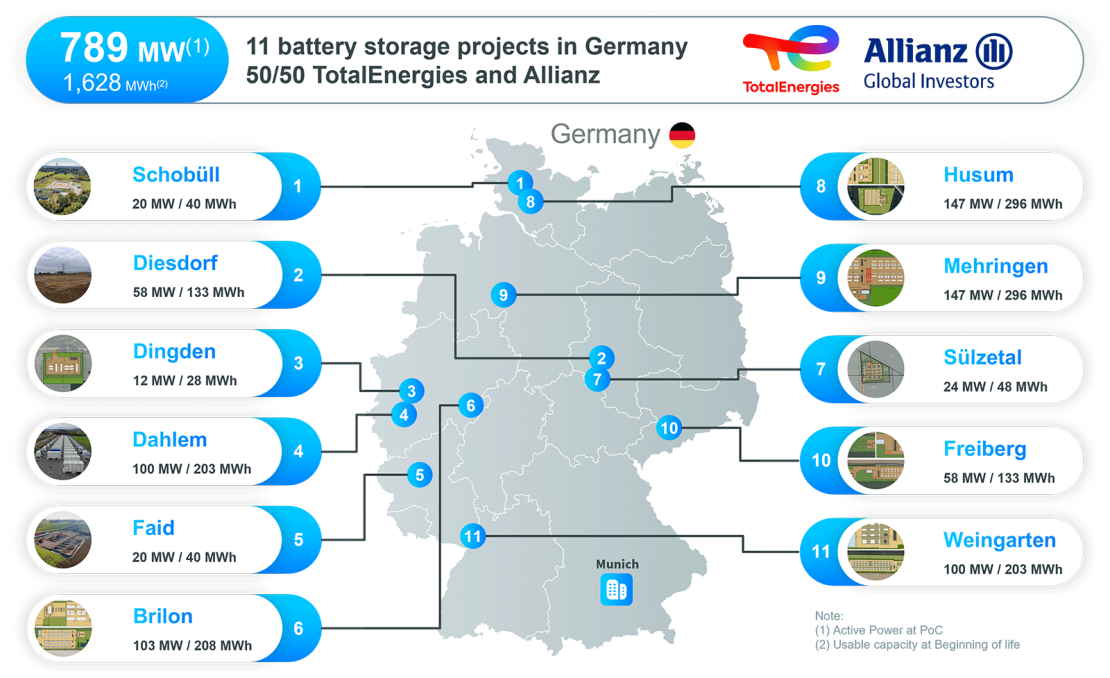
- An approximately €440m financing package will support eleven German battery projects totalling 789MW and 1,628MWh.
- Kyon Energy developed the portfolio, while TotalEnergies will operate the assets and Saft will supply most battery systems.
- The transaction shows grid-scale storage moving towards portfolio finance backed by diversified projects and infrastructure investors.
TotalEnergies has secured approximately €440m of debt financing for eleven battery energy-storage projects under construction across Germany, creating a portfolio with combined power of 789MW and usable energy capacity of 1,628MWh.
Provided by a syndicate of ten financial institutions, the financing supports projects developed by Kyon Energy, which TotalEnergies acquired in 2024. The assets are scheduled to enter operation by 2028, with TotalEnergies retaining responsibility for operation and most of the battery systems using technology supplied by its Saft subsidiary.
The debt package follows an agreement under which Allianz Global Investors acquired a 50% interest in the portfolio. Total investment had previously been placed at around €500m, with debt expected to provide most of the project funding. By combining an industrial operator, infrastructure investor, specialist developer, and bank syndicate, the structure distributes construction and operating exposure across several counterparties.
Individual projects range from 12MW to 147MW, with storage capacities between 28MWh and 296MWh. Across the complete portfolio, the ratio between power and energy capacity averages slightly more than two hours, although duration varies according to location, connection conditions, and intended operating strategy.
Each site will combine high-power battery equipment with civil works, fire protection, power conversion, transformers, switchgear, protection systems, metering, auxiliary supplies, communications, and remote dispatch. Connection studies must also account for fault levels, reactive-power capability, harmonic performance, and the operating limits applied to charging and export.
The projects are intended to provide flexibility and help manage congestion as Germany connects additional renewable generation. Batteries can charge when electricity is abundant or when network conditions restrict generator output, then discharge during higher-demand periods or when the system requires balancing support. Their rapid response also allows participation in frequency and reserve markets that conventional thermal plant cannot always serve as efficiently.
Unlike many wind and solar assets supported by long-term contracted income, storage revenue usually combines several services whose value changes over time. A battery may move between wholesale trading, balancing, ancillary services, congestion-management arrangements, and capacity products during its operating life. Lenders therefore need confidence in dispatch strategy, equipment availability, degradation forecasts, market access, warranty coverage, and operator competence.
Portfolio financing reduces dependence on the performance of any single project. Eleven geographically separated sites spread exposure to construction delays, connection timing, local constraints, and market conditions, while programme-scale procurement can standardise plant design, controls, spares, service procedures, and cybersecurity requirements. A common operating platform also gives specialist teams access to a larger volume of comparable performance data.
German modelling has already indicated that greater storage deployment could reduce wider system costs by limiting redispatch, absorbing renewable output that would otherwise be curtailed, and providing controllable capacity close to constrained parts of the network. Batteries cannot replace required transmission reinforcements, but their location and dispatch can change how intensively existing infrastructure is used.
Vertical integration through Saft gives TotalEnergies a position across development, battery supply, operation, trading, and aggregation. That structure can simplify performance accountability, although contracts will still need clear boundaries around cell warranties, degradation, availability, augmentation, software support, insurance, fire response, and end-of-life responsibilities.
Technical due diligence will remain extensive as banks become more comfortable with battery portfolios. Grid models, cell chemistry, thermal-management design, fire strategy, equipment provenance, cyber controls, construction contracts, and merchant-revenue sensitivities all influence debt terms. Large portfolios can support more sophisticated analysis, but they also create common-mode exposure when several projects use the same hardware, software, or contractor.
Construction and commissioning through 2028 will test whether programme-scale standardisation produces the expected efficiencies. The financing already marks a further step in storage’s transition from isolated merchant development towards a recognised class of power-system infrastructure, supported by long-term investors and lenders willing to assess its risks at portfolio scale.

