IN Brief:
- Eni and Seri Industrial have established an Italian manufacturing and commercial platform for stationary LFP battery systems.
- Brindisi and Teverola are planned to provide 16GWh of annual production capacity by 2030.
- The programme combines cells, modules, BESS assembly, cathode material, recycling, and system sales within one European value chain.
Eni and Seri Industrial have expanded their partnership in stationary energy storage through the launch of FAENIX and the development of an integrated lithium-iron-phosphate battery manufacturing hub in southern Italy.
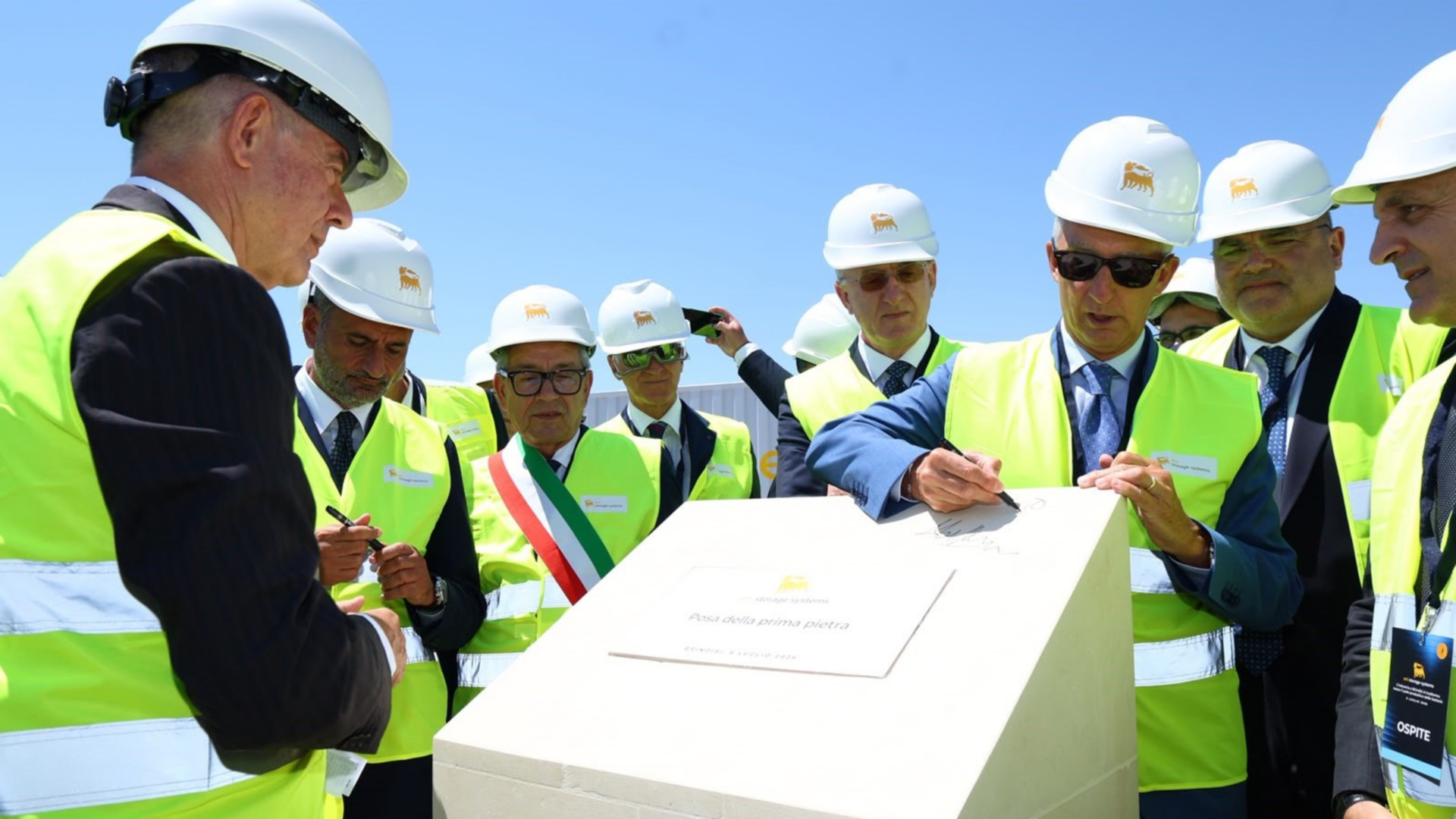
Manufacturing and commercial activity are divided between two jointly controlled businesses. Eni Storage Systems, owned by Eni Industrial Evolution and Seri Industrial subsidiary FIB, is developing production capacity at Brindisi, while FAENIX, owned 70% by FIB and 30% by Eni Industrial Evolution, will commercialise battery systems manufactured at Brindisi and Seri Industrial’s existing Teverola site.
Construction began at a decommissioned area of Eni’s Versalis complex in Brindisi on 6 July. The first phase includes a gigafactory for lithium-iron-phosphate cells and modules, together with a battery energy-storage system assembly plant capable of using modules produced at both Brindisi and Teverola.
A second phase is intended to add production of lithium-iron-phosphate cathode active material and battery-recycling facilities serving the two manufacturing locations. Combined annual output is planned to reach 16GWh by 2030, divided evenly between Brindisi and Teverola.
European demand for stationary batteries is projected to increase from 36GWh in 2025 to approximately 138GWh in 2030 as renewable generation, network constraints, reserve requirements, and intraday price volatility create demand for controllable storage. At full output, the Italian plants would account for more than one-tenth of that projected annual market.
Lithium-iron-phosphate chemistry is widely used in stationary storage because it combines long cycle life, comparatively strong thermal stability, and a cathode that does not require nickel or cobalt. Although its energy density is lower than some alternatives, weight and volume are generally less restrictive at fixed grid sites than in passenger vehicles, allowing designs to prioritise safety, durability, maintainability, and whole-life cost.
Cell production alone will not determine whether the programme competes successfully. Complete battery projects require modules, racks, enclosures, thermal management, power-conversion equipment, transformers, switchgear, protection, fire systems, control software, and long-term service arrangements. Integrating cell and module production with system assembly could provide greater control over configuration and performance responsibility, particularly when products must meet European grid codes and permitting requirements.
The proposed cathode-material and recycling facilities extend the programme further upstream and downstream. Cathode processing affects consistency and cell performance, while recycling can recover material from manufacturing scrap and retired batteries. Commercial performance will depend on achieved yields, process energy use, supply agreements, regulatory compliance, and whether recovered material can be returned to qualified production at scale.
Europe remains heavily exposed to imported cells and components even as project development accelerates. Rapid deployments such as the 1.3GWh Bulgarian solar-storage fleet show how quickly demand for complete systems can grow when grid connections and market conditions align. Manufacturing lead times, shipping exposure, equipment compatibility, and supplier concentration can then become significant project risks.
Brindisi also represents an industrial-conversion programme, with part of a former polymer complex being redeployed for battery production. Existing utilities, logistics, workforce capability, and heavy-industrial infrastructure may shorten some elements of development, although battery manufacturing introduces its own requirements for environmental control, process safety, quality assurance, traceability, and specialist maintenance.
FAENIX will compete with global suppliers operating at considerably larger scale. European production will still be judged on cell consistency, price, delivery certainty, bankable warranties, software performance, safety evidence, and service coverage. Customers and lenders are also likely to require operating data before treating a new manufacturing platform as interchangeable with established suppliers.
Reaching 16GWh annually will depend on more than completing the buildings and production lines. Cells and systems must pass qualification, manufacturing yields must rise without compromising quality, and early projects must establish dependable field performance. By combining materials, cells, modules, system assembly, recycling, and commercial delivery, the venture is attempting to retain a greater share of the stationary-storage value chain within Europe.