IN Brief:
- Planning officers have recommended approval of the 49.9MW Grimethorpe Solar Farm.
- The revised scheme uses over 20% less land and more than 10% fewer modules.
- Further landscaping, biodiversity measures, public space, and community funding have been added.
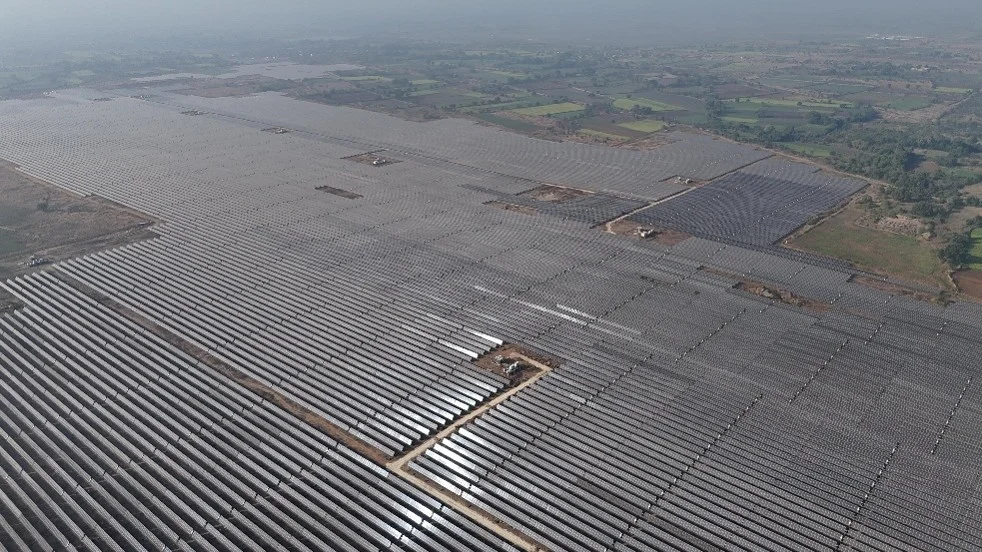
Enviromena has moved closer to approval for the 49.9MW Grimethorpe Solar Farm after planning officers recommended that Barnsley Metropolitan Borough Council approve the development.
The proposed site lies north-west of Grimethorpe, east of Cudworth, and south-west of Brierley. A final decision remains subject to the council’s planning process.
Following consultation on the initial application in January 2023, Enviromena reduced the development area by more than 20% and cut the proposed number of solar modules by over 10%.
Panels have been removed from the most visually sensitive parts of the site, while the revised plans include additional planting and landscaping. Biodiversity-net-gain measures have been expanded, a public green space has been added, and the community benefit offer has increased.
A £100,000 community fund forms part of the proposals, alongside a commitment to use local suppliers and contractors during construction and operation where suitable capability is available.
Annual output is expected to equal the electricity consumption of more than 25,000 homes and avoid approximately 14,000 tonnes of carbon dioxide emissions. Those figures represent projected generation and comparative consumption rather than a direct supply arrangement with particular households.
Statutory consultees raised no objections, and the application received 211 letters of support. The planning assessment has nevertheless considered the site’s green-belt status, landscape effects, biodiversity, access, drainage, and the environmental benefits associated with renewable generation.
Consent is one stage in the electrical programme
Following a positive planning decision, the project would still require a deliverable grid connection, detailed electrical design, financing, procurement, discharge of conditions, construction access, and final investment approval.
At 49.9MW, the scheme sits immediately below the 50MW level historically associated with different planning and market arrangements. Final export capacity, connection voltage, curtailment provisions, and any export-limitation conditions will shape the infrastructure required between the solar field and the public network.
Medium-voltage collection circuits, inverters, transformers, switchgear, protection, communications, metering, and a connection substation will form the core electrical installation. Cable routes must be coordinated with drainage, access tracks, ecological buffers, security fencing, landscaping, and retained public areas.
Grid access is increasingly decisive for large British solar developments. Confirmed connections have already advanced a separate portfolio of Elgin Energy projects, allowing detailed construction and procurement planning to proceed around known network capacity.
Large photovoltaic installations also affect local voltage control and reverse power flows. Inverter settings, reactive-power capability, fault-ride-through performance, export control, and protection coordination must comply with the connection agreement and the applicable grid-code requirements.
Reducing the panel count will alter both the layout and forecast yield. Some lost module capacity can be offset through higher-rated panels, improved spacing, revised orientation, or a different direct-current to alternating-current ratio, although the final energy output will depend on the completed design.
Landscape and biodiversity measures must remain compatible with safe electrical operation. Planting cannot shade modules, obstruct security visibility, interfere with earthing or cable routes, or restrict emergency access, while habitat management must accommodate drainage, vegetation control, and routine maintenance.
Construction would combine civil and electrical work across site preparation, mounting-system installation, module assembly, trenching, cable pulling, inverter and transformer placement, substation construction, testing, and energisation. The sequence will need to protect ecological areas while allowing heavy plant and specialist electrical teams to work safely.
Local procurement could support civil works, accommodation, transport, fencing, security, and parts of the installation programme. Specialist high-voltage design, protection, commissioning, and grid-compliance work may draw on businesses operating across a wider region.
The revised development occupies less land, contains fewer modules, and carries a larger package of environmental measures than the original proposal. Its progression beyond planning will depend on the grid connection, equipment pricing, financing conditions, and the availability of construction and commissioning resources.