
IN Brief:
- The Loughton AI campus is planned with 50MW of initial capacity, scalable to 90MW.
- A required grid connection is not expected to match the proposed 2027 operating timetable.
- Interim generation could preserve delivery dates but introduces fuel, emissions, resilience, and integration requirements.
Nscale is examining alternative power arrangements for its proposed Loughton AI campus after the required grid connection was not expected to be available for the planned 2027 opening.
The Essex facility was announced with 50MW of initial AI capacity and the ability to scale to 90MW. Its first phase is intended to house 23,040 NVIDIA GB300 graphics processors and provide Microsoft Azure services from the first quarter of 2027.
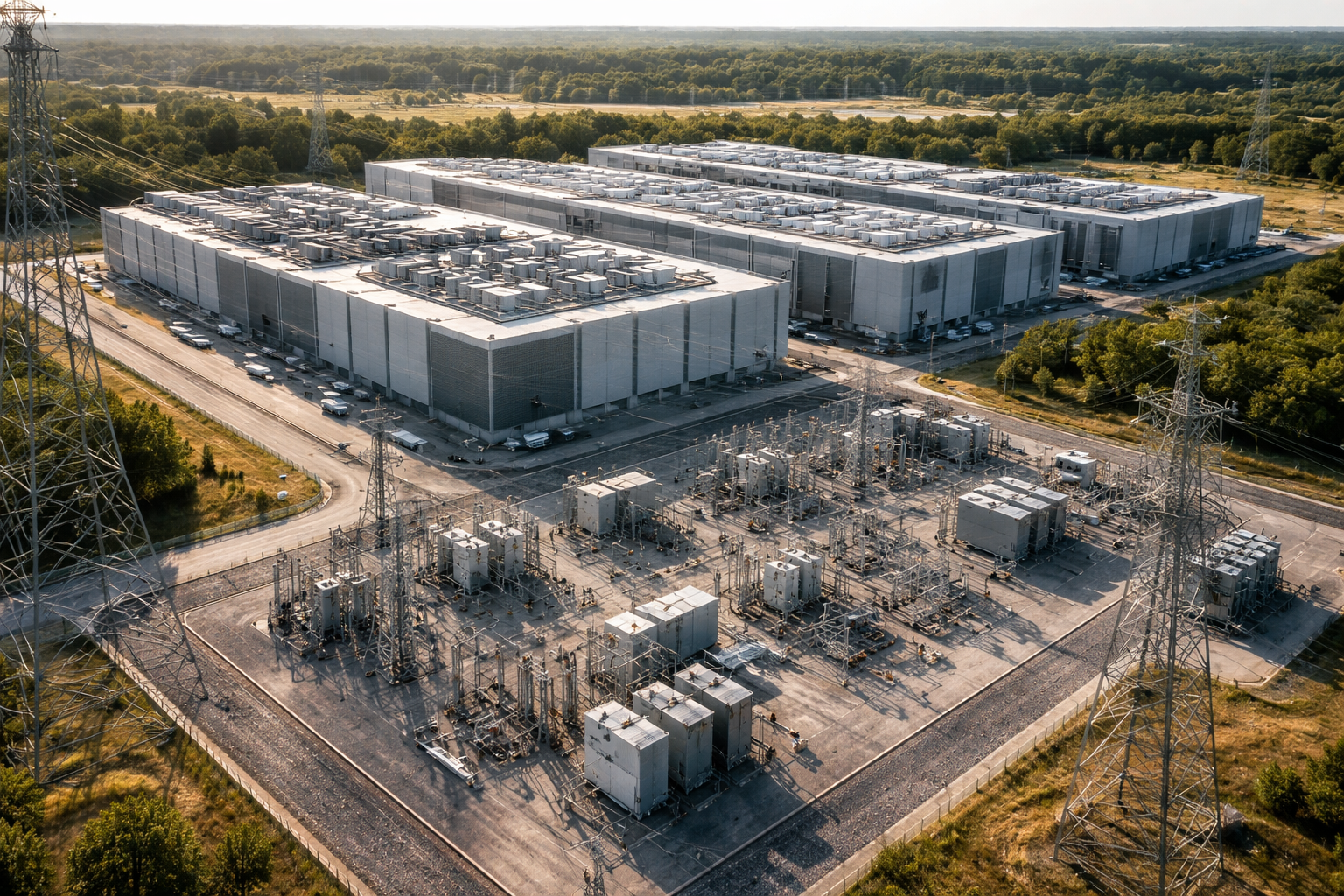
A connection of that scale is comparable with the demand of a substantial industrial facility and requires far more than an agreed import figure. High-voltage circuits, transformers, substations, protection, metering, power-quality studies, operational agreements, and suitable resilience arrangements must all be completed before energisation.
Nscale remains committed to the site and has been considering interim generation options, including solid-oxide fuel-cell technology. Any temporary installation would need to support a critical load with demanding requirements for availability, voltage stability, power quality, and rapid response.
On-site generation could allow part of the campus to operate before the permanent grid supply is ready, although it would alter the electrical architecture. Generators, uninterruptible power supplies, batteries, static transfer equipment, switchgear, standby systems, and the future network connection would all need to operate within a coordinated design.
Fuel availability and emissions would form part of that assessment. Solid-oxide fuel cells can provide efficient local generation, but their carbon performance depends on the fuel used. Natural-gas operation would carry a different emissions profile from renewable hydrogen, while large-scale hydrogen supply, storage, and cost remain substantial constraints.
Data-centre schedules collide with network lead times
AI hardware and prefabricated data-centre equipment can be procured and installed more quickly than major transmission or distribution reinforcement. New substations, high-voltage routes, planning approvals, transformers, and associated network works frequently require several years, creating a mismatch between computing investment cycles and electrical delivery.
Across the wider EMEA market, available power is increasingly limiting data-centre development, with megawatt capacity influencing site selection before land, building design, or hardware procurement reach their final stages.
A delayed connection does not necessarily indicate a shortage of national generation. Local circuit limits, substation space, fault-level constraints, transmission congestion, equipment lead times, and competition from other connection customers can all prevent a new load from connecting on its requested date.
Data centres also require a higher degree of supply resilience than most commercial buildings. A connection may provide sufficient nominal capacity yet remain unsuitable where maintenance or a single network fault would leave the site dependent on standby plant. Connection design must therefore account for both maximum demand and contingency performance.
High-density AI hardware adds further electrical and thermal complexity. Concentrated rack loads, extensive power-electronic conversion, rapidly changing computational demand, and intensive cooling systems increase the need for detailed harmonic, transient, and power-quality studies.
Staged energisation, battery storage, load management, and flexible computing schedules can reduce some of the pressure on an initial connection. Workloads that are not time-critical may be shifted between sites or operating periods, although contractual cloud services and high hardware-utilisation targets limit how much demand can be deferred.
Behind-the-meter generation is likely to become a more common bridge where network reinforcement cannot match project schedules. Continuous fuel supply, maintenance outages, emissions permits, noise, heat rejection, and the operating cost of long-duration generation must be included alongside the capital cost of the plant.
The eventual grid connection also needs to be incorporated from the outset. A temporary system that cannot integrate cleanly with the permanent electrical design risks duplicating transformers and switchgear, stranding equipment, or complicating the transition when the network supply becomes available.
Nscale must now determine whether an interim installation can be engineered, permitted, fuelled, and commissioned within the remaining programme. Staged operation may allow part of the computing capacity to enter service, provided the initial electrical system can support later expansion towards 90MW.
The Essex development demonstrates how substations, transformers, cable routes, connection agreements, and network construction are becoming primary programme risks for AI infrastructure. Processor counts may define the commercial proposition, but the delivery sequence is increasingly governed by the power system serving them.

