IN Brief:
- The North Wales Clean Energy Fund is investing £2 million in HydroWing's tidal energy development.
- The company plans to deploy its first generating device at Morlais in 2027.
- Three Contracts for Difference allocations underpin its planned 30 MW commercial development.
HydroWing has secured £2 million of investment from the North Wales Clean Energy Fund to support construction and installation of its first tidal stream generating device at the Morlais development off Anglesey.
The fund, led by Ambition North Wales, has agreed the investment with HydroWing, the tidal energy division of Inyanga Marine Energy Group. The company is targeting deployment of its first device in 2027, ahead of a wider commercial generation programme.
HydroWing’s Ynni’r Lleuad project has secured support for 30 MW of tidal generating capacity through three successive allocations under the UK government’s Contracts for Difference (CfD) scheme.
The initial 10 MW award was made in 2023, followed by a further 10 MW in 2024. A third allocation, confirmed in February 2026, added another 10 MW, with the final phase of the development scheduled for delivery in 2030.
The latest investment supports the engineering and installation work required before the first generating device can enter operation. Its deployment will establish experience with the technology and marine installation arrangements ahead of the larger commercial arrays.
Managed by social enterprise Menter Môn, Morlais provides a consented development area and associated infrastructure through which tidal energy developers can progress generating installations without each having to establish entirely separate development sites and electricity export systems.
Tidal stream generation uses the kinetic energy contained within moving seawater. Turbines positioned within suitable currents convert that movement into rotational mechanical energy, driving generators that produce electricity.
Although tidal generating output varies throughout the day, the timing of tidal movements can be predicted well in advance. The available generating resource nevertheless depends on local water velocities, which can also be affected by weather and hydrodynamic conditions.
The power contained within a moving fluid increases approximately with the cube of its velocity. Relatively small changes in current speed can therefore produce substantial differences in the energy available to a turbine, making site characterisation important when determining equipment ratings and the positioning of generating devices.
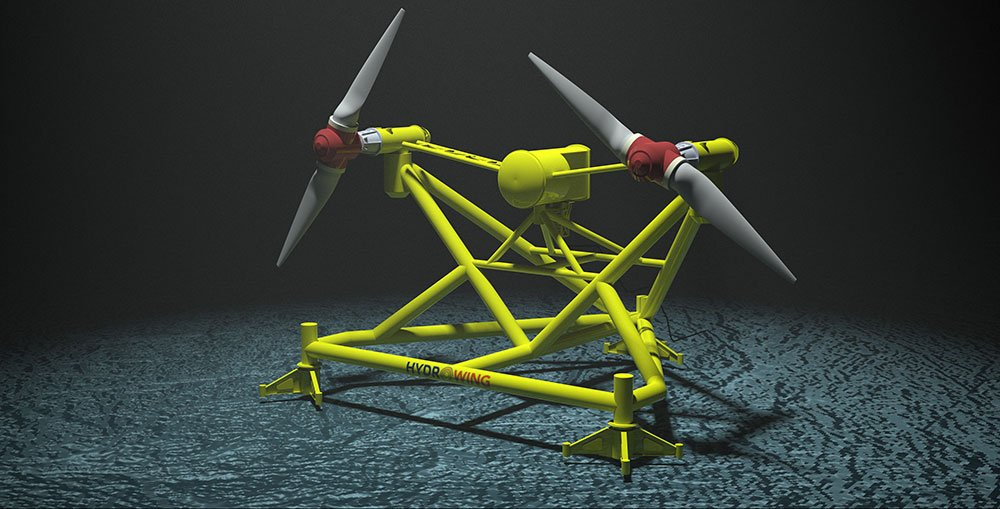
HydroWing’s technology uses a modular generating assembly incorporating multiple turbines mounted on a common structure. Its published design for the commercial Morlais array envisages units incorporating two next-generation Tocardo T3 turbines.
The turbine technology builds on experience from a 1.25 MW demonstration array operated at the Eastern Scheldt storm surge barrier in the Netherlands, which completed eight years of operation in October 2023.
HydroWing’s modular approach separates the generating assembly from elements of the supporting seabed infrastructure. This allows equipment retrieval and maintenance to be considered within the original installation design, rather than treating access to submerged components as a separate engineering problem after deployment.
The effectiveness of that approach will depend on the reliability of the mechanical and electrical interfaces between the generating equipment and its supporting structure. Retrieval operations must also be coordinated with tidal conditions, suitable vessels, and the lifting and handling requirements of the equipment.
Subsea electrical connections need to accommodate repeated exposure to moving seawater while maintaining insulation integrity and reliable electricity transmission. Cable routing, mechanical protection, and the design of equipment interfaces must reflect the forces encountered during installation and subsequent operation.
The development of larger tidal arrays introduces additional requirements for coordinating individual devices. Turbines extract energy from the surrounding flow, creating wakes that can influence water velocities and turbulence experienced by neighbouring generating units.
Device spacing and orientation must therefore be considered alongside seabed conditions, installation access, and electricity collection infrastructure. Optimising an array requires balancing the generating potential of individual devices against their interaction with the wider installation.
Operational monitoring will support those engineering assessments. HydroWing has previously selected Ecodetect’s monitoring technology for the Morlais development, providing additional capabilities for assessing equipment behaviour and conditions within the marine environment.
Monitoring information can also inform maintenance decisions where retrieving a generating unit requires significant advance planning and access to specialist marine equipment.
HydroWing’s existing CfD awards provide a commercial framework for electricity generation once the contracted capacity enters service. The latest investment addresses the preceding development stage, when expenditure on manufacturing, installation, and electrical integration must be committed before electricity revenues become available.
The funding is separate from the £2 million investment announced by the Welsh Government in Inyanga Marine Energy Group in May 2025.
HydroWing’s first planned installation in 2027 will provide operational evidence covering generating performance, electrical integration, installation procedures, and equipment accessibility. Establishing those capabilities will inform the delivery of its subsequent generating arrays as the company progresses towards the full 30 MW development.