IN Brief:
- BW ESS has acquired two Valencia-region BESS projects totalling 126MW and up to 675MWh.
- The 99MW and 27MW projects have symmetric grid-access rights and are expected to reach ready-to-build status in 2027.
- BW ESS plans to lead construction and long-term operation, with commercial service targeted for 2028.
BW ESS has acquired two standalone battery energy storage projects in Spain with combined power capacity of 126MW and up to 675MWh of energy storage, expanding its Spanish development platform ahead of a targeted 2028 start of commercial operation.
The projects, acquired from renewable energy and storage developer Navacant, are located in the Valencia region and have individual power ratings of 99MW and 27MW. They have been under development for around 18 months and are expected to reach ready-to-build status in 2027.
Commercial terms were not disclosed. BW ESS intends to own and operate the assets over the long term, while CST Energy, one of Navacant’s partners, will continue to lead development through the remaining pre-construction phase before BW ESS takes responsibility for construction and operation.
The projects also have symmetric grid-access rights, allowing their connections to support both charging and discharging. For a standalone battery, that is a central technical and commercial requirement because the asset has to import electricity when charging and export it when discharging without one direction becoming the binding connection constraint.
The acquisition adds to BW ESS’s existing Spanish activity, which began in 2025. The company has been building a pipeline around utility-scale storage rather than treating the Valencia transaction as an isolated investment.
Spain is simultaneously trying to increase the amount of flexibility available to a power system adding more variable renewable generation. Its updated National Energy and Climate Plan sets a 2030 storage target of 22.5GW when batteries, pumped hydro, and storage associated with solar thermal generation are combined.
That policy target does not guarantee project delivery. Battery developments still have to secure land, planning, grid access, financing, equipment, construction capacity, and a viable route to market, which makes the distinction between an announced pipeline and a ready-to-build asset increasingly important.
The Valencia projects remain on the development side of that divide. Reaching ready-to-build status in 2027 will be the next material milestone before procurement, civil works, electrical balance of plant, grid-interface construction, energisation, and commissioning can begin.
Grid access is especially valuable because Spain’s storage queue is expanding rapidly. Connection rights determine where a battery can import and export power, while the underlying network studies establish whether the local system can accommodate large changes in power flow without breaching thermal, voltage, or stability limits.
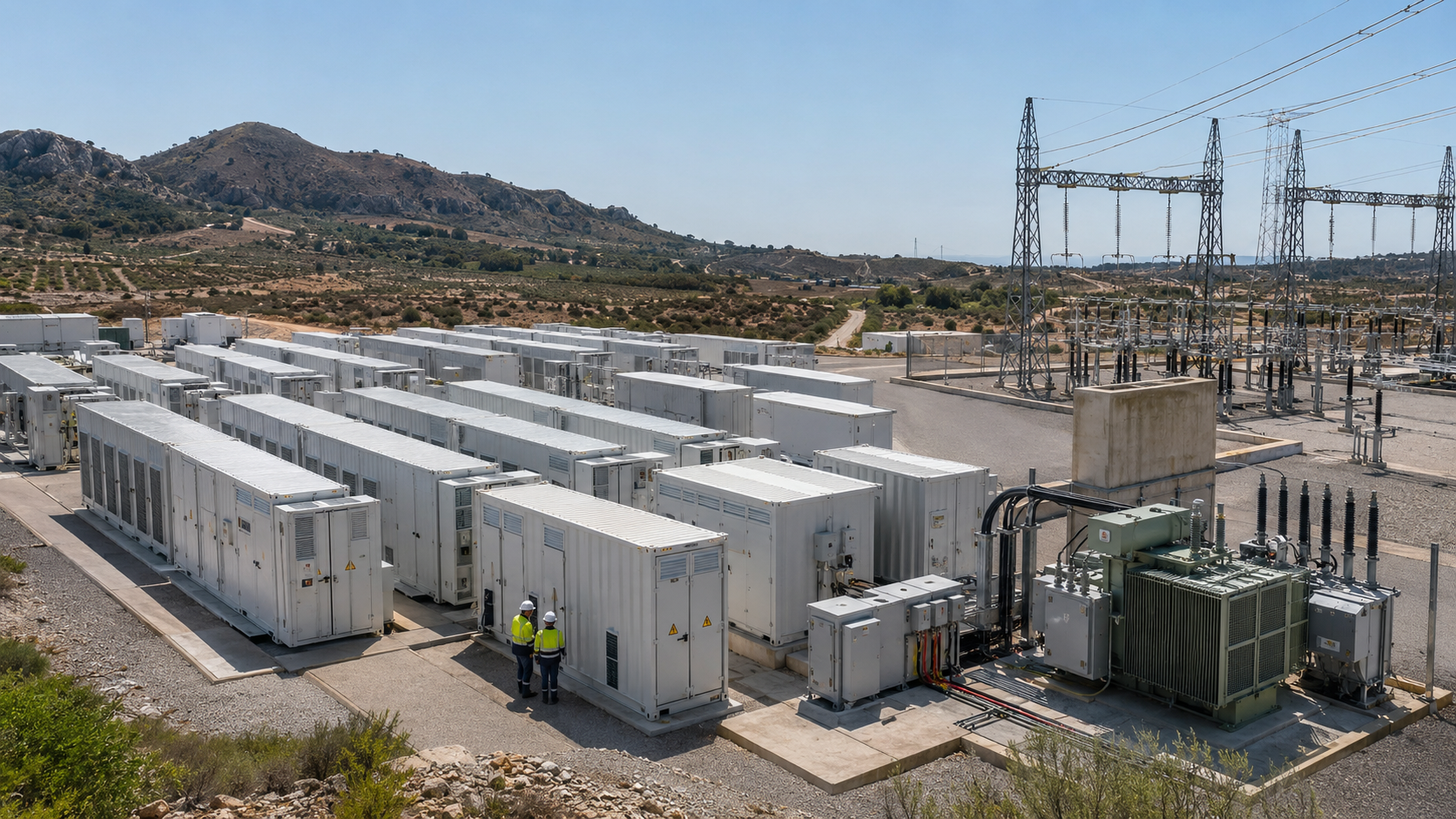
Once construction starts, the electrical scope will extend well beyond battery containers. A utility-scale BESS has to integrate battery racks, power-conversion systems, transformers, switchgear, protection, metering, communications, supervisory controls, auxiliary supplies, fire systems, and the physical grid connection so that the site behaves as one controllable power-system asset.
The final energy duration of each Valencia project has not been disclosed. The portfolio-level figure of up to 675MWh against 126MW indicates that the assets are being developed with substantial energy capacity, but usable duration will depend on the allocation between the two sites, operating limits, degradation allowances, and the final equipment configuration.
Commercial operation in 2028 will also expose the projects to a market structure that may look different from today’s. Batteries can earn revenue from wholesale price spreads, balancing services, capacity or flexibility mechanisms, and bilateral contracts, but the mix available in Spain will determine how frequently the assets cycle and which services take priority.
Every revenue stream competes for the same finite power and state of charge. Holding energy in reserve for system services can reduce arbitrage opportunities, while aggressive daily cycling can accelerate degradation. Optimisation therefore has to reconcile market value with technical limits rather than simply dispatching whenever prices move.
BW ESS has used a similar owner-operator model elsewhere. In August, it acquired the 250MW/1,000MWh Yanco BESS in New South Wales after that project had reached ready-to-build status, taking responsibility for construction and long-term operation.
The Spanish transaction is earlier in the delivery cycle, with CST Energy remaining responsible for development until the ready-to-build milestone. That structure keeps local development expertise in place while BW ESS prepares to assume the higher-capital phase of procurement and construction.
Spain’s storage build is now moving into a period when connection rights and project maturity will matter as much as headline gigawatts. The Valencia portfolio gives BW ESS another sizeable position in that market, but the decisive test remains delivery: ready-to-build status in 2027, followed by construction, energisation, commissioning, and commercial operation in 2028.