
IN Brief:
- Alfen and CATL have agreed a framework covering up to 5GWh of sodium-ion battery storage across Europe.
- Alfen will integrate CATL cells into stationary systems designed for European grid and project requirements.
- Commercial deployment will depend on contracted projects, warranties, operating data, and whole-system economics.
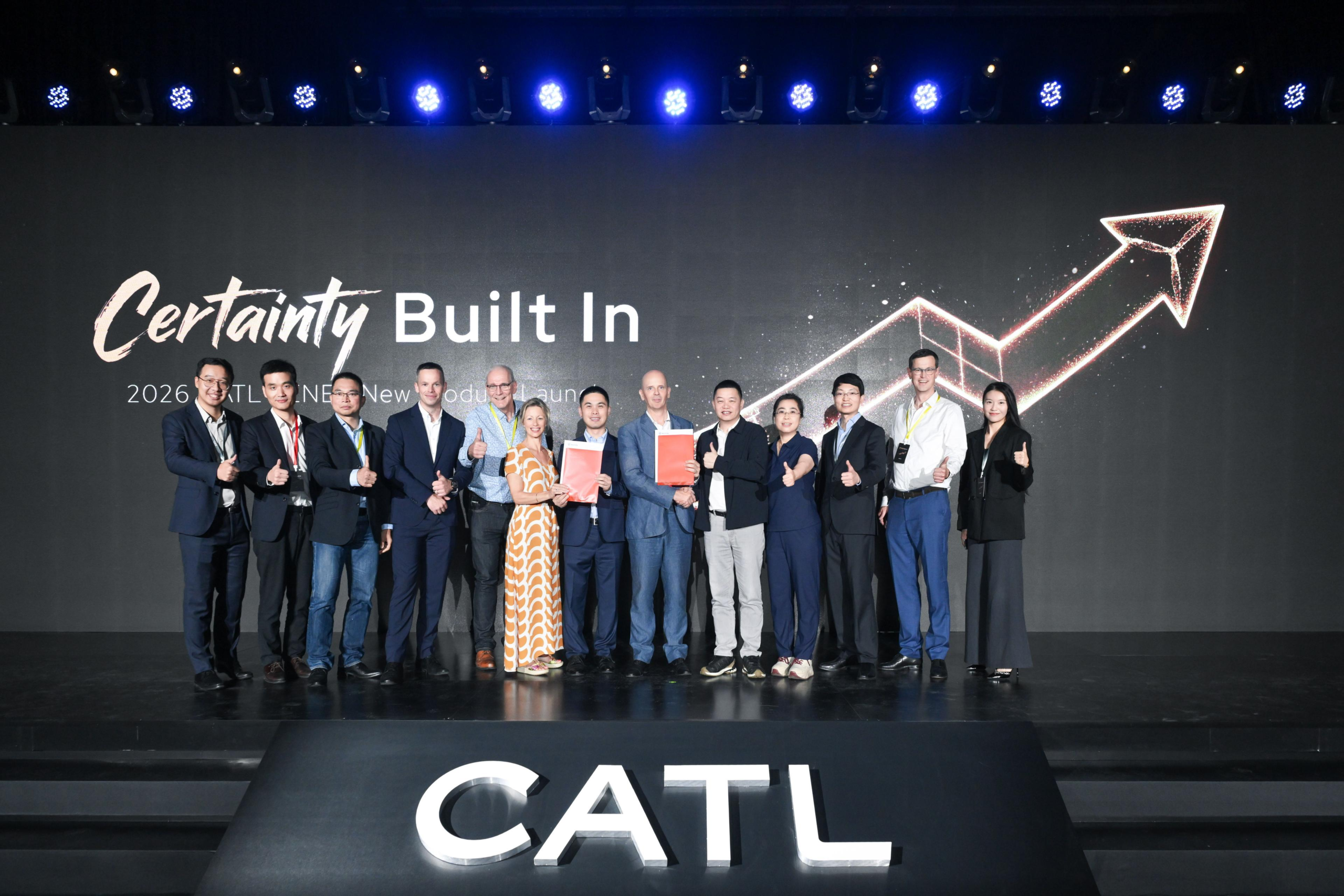
Alfen and CATL have agreed a framework covering the deployment of up to 5GWh of sodium-ion battery energy storage across Europe, creating a substantial prospective route to market for a chemistry that has so far remained behind lithium-ion in commercial stationary applications.
Under the agreement, Alfen will integrate CATL’s sodium-ion cells into medium- and large-scale storage systems, combining the battery technology with power conversion, controls, thermal management, grid interfaces, and project-specific electrical infrastructure. CATL will provide the cell technology, while Alfen will lead system integration and delivery for European customers.
Although the 5GWh figure establishes the potential scale of the partnership, it does not represent an installed or contracted project portfolio. Individual developments will still require customer commitments, connection agreements, planning and environmental approvals, financing, equipment procurement, construction, commissioning, and market-access arrangements before capacity enters operation.
The two companies have worked together on lithium-ion storage since 2023, with their relationship expanding during 2024. Adding sodium-ion technology broadens the range of chemistries available to Alfen as developers and asset owners examine how different battery systems perform under varying operational, commercial, and environmental conditions.
Sodium-ion cells replace lithium as the principal charge-carrying material with sodium, an element that is widely available and less geographically concentrated. The chemistry can also reduce reliance on some of the materials that have created price volatility and strategic dependency within lithium-ion supply chains, although the precise composition and sourcing profile varies between manufacturers.
Lower energy density remains one of sodium-ion technology’s principal limitations, especially where mass and volume are tightly constrained. Stationary storage projects can accommodate larger enclosures more readily than vehicles or portable equipment, however, allowing developers to weigh footprint against capital cost, safety performance, cycling capability, degradation, and material availability.
European deployment will depend on more than cell performance. Storage systems must satisfy national connection rules, protection requirements, fault ride-through standards, communications protocols, fire-safety provisions, acoustic limits, planning conditions, and market interfaces. Integrators are therefore required to convert battery cells into complete electrical assets rather than simply package them into containers.
Storage procurement moves beyond a single chemistry
Lithium iron phosphate currently dominates utility and commercial storage procurement because it benefits from high manufacturing volumes, established warranties, experienced engineering contractors, and a growing body of field data. CATL’s earlier launch of a sodium-ion system for grid applications nevertheless indicated that major cell manufacturers were preparing alternatives specifically for stationary deployment.
Sodium-ion technology will have to establish competitive performance across round-trip efficiency, availability, cycle life, degradation, auxiliary consumption, thermal control, and maintenance. These factors determine the volume of energy that remains commercially usable over the life of an asset and influence the revenue that can be earned from wholesale trading, balancing services, capacity mechanisms, congestion management, and renewable-energy firming.
Financial models for battery projects are particularly sensitive to warranty terms. Restrictions on depth of discharge, annual cycles, operating temperature, charge rate, and state of charge can limit how an asset participates in several markets. A technically capable system may therefore deliver less commercial flexibility if its warranty does not accommodate the intended operating profile.
Sodium-ion systems could prove attractive where land is available, supply-chain resilience carries additional value, or the required duty cycle rewards frequent cycling rather than maximum energy density. They may also provide procurement leverage by giving developers a wider selection of technically credible suppliers and reducing dependence on one material chain.
Different chemistries can require changes to container layout, cooling, battery-management software, fire detection, emergency response, auxiliary supplies, and replacement strategy. Project specifications will need to distinguish between nominal capacity and the usable energy available at the grid connection after accounting for degradation, state-of-charge limits, temperature, conversion losses, and equipment availability.
Network conditions will remain equally influential. A battery can only absorb and return energy within the capacity permitted by its connection agreement, while charging restrictions and network-use charges can materially alter project economics. Sites located near constrained renewable generation may offer strong system value, but they can also face complex operating limits and reinforcement requirements.
Alfen’s existing activities in substations, charging equipment, and energy storage provide an integration route between the battery and its surrounding infrastructure. Projects requiring packaged medium-voltage connections, switchgear, controls, protection, and market interfaces may therefore be developed as broader electrical systems rather than isolated battery installations.
The framework places sodium-ion technology within a sizeable European development pipeline, although commercial credibility will be established through delivered projects and long-term operating results. Contracted capacity, independently verified performance, warranty strength, and whole-life cost will determine whether the chemistry becomes a significant part of Europe’s storage market or remains confined to selected applications.

