IN Brief:
- CATL has launched a sodium-ion version of its TENER energy storage system for large-scale BESS applications.
- The platform was presented in Munich during The smarter E Europe, with international shipments planned from June 2027.
- Sodium-ion storage is emerging alongside lithium-ion where temperature range, raw-material availability, and lifecycle performance shape project design.
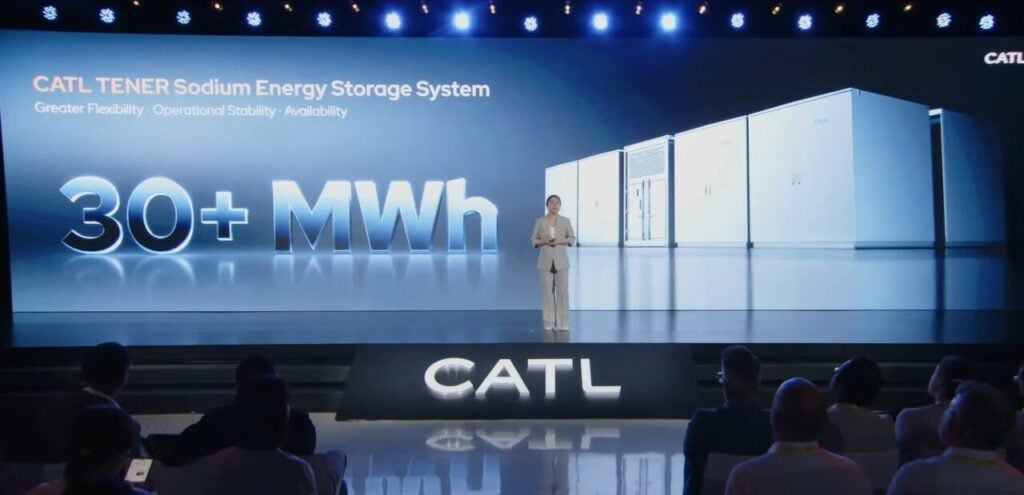
CATL has launched a sodium-ion version of its TENER battery energy storage system, adding another chemistry option to the grid-scale storage market as European deployment moves toward larger and more technically demanding projects.
The system was unveiled in Munich during The smarter E Europe and is designed for large-scale stationary storage applications. Built around sodium-ion cells, the platform has been presented as a modular, 30MWh-plus storage solution for utility and infrastructure projects, with international shipments scheduled to begin in June 2027.
Sodium-ion technology brings different design priorities from lithium-ion. Lithium-ion remains the dominant chemistry in grid storage because of its mature supply chain, high efficiency, established operating history, and strong energy density. In stationary applications, however, weight and volume are not always the limiting factors. A system with lower energy density can still be commercially attractive where safety characteristics, operating temperature range, long-cycle performance, or material availability improve the whole-project case.
Those factors are becoming more prominent as battery systems move from smaller ancillary-service assets into larger grid infrastructure. Developers and utilities are now weighing cell chemistry alongside fire safety, warranty structure, degradation profile, cooling strategy, auxiliary load, supply-chain risk, grid-code compliance, and long-term serviceability.
Large BESS projects also have to account for a wider range of electrical conditions. Storage assets may be required to charge during periods of high renewable output, discharge into evening peaks, support balancing markets, respond to frequency events, and provide local network services. The battery cell is only one element of that performance. Power conversion systems, battery management, controls, protection, communications, and thermal design determine how the plant operates in practice.
The growth of mixed AC/DC infrastructure is already shaping component specification across storage, renewables, EV charging, and data-centre environments. In protection systems, for example, combined AC and DC fuse designs are being developed around higher fault levels, dense power electronics, and more complex electrical architectures. Battery chemistry sits upstream of that same design chain, influencing everything from enclosure layout to protection coordination and fire-safety strategy.
Temperature tolerance is one practical design factor for European deployment. Storage systems can be installed in climates ranging from Nordic winter conditions to high-temperature Southern European sites. Thermal management affects efficiency, safety, degradation, auxiliary consumption, and lifetime operating cost. A chemistry with a wider operating range can reduce some design pressure, although full project performance still depends on enclosure specification, cooling strategy, battery management, and operating profile.
Supply-chain resilience is another driver. Lithium-ion storage relies on global material, cell, module, and container supply chains that remain highly concentrated. European developers have benefited from falling battery prices, but they remain exposed to trade policy, manufacturing allocation, shipping disruption, and raw-material volatility. Sodium-ion does not remove those risks, but it broadens the technology base available to stationary storage projects.
Grid operation requirements are also becoming more demanding. Storage assets increasingly need to provide more than energy shifting. Network operators and system operators are looking at balancing, voltage support, congestion management, frequency response, and, in selected cases, grid-forming operation. Those services require a coordinated system design rather than a battery container specified in isolation.
Sodium-ion therefore enters a market that is diversifying by duration, performance profile, and use case. Lithium-ion will remain central to short- and medium-duration applications, but flow batteries, iron-air systems, thermal storage, zinc-based systems, and sodium-ion platforms are all competing for roles where different cycle lives, discharge durations, safety profiles, and cost structures are required.
Commercial adoption will depend on bankability. Developers, insurers, lenders, and utilities will want field data, warranty terms, degradation assumptions, fire-safety evidence, availability guarantees, and integration experience. A successful launch provides a technical opening; repeatable deployment depends on whether the system can be financed, connected, operated, and maintained across full asset lifetimes.
Europe’s storage market now needs volume, but not only volume. It needs systems that can be supplied through resilient manufacturing routes, connected through constrained grids, and operated safely for decades. Sodium-ion gives project designers another option. Its progress will be determined by delivery evidence rather than chemistry alone.