IN Brief:
- ACME Hybrid Urja commissioned the first 63.78 MW/255.12 MWh section on 25 November.
- The commissioned equipment has 300 MWh of installed energy capacity, with commercial operation scheduled for 27 November.
- The complete NHPC battery project is specified to deliver 280 MW/1,120 MWh of discharge capacity.
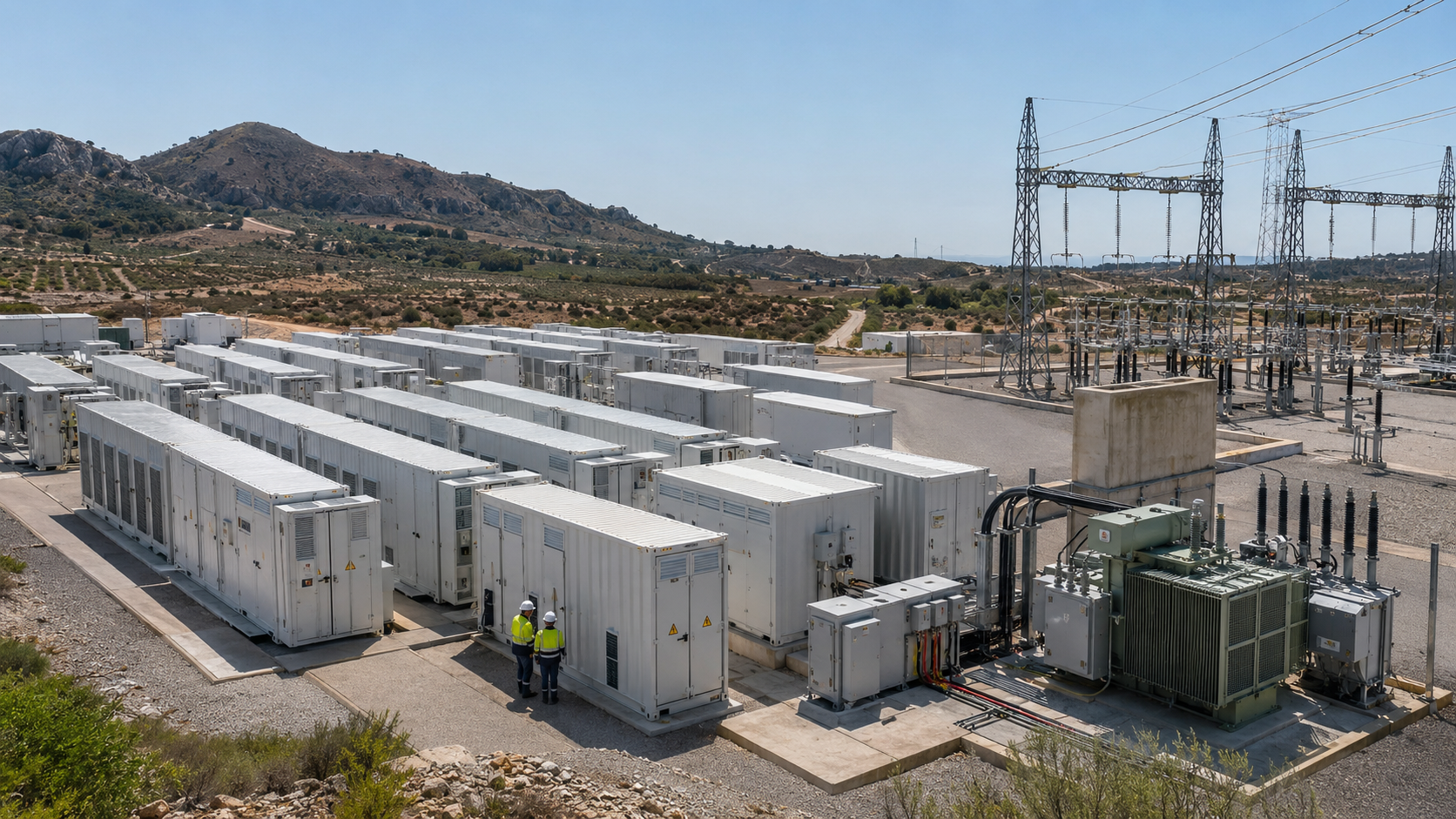
ACME Solar Holdings has commissioned a 63.78 MW/255.12 MWh section of the battery storage installation serving its firm and dispatchable renewable energy project for Indian electricity company NHPC in Rajasthan.
ACME disclosed the commissioning through a stock exchange filing on 26 November, confirming that its subsidiary ACME Hybrid Urja had completed the work on 25 November at Mehar Nagar in the Pokaran area of Jaisalmer district. Commercial operation of the commissioned section was scheduled for 27 November.
The newly commissioned equipment has an installed energy rating of 300 MWh, compared with a specified discharge rating of 255.12 MWh. Across the complete installation, ACME intends to provide 280 MW of discharge power and 1,120 MWh of discharge energy from equipment with an installed energy capacity of 1,316 MWh.
The first section therefore accounts for nearly 23% of the proposed discharge capacity. At the specified power rating, it has a nominal four-hour discharge duration, matching the duration of the wider battery development. The commercial operation date applies to the commissioned storage section rather than the entire renewable energy project.
Specifying both installed and discharge capacity allows the battery’s electrical performance to be considered against the quantity of energy available to fulfil delivery obligations. The rated discharge energy in the initial section represents approximately 85% of its installed energy capacity, a ratio broadly consistent with the specifications for the completed project.
Battery equipment is commonly operated within a defined state-of-charge range, while conversion losses and auxiliary electricity consumption can reduce the energy available at the delivery point. Developers may also incorporate capacity allowances for deterioration over time. ACME has not published the contractual measurement boundary or allocated the difference between the two energy ratings to specific engineering factors.
The firm’s agreement with NHPC is part of the Indian market for firm and dispatchable renewable energy (FDRE), in which electricity procurement can require deliveries at specified times or against defined availability requirements. ACME has separately signed a 300 MW four-hour supply agreement, disclosed in October, which illustrates the growing use of storage-backed renewable electricity contracts in India.
The power rating determines how quickly the battery can deliver electricity, while the energy rating establishes how long it can sustain that output. A contracted four-hour delivery period can therefore influence both the number of battery modules procured and the capacity of the inverters, transformers, and collection circuits carrying their combined output.
Charging schedules must also account for the availability of renewable generation. A forecast reduction in solar output, for instance, may alter how much electricity can be stored before a subsequent delivery obligation. The plant’s control system must reconcile these commercial requirements with cell temperature, state of charge, and electrical operating limits.
ACME has used staged commissioning across several Rajasthan projects. In October, it reported commissioning 107.36 MW/437.49 MWh of discharge capacity across two developments, following work completed on 30 September. Those projects were separate from the latest NHPC commissioning. The October update placed cumulative operational battery capacity at 4.96 GWh before the subsequent additions reflected in the investor presentation.
Bringing sections into service sequentially enables electrical testing and acceptance to progress as equipment becomes available. The operating arrangements must distinguish energised equipment from sections still under construction, while protection and supervisory controls must accommodate the changing configuration as more battery units are connected.
The company’s October investor presentation reported approximately 5.2 GWh of cumulative commissioned battery capacity, following the addition of around 2.1 GWh during the quarter and subsequent reporting period. ACME increased its cumulative commissioning target for the financial year ending March 2027 from 10 GWh to more than 12 GWh.
The presentation also identified approximately 17 GWh of battery installations associated with contracted projects under construction for which power purchase agreements had been signed. The scale of that pipeline creates substantial requirements for battery supply, conversion equipment, electrical connections, and commissioning personnel, with completion schedules dependent on the availability of each element.
NHPC’s Rajasthan development will require a further 216.22 MW and 864.88 MWh of discharge capacity to reach its specified battery ratings. ACME has not established a revised date for completing the remaining sections in its latest disclosure. Until those sections are commissioned, the 1,120 MWh figure remains the project’s planned discharge capacity rather than its available operational energy rating.