IN Brief:
- Four completed photovoltaic installations are forecast to avoid approximately 40 tonnes of carbon emissions annually.
- Camborne Redruth Community Hospital's 331-panel array is expected to reduce annual electricity expenditure by more than £30,000.
- Your Eco selected equipment incorporating module-level power optimisation, voltage reduction during shutdown, and connector temperature monitoring.
Cornwall Partnership NHS Foundation Trust has completed rooftop photovoltaic installations at four further healthcare and administrative facilities, extending a programme of on-site generation expected to cut annual electricity consumption from the grid and reduce expenditure across its estate.
Designed and installed by Your Eco, the four systems are forecast to generate approximately 206 MWh of electricity annually and avoid around 40 tonnes of carbon emissions. The contractor selected SolarEdge DC-optimised inverter technology, which allows the output of individual pairs of photovoltaic modules to be managed separately within a string.
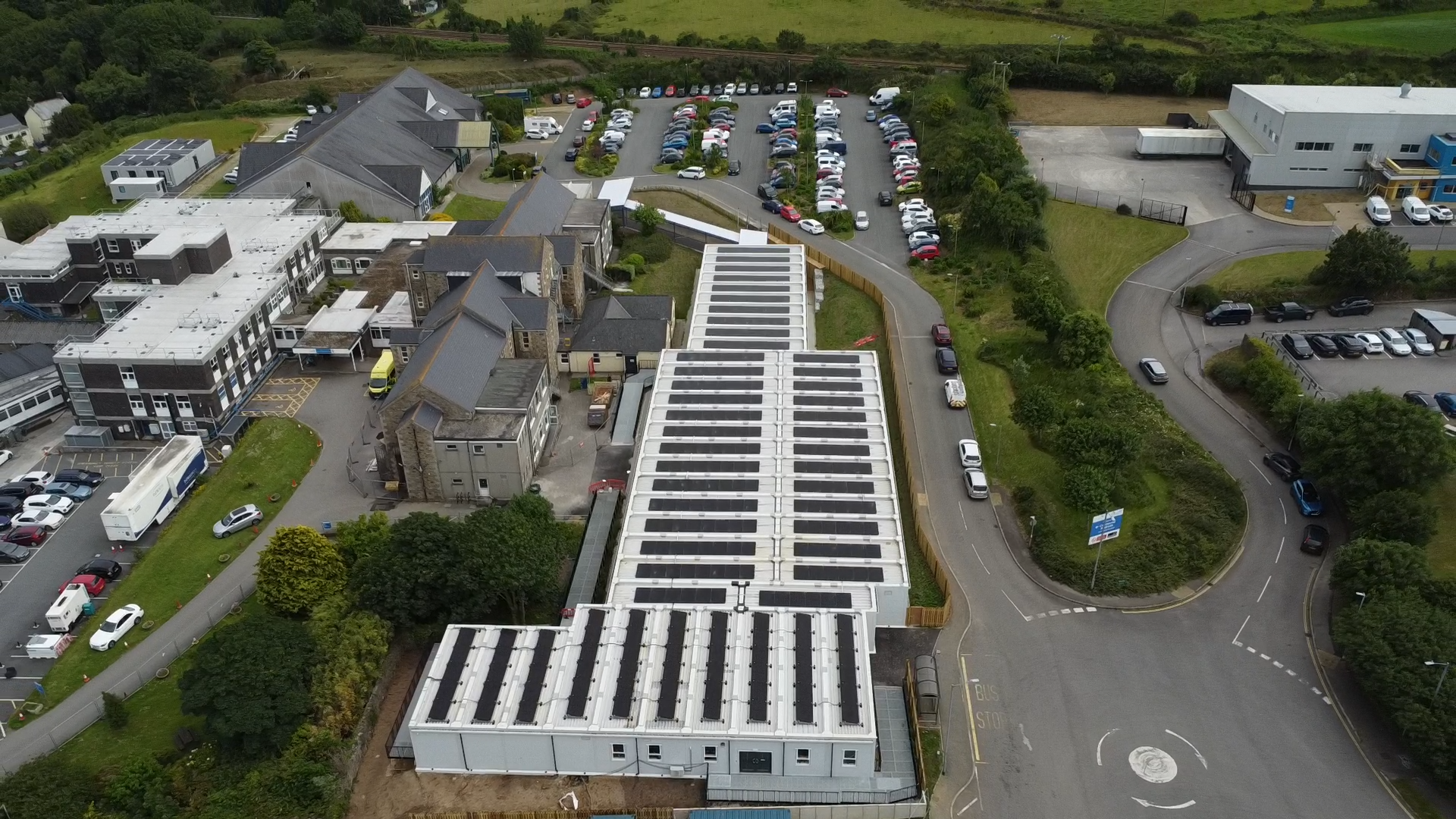
The largest array contains 331 panels at Camborne Redruth Community Hospital, which accommodates inpatient wards, a minor injuries unit, and stroke rehabilitation services. The trust expects that installation alone to cut annual electricity costs by more than £30,000. A further 51-panel system at a facility supporting children with learning disabilities and autism is expected to offset around 64% of its electricity consumption.
Two smaller installations serve facilities in Liskeard. The 16-panel array at the Coach House mental health resource centre is sized to generate electricity equivalent to 105% of annual building consumption, while a fourth system serves the Layland Short Break Home for children with complex healthcare needs.
The four sites follow the installations completed by Your Eco in 2023 at St Austell Community Hospital and the Sowenna Child and Adolescent Mental Health Unit. The trust has also secured £2.2 million in Great British Energy funding for further solar installations as it works towards a net zero carbon footprint by 2030.
Generating the equivalent of a building’s annual demand does not eliminate its need for a grid connection. The Coach House array may produce surplus electricity during daylight hours and require imports at other times. The financial benefit depends on how much generation coincides with demand and the terms available for any exported electricity. At larger hospitals, the electricity required for continuously operating services can provide a more consistent load against which daytime production can be used.
Your Eco’s selection of DC optimisation addresses differences in output between modules installed on existing buildings. Photovoltaic cells have a characteristic current and voltage relationship that changes with irradiance and temperature. In a conventional series string, current is shared by the connected modules, so shading or other differences in output can reduce the power available from the string as a whole.
The SolarEdge arrangement uses DC converters beneath pairs of panels to adjust their electrical operating conditions independently. Each optimiser regulates the relationship between the current and voltage supplied by the connected modules and the electrical conditions required by the rest of the string. This can reduce mismatch losses where the orientation of panels or obstructions on a roof create uneven generation conditions.
The S Series optimisers selected by the contractor also incorporate safety functions addressing hazards on rooftop DC circuits. Disconnecting a building from the public supply does not stop illuminated photovoltaic modules producing electricity. The equipment is designed to reduce the DC voltage associated with each optimiser during shutdown, subject to correct installation and operation of the system.
SolarEdge’s Sense Connect function monitors connector temperatures for abnormal increases. Resistance at a deteriorating or poorly made connection causes heat to develop when current flows; temperature monitoring allows protective action before the connection degrades further. The function addresses a specific failure mechanism and operates alongside the protective devices, cable specifications, isolation arrangements, and inspection procedures required for the complete installation.
The importance of those arrangements extends beyond the initial installation because hospital maintenance and emergency response may require access to roofs and associated electrical equipment while clinical facilities remain occupied. Accurate circuit records and accessible isolation points help maintenance personnel identify which equipment remains energised under different operating conditions.
The forecast 206 MWh annual output across the four sites corresponds to average generation of approximately 23.5 kW over a full year. That figure is considerably different from the instantaneous peak output of the combined arrays and cannot be used to establish the ratings of the installed inverters or distribution equipment. Neither the combined peak DC rating nor the individual inverter ratings have been disclosed.
Further installations supported by the Great British Energy grant will increase the number of distributed generating assets under the trust’s management. Metered generation and import data will allow the estates team to compare the actual performance of the completed arrays with the forecast electricity and financial savings, while identifying the operating profiles of buildings being considered for subsequent installations.