IN Brief:
- RES has secured an asset management contract from Copenhagen Infrastructure Partners for the 392MW Peştera II wind farm.
- The Romanian project comprises 56 Nordex N163/6.X turbines rated at 7MW each, with commissioning planned for 2028.
- RES will support the project through construction and operation, following its June financial close and the award of a 15-year contract for difference covering 245MW.
RES has secured an asset management contract from Copenhagen Infrastructure Partners (CIP) for the 392MW Peştera II wind farm in south-eastern Romania, adding an operational services agreement to a project already under construction.
The development in Constanța County will comprise 56 Nordex turbines, with commercial operation expected in 2028. RES’s Romanian team will support CIP during construction and the transition into operation, with the agreement extending into the wind farm’s operating life.
The appointment is separate from the turbine manufacturing, construction and project financing agreements already established for Peştera II. It introduces an asset management provider while the development is still progressing towards commissioning, allowing arrangements for performance monitoring and commercial oversight to be developed before generation begins.
RES has operated in Romania since 2015 and maintains its national office in Constanța. The company has expanded its European asset management activities during 2026, securing contracts in Greece, Belgium, Lithuania and Italy alongside the Romanian agreement.
The Peştera II appointment also extends its relationship with CIP. In July 2025, RES was selected to manage Coalburn I, the investor’s 500MW/1GWh battery storage installation in South Lanarkshire, Scotland.
RES reports more than 15GW of renewable assets under management across 14 countries. Its monitoring arrangements are supported by operational control centres in Glasgow, Albacete and Denver, providing continuous oversight of generation assets.
Those facilities give asset managers access to information about equipment condition, operating status and generation performance. However, monitoring arrangements do not establish that every maintenance or operational activity is carried out directly by RES, as responsibilities are allocated through the applicable service agreements.
Peştera II reached financial close on 22 June 2026, securing approximately €510 million through a consortium of seven commercial banks. Erste Group and Banca Comercială Română participated alongside Deutsche Bank, Société Générale and BRD, Eurobank, and Piraeus Bank.
The project is being developed through CIP’s Growth Markets Fund II, with co-investment from the European Investment Bank and a Danish pension fund. The financial structure supports construction of one of Romania’s larger onshore wind developments.
A 15-year contract for difference covering 245MW of the proposed capacity provides a further element of its commercial arrangements. That volume represents 62.5% of the wind farm’s nominal 392MW capacity.
Under a contract for difference, payments are calculated against defined market and contractual reference prices, subject to the applicable scheme rules. The mechanism can reduce some exposure to wholesale electricity price fluctuations, although it does not remove production risk or guarantee a particular generating output.
The contract also does not mean the remaining installed capacity lacks commercial arrangements. The available information establishes the volume awarded under Romania’s support mechanism but does not provide a complete breakdown of the project’s other electricity sales arrangements.
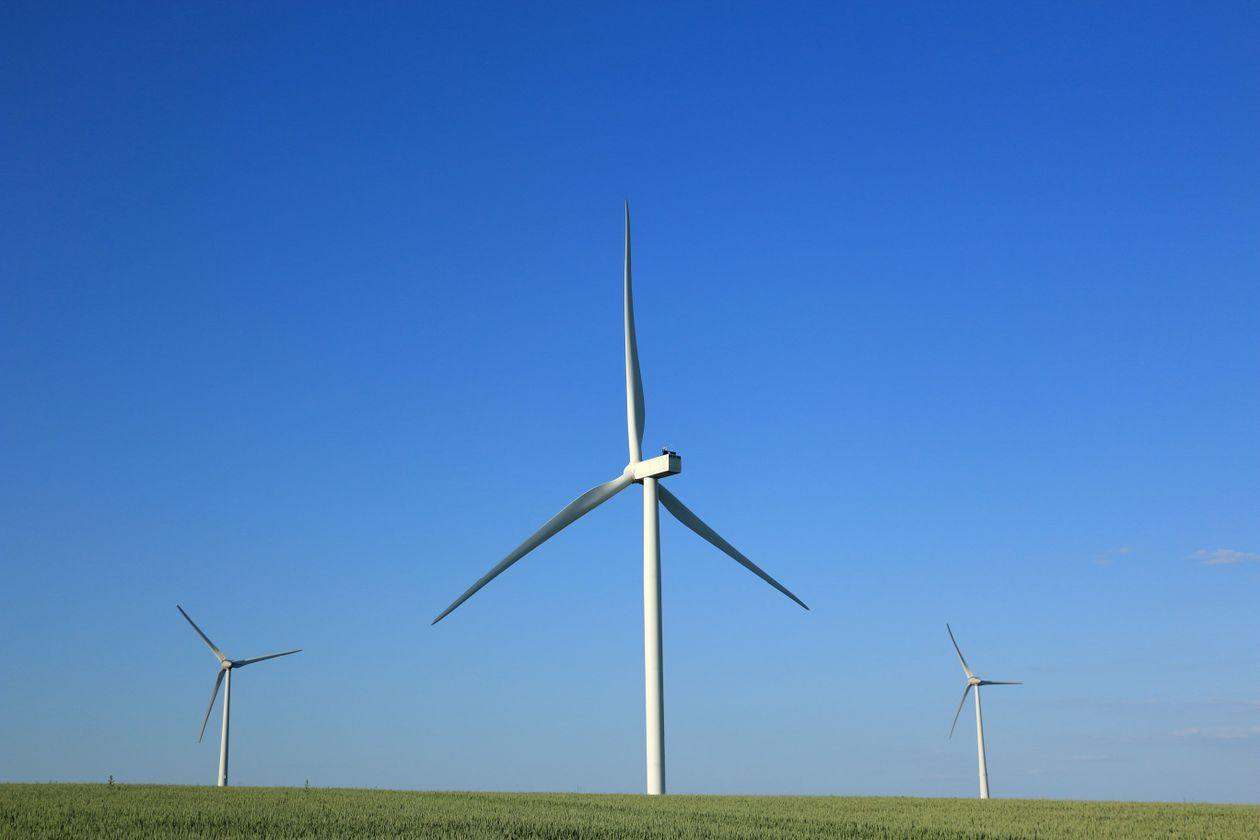
Nordex is supplying 56 N163/6.X wind turbines, each rated at 7MW and mounted on a 138-metre steel tower. Multiplying those individual ratings gives the stated 392MW installed capacity.
Manufacturing began during 2026, while early site preparation and procurement work continued. The project programme includes foundation construction, turbine delivery, installation and electrical commissioning before commercial generation can begin.
Each turbine converts the kinetic energy of wind into mechanical rotation, which drives a generator through its powertrain. Electrical conversion and control equipment then conditions the output for collection and transfer through the wind farm’s electrical infrastructure.
The installation will require collection circuits, switching equipment, protection systems and transformers arranged to connect individual turbines with the project’s export infrastructure. Their final configuration must satisfy the applicable grid connection and operating requirements.
The announced installed capacity describes the combined maximum nominal generating power, not continuous electrical production. Actual output will vary with wind conditions, equipment availability and operating restrictions.
That variation makes accurate performance assessment central to asset management. Measurements of electricity output must be interpreted alongside wind resource conditions, turbine operating data and any restrictions imposed by the electrical network.
A period of lower generation does not necessarily indicate equipment deterioration. Turbines may be operating correctly during low wind conditions, or their output may be reduced through curtailment, planned maintenance or electrical restrictions.
Conversely, differences between measured and expected production can indicate faults, control problems or other conditions requiring investigation. Asset management depends on distinguishing those causes before maintenance activities or contractual remedies are pursued.
Turbine condition monitoring can identify changes in equipment behaviour, while operating records allow maintenance requirements to be coordinated with periods when access and weather conditions permit work.
The responsibilities of an asset manager can also include contractual reporting, oversight of service providers, financial monitoring and coordination with the asset owner. The precise scope depends on the management agreement, whose detailed terms have not been disclosed.
RES’s appointment does not replace Nordex as the turbine supplier or establish that the company has taken over construction delivery. The existing project participants retain their respective roles unless the developer announces contractual changes.
The wind farm’s scale introduces substantial requirements for electrical reliability. Faults affecting individual turbines can reduce output from part of the installation, while interruptions involving collection infrastructure or the export connection may affect a larger proportion of generation.
Protection coordination and appropriate maintenance arrangements are therefore necessary to manage faults without exposing equipment or personnel to unacceptable risk. Their effectiveness will be assessed through installation testing, commissioning and subsequent operating experience.
Generation forecasts must also account for electrical losses between turbines and the grid connection. Those losses, turbine availability and periods of curtailed operation affect the difference between theoretical energy production and electricity ultimately delivered.
The performance of Peştera II cannot yet be judged against operating targets because the wind farm remains under construction. Its annual generation, availability and maintenance costs will become measurable only as commissioning is completed and the installation enters service.
CIP’s delivery programme currently targets commercial operation in 2028. RES will support the transition from construction into asset operation, with the next milestones centred on turbine installation, completion of electrical infrastructure and commissioning of the 392MW facility.