IN Brief:
- Infineon's XDP8HD40S-1 provides programmable hot-swap protection for AI server power paths using ±400 V and 800 VDC architectures.
- The controller combines digital safe operating area management, external SiC switch control, PMBus 1.5 monitoring and fault-event recording.
- The product supports monitored rails from 30 V to 1,500 VDC, with engineering samples targeted for the second quarter of 2027.
Infineon Technologies has introduced the XDP8HD40S-1, a high-voltage hot-swap controller designed to manage the safe connection and disconnection of electrical loads in next-generation AI server infrastructure. The device combines programmable power-path protection, electrical monitoring and fault diagnostics for systems operating with ±400 V and 800 V direct-current architectures.
The controller is intended for intermediate bus converters, GPU power supplies, server rack distribution equipment and battery backup systems. Engineering samples are targeted for the second quarter of 2027, with the product currently listed as coming soon rather than commercially available.
Increasing the distribution voltage within a server installation allows greater power to be transferred at lower current. For a given level of delivered power, reducing current can lower resistive losses and ease some of the demands placed on conductors and electrical distribution equipment. Higher voltages, however, create more demanding requirements for insulation, switching and fault protection.
When a new server module connects to an energised direct-current distribution bus, its initially discharged input capacitors can draw a large inrush current. Controlled charging protects the switching devices and limits disturbances to other loads sharing the supply.
That inrush current can stress switching devices, disturb the upstream supply and interfere with other equipment sharing the same power distribution system. A hot-swap controller manages the connection sequence so that the downstream circuit is energised within defined electrical limits rather than being subjected to an uncontrolled initial current.
The XDP8HD40S-1 drives external power semiconductor switches and monitors local voltage and current conditions. A complete protection stage also requires compatible switching devices, sensing and supporting circuitry, with protection coordination across the wider electrical system.
Infineon has incorporated digital safe operating area control to manage current and voltage during start-up and abnormal operating conditions. A semiconductor’s safe operating area describes the combinations of electrical stress and operating duration it can withstand without exceeding its specified limits. The controller uses programmable protection to regulate the external switch accordingly.
A variable pulse safe operating area function, described as Boost Mode, provides further control over the start-up process. The product supports automatic and fully programmable boost arrangements, allowing the protection response to be adapted to different circuits. Appropriate settings depend on the selected semiconductor, downstream capacitance and expected operating conditions.
The integrated gate driver is designed to control external silicon carbide cascode switching stages based on a MOSFET and JFET combination. These semiconductors perform the electrical switching, while the controller supervises their operation and applies the defined protection response. Infineon identifies compatibility with devices from its OptiMOS MOSFET and CoolSiC JFET portfolios.
Switch selection influences conduction losses, thermal performance and the ability to withstand transient electrical stresses. Those characteristics become more demanding as distribution voltages increase, particularly when equipment must be connected and disconnected repeatedly without interrupting the operation of other server subsystems.
The controller provides a configurable gate-driver pull-down current of up to 1.5 A for rapid switch shutdown. It also supports surge protection and monitoring for conditions including overcurrent, overvoltage, undervoltage, excessive temperature and switching-device faults. The effectiveness of these functions depends on the settings and electrical characteristics of the completed circuit.
Infineon’s product specification identifies two independently programmable overcurrent protection levels, as well as short-circuit detection and configurable responses to faults. Depending on the selected configuration, the controller can latch a circuit off, attempt automatic recovery or follow a digitally defined response. Those options allow protection behaviour to be matched to the requirements of individual modules and the wider power distribution architecture.
The electrical design must establish how the controller’s separate low-voltage supply domains remain available for start-up control and fault response. The sensing and insulation arrangements around the external switching stage also require coordination with the selected high-voltage circuit.
Infineon specifies high-side and low-side current sensing options for the controller. Current measurement accuracy and the programmed protection response depend on the selected sensing components, their integration with the external switch and calibration of the completed circuit.
Remote monitoring is provided through a PMBus 1.5 interface, supporting communication with power management equipment across the server installation. The product specifications identify a communications rate of 400 kHz, allowing electrical measurements and status information to be exchanged with supervisory systems.
Infineon reports voltage and current telemetry accuracy of approximately 1%, together with power measurement accuracy of 3%. The controller includes analogue power monitoring and a 40-bit energy reading register. The performance achieved in an operating installation will depend on the complete sensing and calibration arrangements, as well as the conditions under which measurements are taken.
Fault investigation is supported by an integrated black-box recording function that stores information about critical operating events. The device incorporates flash memory for this purpose, enabling recorded conditions to be examined after a fault or unexpected shutdown rather than relying exclusively on measurements available while the event is taking place.
These monitoring functions can assist with diagnosing whether an interruption originated from an upstream supply disturbance, a downstream load fault or the local switching stage. They may also provide evidence about repeated abnormal conditions that have not yet caused a permanent equipment failure.
High-density AI racks may contain multiple converters, computing modules and backup supplies connected to common direct-current distribution equipment. Power-path monitoring can locate abnormal electrical conditions at individual branches, allowing coordinated protection to isolate the affected circuit.
Infineon also identifies server battery backup units and peak-shaving equipment as potential applications. A battery installation may need to connect or disconnect from a high-voltage power path as operating conditions change, requiring controlled switching and suitable fault protection. The hot-swap controller does not supply stored energy or perform the main battery power conversion function.
The new device complements Infineon’s existing work on 800 VDC AI power distribution and high-density conversion. While reference power supplies and solid-state circuit breaker systems address other parts of the electrical architecture, the XDP8HD40S-1 is directed towards control and protection at the individual power-path interface.
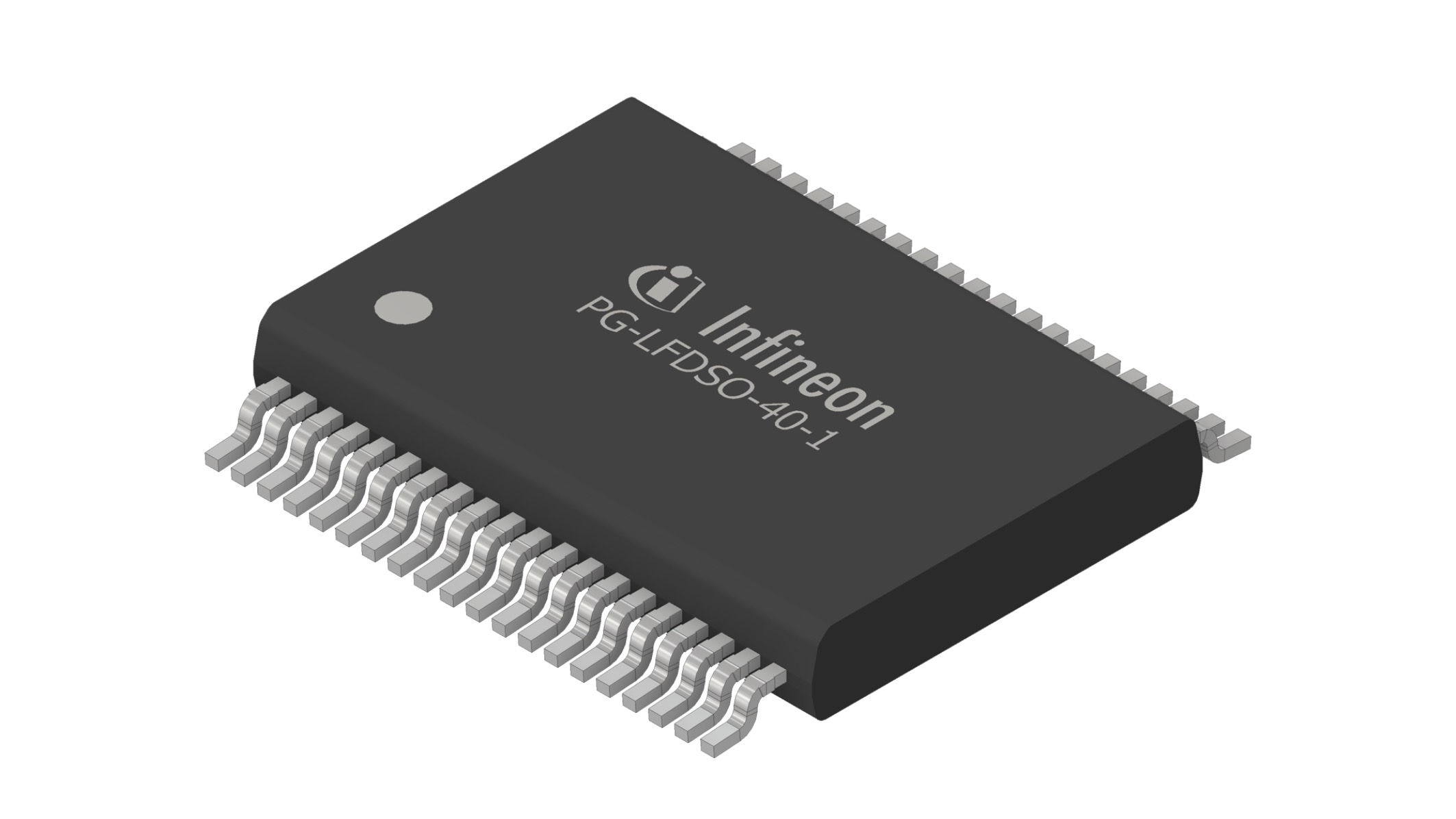
The controller is packaged in a 40-pin LFDSO device measuring 10.7 by 10.3 millimetres. Before it can be incorporated into a commercial server design, engineers will need to establish suitable switch ratings, protection thresholds, thermal characteristics and circuit behaviour under normal and fault conditions.
Infineon has not announced a production release date, customer adoption programme or commercial pricing. With samples targeted for Q2 2027, the XDP8HD40S-1 remains a pre-sampling product intended to support the development and qualification of future high-voltage AI server power systems.