IN Brief:
- Dublin Airport has commissioned Ireland’s first pantograph charging system for an electric airport shuttle fleet.
- Fourteen buses receive rapid opportunity charging at route termini, supported by a seven-bay depot facility.
- The €17m programme required major voltage upgrades and forms part of a wider airport-campus electrification project.
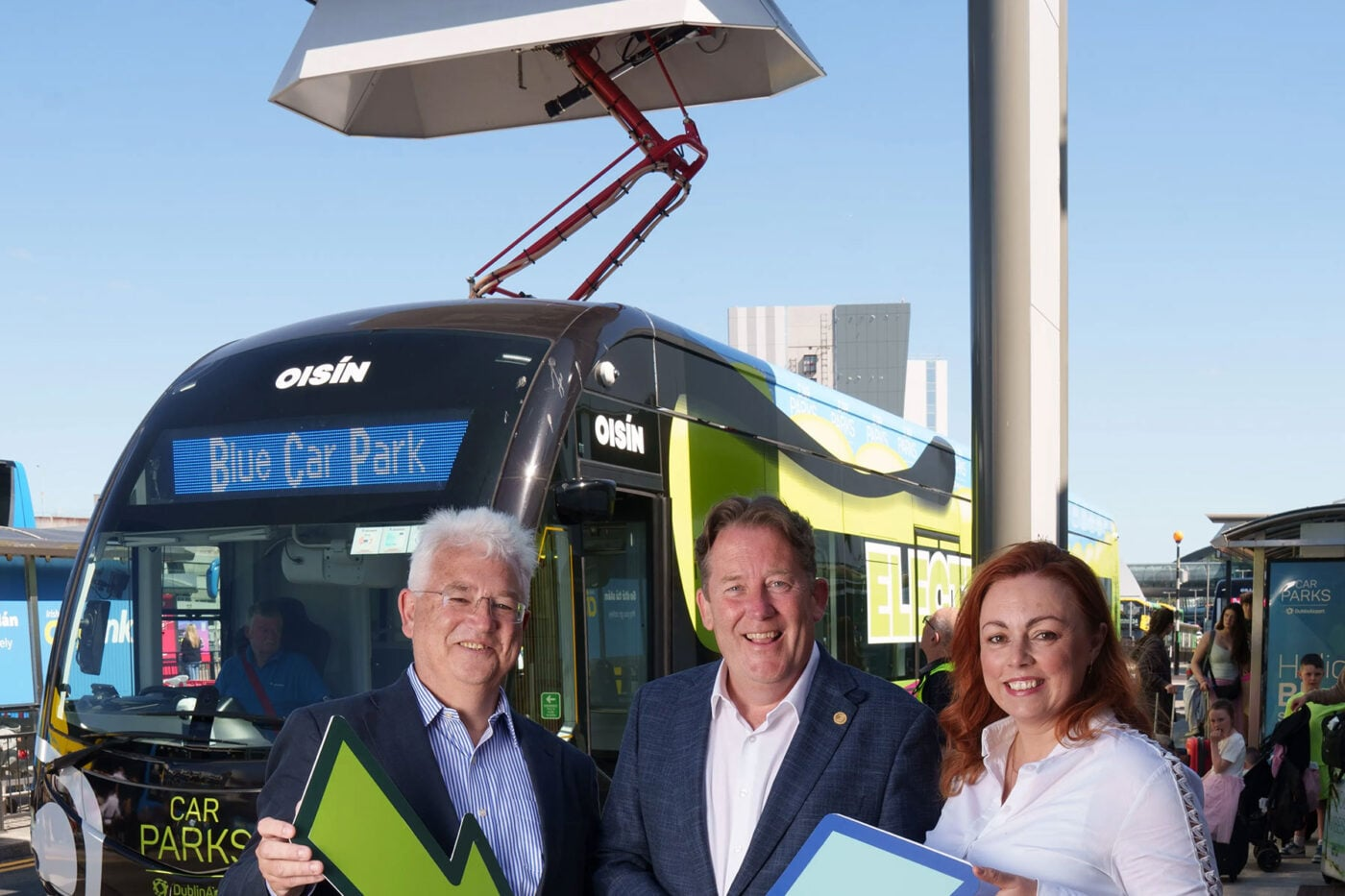
Dublin Airport has commissioned a pantograph charging system and associated depot infrastructure to support fourteen electric shuttle buses operating between its car parks and terminal buildings.
Operated by Aircoach, the zero-emission fleet can carry up to 120 passengers per journey and serves an operation handling approximately 2.5 million passenger movements annually. The high-frequency duty cycle leaves limited time for daytime charging and places a premium on equipment availability.
Pantographs installed at route termini provide rapid opportunity charging while buses are stationary between journeys. Electrical contacts connect automatically with equipment mounted on the vehicle roof, transferring energy without requiring the driver to handle a charging cable. A seven-bay depot installation provides overnight charging, operational backup, and greater flexibility when vehicles are rotated through maintenance.
The charging assets form part of a €17m investment that included substantial upgrades to the airport’s electrical supply. Funding includes €4.7m from the European Commission’s Connecting Europe Facility Alternative Fuels Infrastructure Facility, while the wider campus electrification programme also covers light vehicles, airside buses, and ground-service equipment.
Opportunity charging changes the relationship between battery capacity and infrastructure power. A bus receiving regular high-power charges during its working cycle can use a smaller battery than one expected to complete an entire day before returning to the depot, reducing vehicle weight and potentially improving passenger capacity. The operating model becomes more dependent on charger availability, timetable discipline, and the capacity of the local electrical network.
At an airport, charger reliability is closely tied to transport resilience. A failed unit, protection trip, communications fault, or delayed vehicle can affect subsequent services when there is insufficient spare energy or alternative charging capacity. The depot installation therefore provides more than overnight energy, giving the operator another route for recovering vehicles when opportunity charging is interrupted.
Electrical design must account for concentrated demand rather than daily consumption alone. Several buses arriving in close succession can create abrupt load steps, while depot charging may coincide with other airport demand. Load-management software can stagger charging, reserve capacity for vehicles with urgent duties, and keep total demand within the agreed connection level.
The voltage upgrades required for the project show that high-power charging cannot be treated as an isolated transport installation. New transformers, switchgear, protection, cables, metering, and control interfaces may be necessary when an existing campus network is extended to support repeated charging events. Power quality, harmonic performance, earthing, and fault levels also need to be reassessed across the modified system.
Airport electrification shares several characteristics with motorway hubs, logistics depots, and bus garages, where vehicle demand is concentrated at predictable locations but individual charging events remain operationally critical. Elsewhere, battery-backed charging sites are supplementing constrained grid connections during periods of high charger demand.
Although storage is not identified as part of the Dublin pantograph installation, the campus model creates a future role for coordinated energy management. Charging loads can be aligned with building demand, on-site generation, electricity prices, and network conditions. Bus fleets also offer predictable energy requirements because departure times, routes, and required state of charge are known in advance.
Maintenance extends across mechanical contacts, power electronics, switchgear, communications, and vehicle interfaces. Pantograph alignment, contact wear, environmental exposure, and repeated high-current operation require inspection regimes that connect transport engineering with electrical maintenance, while charger and vehicle software must remain compatible throughout the fleet’s working life.
The fourteen buses are the visible part of a wider electrical-infrastructure programme. Dependable service rests on the upgraded supply, route-end chargers, depot capacity, controls, operational planning, and maintenance arrangements behind them. As commercial fleets electrify, system availability and network integration will become more useful measures of performance than the number of charging points installed.