
IN Brief:
- European Energy has grid-connected battery systems at the Stouby and Agersted solar parks in Denmark.
- The two four-hour installations provide a combined 38MW of power and 152MWh of energy capacity.
- Shared connections and coordinated controls allow existing solar sites to deliver balancing and frequency services.
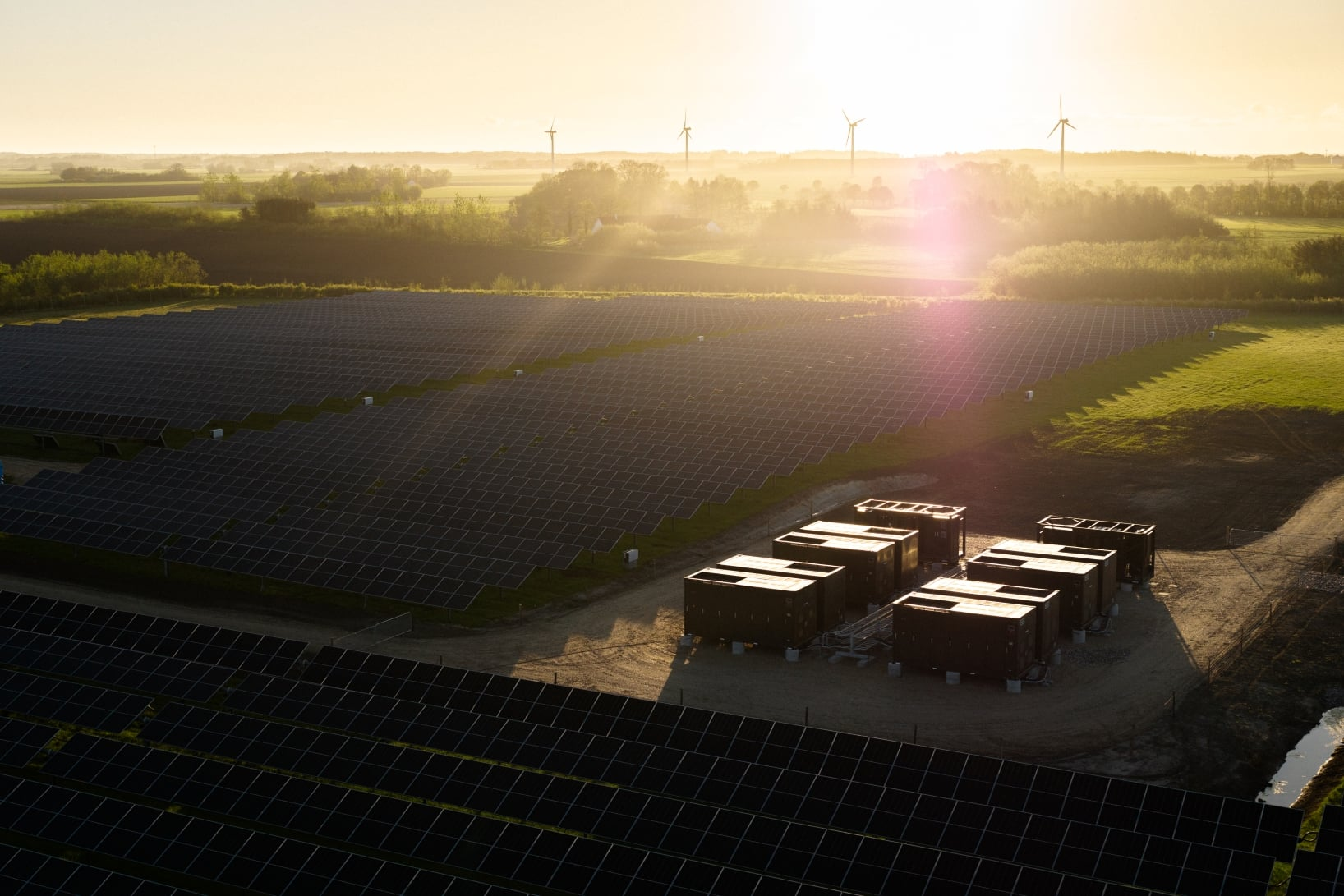
European Energy has connected two co-located battery projects in Denmark, adding 38MW of power and 152MWh of energy capacity alongside operating solar generation.
At Stouby, a 28MW battery with 112MWh of storage has been integrated with an 88MW solar park that entered operation in September 2024. A second installation at Agersted combines a 10MW and 40MWh battery with a 31MW solar project operating since 2022.
Both batteries have a nominal four-hour duration and were developed, engineered, procured, constructed, and integrated in less than a year. Their operating strategy includes frequency regulation and balancing services, together with the shifting of solar output between periods of high generation and stronger electricity demand.
Because the batteries are located beside existing solar parks, each project can share parts of the established grid infrastructure. That arrangement can reduce the requirement for a completely separate connection and allow greater use of export capacity outside peak solar-production periods, although the usable benefit depends on connection limits, metering arrangements, and whether batteries may charge from both the solar plant and the public network.
A four-hour configuration provides a wider operating range than batteries designed mainly for short frequency events. The systems can still respond rapidly to balancing instructions while retaining enough energy to move a significant block of midday solar production into the evening. Dispatch software must coordinate those services carefully so that capacity committed to one market remains available when required elsewhere.
Hybrid operation introduces several engineering interfaces. The power-plant controller must coordinate solar inverters and battery converters while keeping the combined site within its authorised import and export envelope. Protection systems need to accommodate generation, charging, and discharge conditions, while metering must distinguish energy flows for settlement, taxation, guarantees of origin, and market participation.
Charging also changes the duty placed on transformers, cables, and switchgear. Equipment originally selected for a solar park may have been sized around daytime export rather than repeated import and export cycles across a longer operating window. Thermal modelling, harmonic assessment, reactive-power capability, and protection settings therefore need to reflect the hybrid plant’s complete operating profile.
The Danish sites form part of a broader shift from single-purpose renewable generation towards controllable power-system assets. A similar model is taking shape in a Greek solar-storage development, where batteries are being integrated with generation to improve dispatchability and make more effective use of grid capacity.
Co-location can be particularly useful where new connections are constrained. Adding storage behind an established point of connection does not create unlimited capacity, but it can reshape import and export to fit within an existing envelope. Solar production that would otherwise be clipped or exposed to low prices can be stored, while discharge can be moved into periods when network and market conditions are more favourable.
Revenue stacking will remain central to the commercial case. Frequency services can provide valuable income, but those markets are finite and may become increasingly competitive as battery capacity grows. Wholesale arbitrage, imbalance management, congestion support, and capacity arrangements can broaden revenues, although each service imposes different cycling patterns, response requirements, and availability obligations.
Long-term performance will depend on how the dispatch strategy balances income against degradation. Frequent shallow cycles for ancillary services affect cells differently from sustained four-hour operation, while temperature, state-of-charge limits, augmentation planning, and warranty terms all influence available capacity. Those factors need to be embedded in operating software rather than treated solely as maintenance concerns.
Stouby and Agersted give European Energy an operating reference for four-hour batteries within a Nordic market increasingly shaped by wind, solar, interconnection, and rapid changes in system balance. Their performance will be measured through availability, delivered services, and the extent to which storage increases the useful output and connection efficiency of the adjoining solar parks.

