IN Brief:
- Wood Mackenzie estimates €140m in foregone Spanish renewable revenue during 2026, with uncompensated technical curtailment equivalent to 4% of available renewable output.
- Curtailment exceeds 25% at some nodes in Extremadura and Murcia, while grid-support requirements account for a substantial part of the national problem.
- The analyst expects additional solar connections and inverter compliance to determine whether curtailment stabilises or rises through 2028.
Wood Mackenzie estimates that technical curtailment has cost Spanish renewable generators €140 million in foregone revenue during 2026. Losses remain elevated following the April 2025 Iberian blackout as network operators balance rising solar and wind output against the system’s ability to carry electricity and maintain stable operating conditions. The figures were circulated on 16 November in a fresh communication of research originally published in September.
Uncompensated curtailment represents approximately 4% of available renewable generation nationally so far this year, according to the consultancy’s network modelling. The effect is much more concentrated at particular connections. Some nodes in Extremadura and Murcia have lost more than a quarter of their potential renewable output, exposing generators at the most constrained locations to a markedly different revenue risk from the national average.
The modelling comes from Spain’s Technical Curtailment Crunch: How the Next Wave of Solar Growth Will Impact Trends, a study dated 17 September 2026 and subsequently discussed in the company’s 16 November communication. It examines individual nodes on Spain’s transmission system and separates the causes of curtailed output. Reducing curtailment requires different interventions depending on whether the limiting factor is line loading, local voltage behaviour or wider power-system stability.
Electricity that cannot be accommodated securely at one point on the network may have to be curtailed even if sufficient thermal capacity exists elsewhere. Grid operators must hold voltage and frequency within operating limits, preserve fault response and maintain enough controllable resources to recover from disturbances. They can therefore instruct some wind or solar plants to reduce output while dispatching synchronous generation to supply system support, with the cost and commercial effects distributed unevenly between generators.
Wood Mackenzie estimates that around half of Spanish technical curtailment in 2026 reflects synchronous system requirements rather than conventional line congestion. Inertia, short-circuit strength, frequency response and dynamic voltage control contribute in different ways to grid security. Rotating machines at conventional generating stations inherently provide some of these characteristics; inverter-connected resources require appropriate control settings and, in some cases, hardware modifications before they can deliver equivalent services.
Existing renewable plant offers a potentially faster route to additional voltage support. The consultancy identifies more than 35 GW of capacity whose equipment could provide dynamic voltage control without additional capital expenditure, provided the necessary compliance and qualification work is completed. Settings, fault-ride-through behaviour, protection coordination and validation against network requirements determine whether that technical potential can be accepted by system operator Red Eléctrica. Physical capability at the connection point alone does not qualify a plant for dispatch.
Older renewable installations may need additional engineering work. Wood Mackenzie identifies approximately 7 GW of solar PV and 26 GW of wind commissioned before Royal Decree 647/2020 that require retrofit or compliance work to provide dynamic voltage services. Some interventions may involve configuration and testing of existing inverters, while other sites will need equipment expenditure. The availability of the lower-cost potential therefore depends on plant-specific designs and the scope of modification required.
By May 2026, Red Eléctrica had enabled 4.2 GW of renewable capacity through its habilitación programme, according to the figures cited by Wood Mackenzie. Further qualification would increase the pool of plant able to contribute to voltage control, potentially reducing occasions when renewable output is constrained to secure support from other generators. Transmission bottlenecks, fault-level limits and other restrictions would continue to bind where they are independent of voltage control.
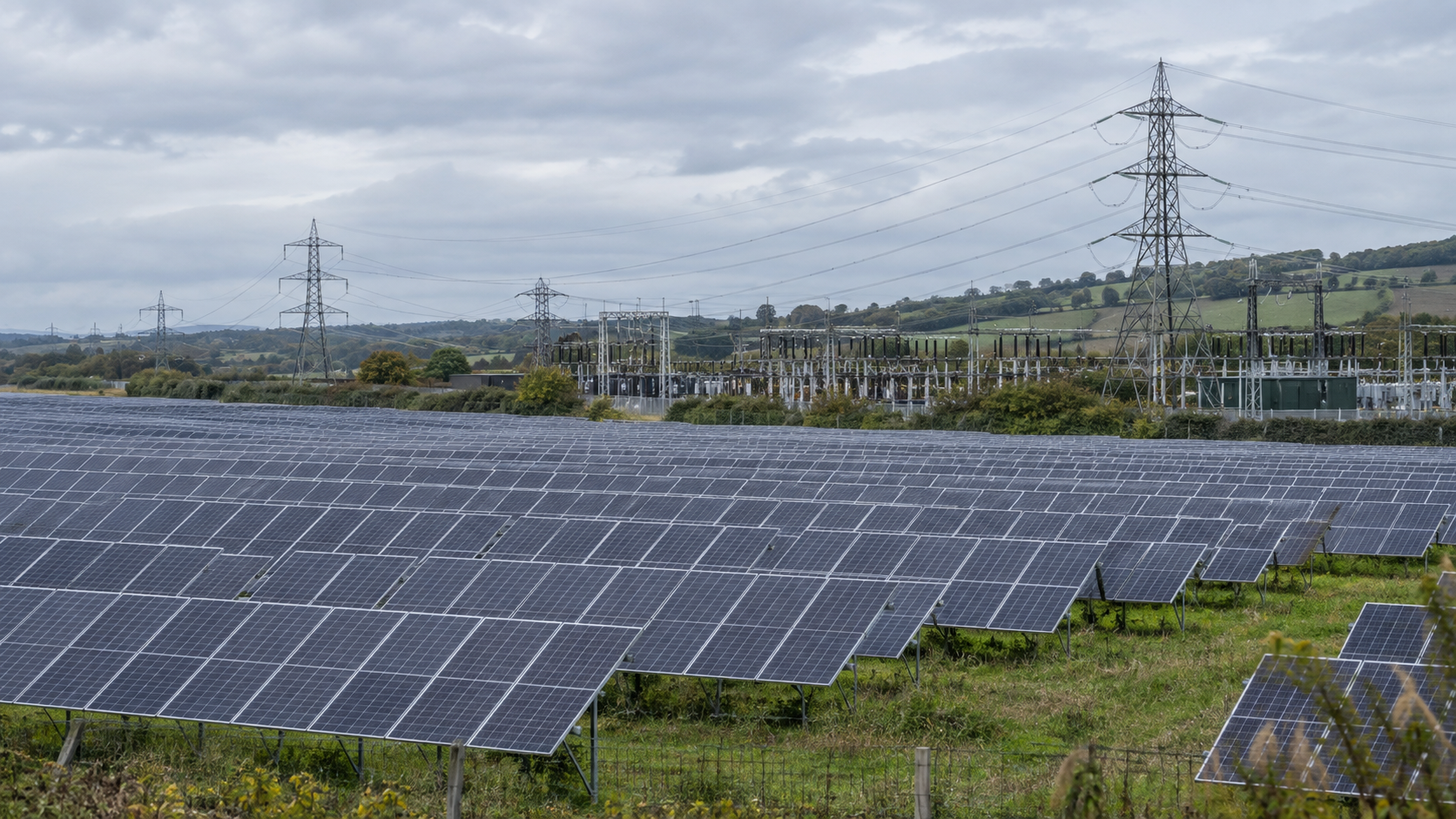
Spain’s generation pipeline adds urgency to that work. Approximately 16 GW of utility-scale solar capacity is expected to connect over 2026–2028, including additions already made in the first eight months of this year. Roughly 10 GW remains to connect over the balance of the period. About 3 GW of additional solar is concentrated around Madrid, Toledo and Cáceres, while developers are also considering León, Valladolid, Huesca and Zaragoza, where the grid position may offset a less favourable solar resource.
The resulting forecasts are sensitive to the speed of operational change. Wood Mackenzie’s base case anticipates curtailment stabilising during 2027 and 2028 as more renewable generators qualify to supply dynamic voltage control. Its downside case assumes that the identified 35 GW of potentially capable plant is not enabled and projects an 18% rise over two years, reaching 6.5 TWh in 2028 compared with 1.3 TWh in 2023. These outcomes are conditional model results rather than forecasts of unavoidable losses.
New transmission reinforcement would expand the network’s ability to move power between locations, but Wood Mackenzie cites an average seven-year development period for greenfield grid projects. Batteries and demand flexibility have shorter potential deployment times, although both rely on obtaining viable connections and providing the right services in the right place. The consultancy forecasts 10 GW of operational battery storage in Spain by 2030, rising to 20 GW in its high case from 0.2 GW in 2025. More than 40 GW is in development and 25 GW has grid access approval, considerably more than the capacity expected to reach operation.
Demand-side changes could further alter the geography of congestion. Wood Mackenzie identifies a 2.3 GW data centre demand pipeline and expects more than 2 GW to be online by 2030, although its effect on curtailment will depend on location and load profile. Alongside inverter-based voltage support, the consultancy expects synchronous condensers to address remaining system-strength requirements by 2029. The rate of plant qualification, storage construction and network delivery will establish how much renewable electricity Spanish operators can accommodate before the next generation of reinforcements is complete.