IN Brief:
- UKAEA has installed a 12-tonne double beam box at the MAST Upgrade fusion research facility in Oxfordshire.
- Two additional neutral beam injectors will increase heating power from 4.4MW to 8.8MW, supporting experiments at higher plasma temperatures.
- Major equipment installation is scheduled for completion by autumn 2027, ahead of scientific experiments beginning in 2028.
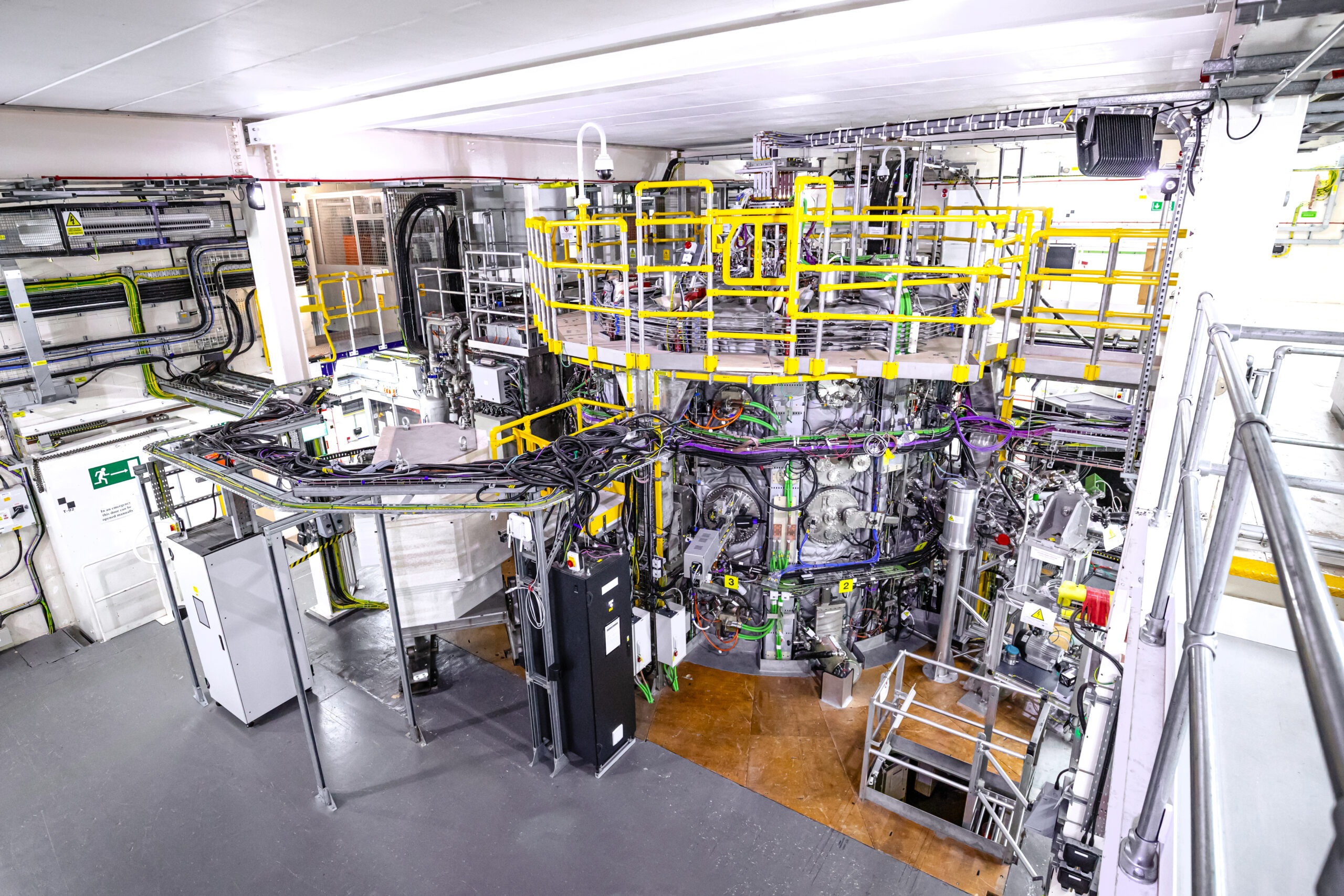
UK Atomic Energy Authority (UKAEA) engineers have positioned a 12-tonne vessel at the MAST Upgrade fusion research facility in Culham, Oxfordshire, completing a major installation operation that will allow the machine’s neutral beam heating power to be doubled.
The component, known as the double beam box, will accommodate two additional neutral beam injectors within a compact, vertically arranged enclosure. Once the associated equipment has been installed and commissioned, MAST Upgrade’s neutral beam heating capacity will increase from 4.4MW to 8.8MW.
UKAEA confirmed the installation on 3 November as part of a wider engineering programme at its Culham Campus. The additional heating equipment is intended to support experiments at higher plasma temperatures and pressures, providing researchers with more demanding operating conditions in which to investigate confinement, stability, and the management of energy leaving the plasma.
MAST Upgrade is a spherical tokamak, a magnetic confinement device in which plasma is held within a compact, toroidal magnetic field configuration. Its experimental programme examines how sufficiently hot plasma can be maintained and controlled, including the behaviour of energy and particles as they move through the confined plasma towards its boundary.
Neutral beam injection provides one method of delivering additional energy to the plasma. The system accelerates charged particles to high energies before neutralising them, allowing the resulting fast atoms to travel across the confining magnetic field and enter the plasma.
Inside the plasma, interactions with other particles transfer energy from the injected atoms to the confined material. The injected atoms can also become ionised, after which their motion is influenced by the magnetic field. Heating performance consequently depends on beam energy, particle interactions, and the plasma conditions established during an experiment.
MAST Upgrade currently operates with 4.4MW of neutral beam heating capacity. The two additional injectors are designed to provide another 4.4MW, bringing the combined installed capability to 8.8MW and expanding the experimental conditions available to researchers.
UKAEA expects plasma temperatures in the upgraded experiments to reach approximately 60 million degrees Celsius, compared with the existing experimental range of around 30 million degrees. These are research targets associated with the additional heating power rather than temperatures already achieved using the new equipment.
Higher plasma temperatures create opportunities to investigate confinement behaviour at increased energy and pressure. The interaction between heating, plasma stability, and the magnetic field is particularly important because the energy delivered to the plasma must be retained for sufficient periods while avoiding operating conditions that could disrupt confinement.
The increased energy input will also place greater demands on the machine’s exhaust arrangements. Heat and particles escaping confinement must be directed towards components designed to receive them, making the performance of the divertor and associated plasma-facing structures an important part of the experimental programme.
The double beam box provides the physical enclosure needed to integrate the additional injection systems. Its double-decker layout accommodates two beam assemblies within the available installation space, while supporting the vacuum conditions and equipment interfaces required for their operation.
The vessel is fabricated from 316L stainless steel and has an internal volume of approximately 20 cubic metres. The material provides mechanical strength, corrosion resistance, and compatibility with the vacuum environment required by the neutral beam equipment.
The component weighed approximately 12 tonnes during installation and is expected to weigh around 15 tonnes once its lid and associated elements are included. Manoeuvring the vessel into position required suitable lifting arrangements and coordination with the existing machine infrastructure.
Vacuum performance is central to the operation of the injection system. Residual gas within the beam line can interfere with the formation and transport of the energetic beam, so the enclosure must operate at pressures appropriate for the intended particle trajectories and equipment configuration.
A cryopump is being manufactured and assembled for installation inside the vessel. It will remove gas from the enclosed volume and help maintain the required pressure conditions during operation, supporting the performance of the injection equipment.
Engineers are also progressing the beam line module, which will form and direct the beam towards the plasma. Installation of the positive ion neutral injectors forms part of the same programme, alongside the electrical and control equipment needed to operate the additional systems.
Some of the supporting power supply infrastructure will be transferred and repurposed from the former Joint European Torus (JET) facility. That work involves adapting existing fusion engineering equipment for a different experimental installation, with the relevant electrical interfaces and operating requirements incorporated into the MAST Upgrade programme.
The neutral beam expansion is being undertaken alongside installation of an electron Bernstein wave microwave heating system. This provides a different means of transferring energy to the plasma through electromagnetic waves, expanding the range of heating conditions available for scientific experiments.
Operating multiple heating systems requires coordination of electrical power supplies, cooling, controls, and experimental timing. Their combined use must remain compatible with the magnetic confinement system and the permitted operating conditions of the equipment.
The programme is intended to provide experimental evidence relevant to future fusion energy systems, including the UK’s Spherical Tokamak for Energy Production (STEP) development. Investigations into plasma stability, heating efficiency, and exhaust management will contribute to the engineering knowledge required for larger fusion installations.
MAST Upgrade remains a research facility rather than a commercial generating station. Its 8.8MW target describes neutral beam heating power delivered by the injection equipment, not electricity produced by fusion reactions or available for export to the grid.
UKAEA expects the major hardware to be manufactured and fitted within the double beam box by the end of autumn 2027. The completed vacuum vessel and heating equipment will then undergo commissioning, with experiments using the additional capability scheduled to begin in 2028.