IN Brief:
- Derril Water’s 42MWp solar park faces curtailment because local grid constraints limit export capacity around Alverdiscott.
- Elliott Meighan distinguishes grid-export projects from behind-the-meter systems that reduce a site’s imported electricity demand.
- Combining on-site generation with battery storage can increase self-consumption and reduce exposure to wider network constraints.
By Elliott Meighan, Energy Solutions Consultant AT Equity Energies
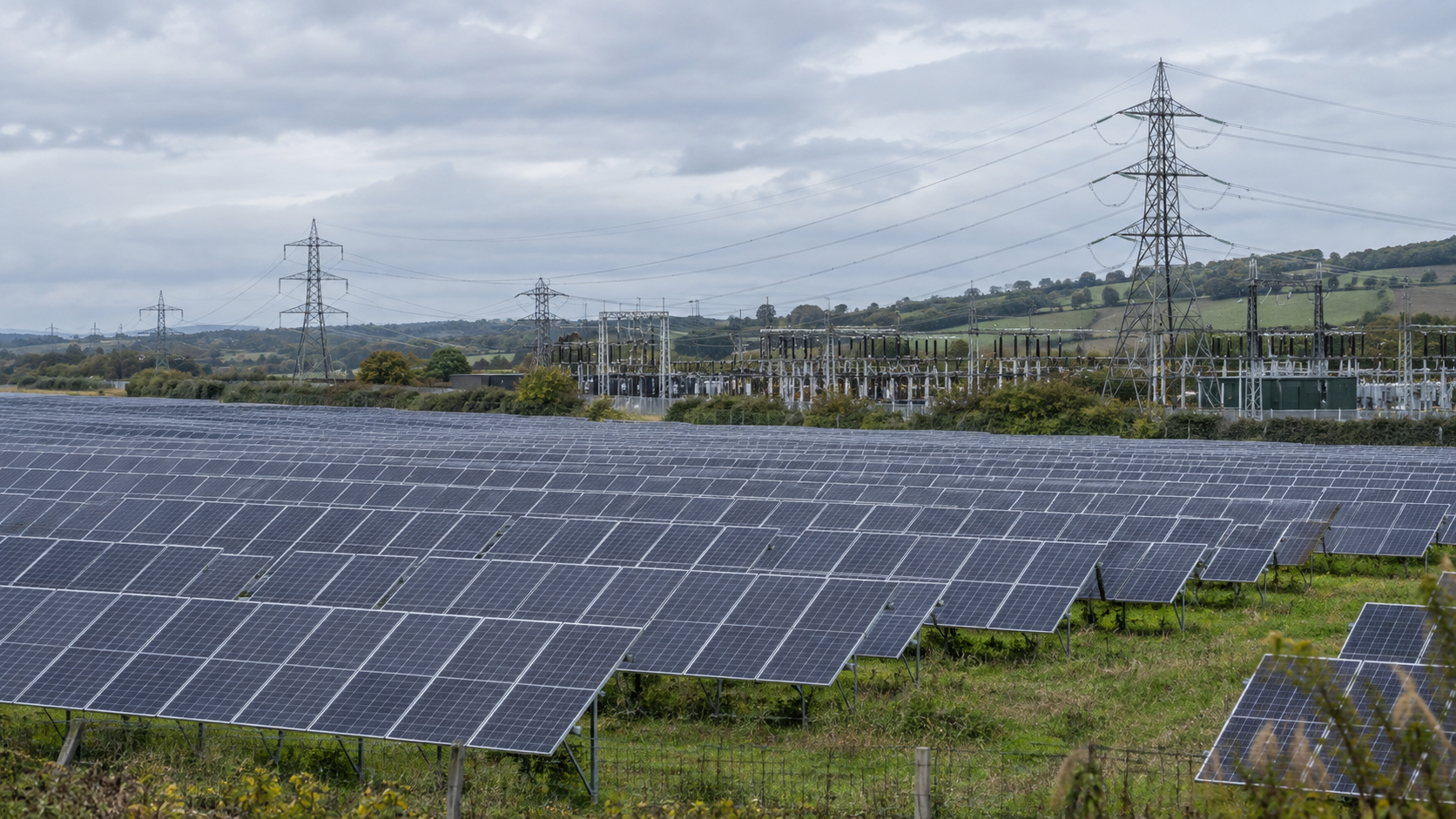
The recent story about the curtailment of the 42MWp Derril Water solar park in north Devon has rightly drawn attention. A community-funded project, backed by close to 10,000 households and small businesses, is spending its first full summer switched off — not through a fault or a lack of sun, but because the wider network around the Alverdiscott area cannot safely absorb everything it is generating. With the constraint potentially lasting into September, the co-operative has estimated the interruption could cost it in the region of £2 million in lost revenue.
For an audience that works in this sector, the causes will be familiar: a supergrid transformer taken out of service, reduced headroom, and reverse power flow raising voltage on a network originally built to move electricity in one direction. None of it reflects a failing in the solar farm, whose modules and inverters remain perfectly capable of producing power. The output simply has nowhere safe to go.
What concerns me is not how the industry reads this story — most people working in this sector will follow the mechanics immediately. The real risk is how everyone else does, and what conclusions they may draw from it.
Two systems on opposite sides of the meter
To most people working in electrical and energy engineering, the difference between Derril Water and a commercial rooftop array is self-evident. One is a grid-scale export project, built to push power onto the network and earn revenue from doing so. The other is a self-consumption system, built to reduce the power a site imports. They sit on opposite sides of the meter, and opposite sides of the problem. Export generation adds to a constrained network; behind-the-meter generation takes load off it.
What curtailed Derril Water was, in essence, too much power trying to flow up the system at a time of low local demand. A self-consumption system on a factory, warehouse or office does the reverse. Every unit it generates and uses on site is a unit not drawn from the grid, reducing import rather than adding export. The upstream constraint that stopped a Devon solar farm exporting has little bearing on whether a business elsewhere can generate and consume its own power behind its own meter.
That distinction is second nature inside the industry. It is not obvious at all to the businesses making the investment decisions.
Confidence is at risk
The organisations weighing up on-site solar and storage — the behind-the-meter commercial and industrial market — rarely split “solar” into export and self-consumption. They see a headline about a solar project switched off for a summer, a substantial revenue loss, and a co-operative left exposed to something outside its control, and they may draw a simple conclusion: solar looks too risky right now.
That conclusion is wrong, if entirely understandable. But it’s where the potential for real damage lies. A single constrained export project, tied to a specific local network condition, risks being read across an entire market that operates on completely different terms. And the threat to confidence has almost nothing to do with what physically happened in Devon. For a sector that depends on distributed generation continuing to grow, that’s important to take seriously, because confidence is far quicker to lose than it is to rebuild.
The role of education
In practice, for prospective commercial and industrial (C&I) buyers who have seen the Derril Water story and are questioning whether to press on with their own projects, the most useful thing we in the industry can do is not defend solar in the abstract but walk through what their system would actually do and what it would not. The distinction between export and self-consumption is the single clearest reframe available, because it reframes the nature of the risk they think they are taking on.
The wider lesson Derril Water offers is that of sequencing. Generation can be built in months, but the network reinforcement and voltage-management equipment needed to receive it can take years. When the first outruns the second, the gap must be absorbed somewhere — unfortunately, here by the members who funded the asset.
That’s not an argument against renewables; it’s an argument for planning generation in the context of the network it connects to and the demand it is meant to serve, rather than in isolation.
For a business investing behind the meter, that means designing generation and demand together, reading the connection terms as carefully as the returns model, and being clear about whether a business case rests on exporting power onto a network it doesn’t control, or on reducing the power it buys. For most commercial and industrial sites, the stronger case is the second, reducing exposure to the constraints of the wider system and aligning with the parts of the bill that are rising fastest. Battery storage strengthens this position further. A well-sized Battery Energy Storage System (BESS) allows a site to shift self-generated power to when it is most needed, maximise behind-the-meter consumption, and cut peak import charges, without relying on the network to absorb surplus generation. Used together, renewable generation and storage can give a C&I site a resilient, cost-effective energy position that may be largely insulated from the kind of constraint that brought Derril Water’s summer to a halt.
Derril Water is a genuinely difficult situation for the members who backed it, and the questions it raises about connection terms, outage planning and compensation deserve proper examination. But it’s a single instance, rooted in a specific set of local network conditions. It shouldn’t become shorthand for the risk of on-site generation, because that is a fundamentally different proposition.
Getting the most from distributed solar and storage over the coming decade depends on organisations understanding exactly what they are buying and what problem it is designed to solve. A business that invests in a well-designed behind-the-meter system is not taking on the risks that Derril Water has faced. It is doing something categorically different. Helping clients see that clearly, and act on it, is the most practical contribution those of us in this space can make right now.