IN Brief:
- Greece's transmission system operator has authorised projects awarded under Prysmian's June 2026 framework agreement.
- The programme connects the Dodecanese and North Aegean islands to the national electricity network.
- Prysmian expects to establish a new installation depth record for static three-core 150 kV AC cables.
Prysmian has received authorisation from Greece’s Independent Power Transmission Operator (IPTO) to proceed with seven island electricity interconnection projects worth up to €910 million, including submarine cable installations expected to reach depths exceeding 1,150 metres.
The Italian manufacturer will design, manufacture, and install more than 900 km of high-voltage alternating current (HVAC) cables connecting islands in the Dodecanese and North Aegean regions to Greece’s national electricity network. IPTO awarded the framework agreement in June 2026, with the latest authorisations allowing Prysmian to incorporate the projects into its order backlog.
Final delivery is scheduled for 2033. The offshore installation programme is expected to establish a new depth record for static three-core 150 kV AC submarine cables, extending the operating requirements of cable technology into particularly challenging sections of the Mediterranean seabed.
At depths exceeding one kilometre, the cable’s mechanical characteristics become increasingly important during installation. A cable-laying vessel must support the weight of the suspended cable between its deployment equipment and the seabed, with the resulting tensile forces influenced by water depth, cable mass, vessel movement, and the geometry of the suspended section.
Cable armour contributes to the tensile strength necessary to withstand those loads, although increasing the quantity of armour also affects the cable’s weight and bending stiffness. The cable construction must therefore accommodate the mechanical requirements of deployment while maintaining the integrity of its electrical insulation, conductors, and protective layers.
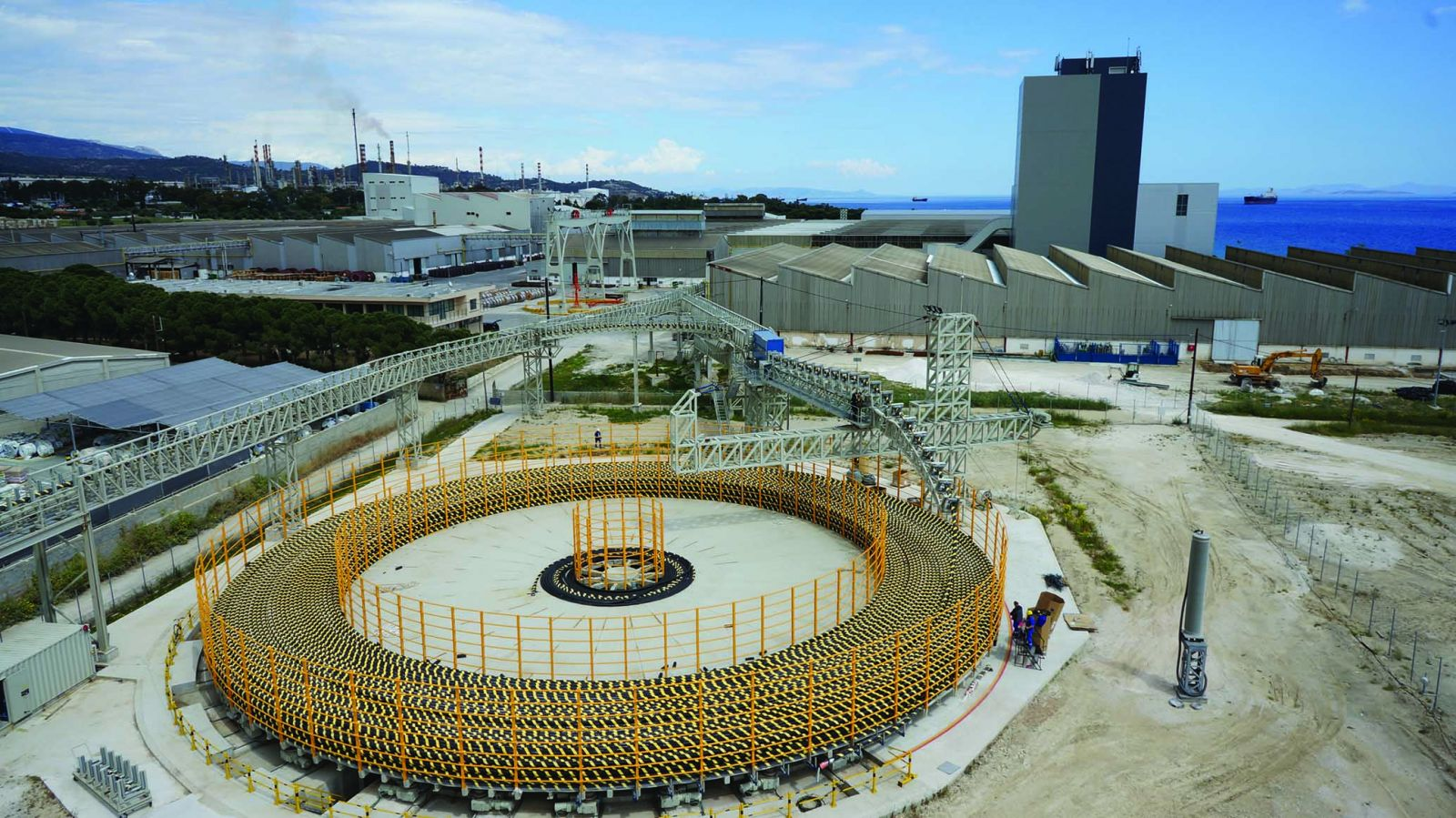
A three-core cable incorporates all three phases of an AC circuit within a common construction. Its comparatively large diameter and mass influence the capacity of installation equipment, including cable storage systems, tensioners, and machinery responsible for controlling the cable’s curvature as it leaves the vessel.
The ability to maintain tension and bending within acceptable limits is particularly important during deepwater deployment, where a substantial length of cable remains suspended before reaching the seabed. Route engineering must establish installation conditions that allow this transition to take place without subjecting the cable to excessive mechanical stress.
Prysmian’s expected installation depth represents a specific advance for static three-core 150 kV HVAC cables, rather than an absolute record across every submarine cable technology. Different cable constructions and transmission voltages impose different requirements on mechanical design and electrical performance.
IPTO’s programme will also involve terrestrial cable infrastructure connecting submarine landfalls with the relevant electricity networks. Coordination between the offshore and onshore installation schedules will determine when completed circuits can be integrated into the transmission system.
The expansion of Greek island interconnection infrastructure is intended to reduce reliance on local diesel and oil-fired generating stations, which have historically supplied geographically isolated electricity networks.
Small island systems must maintain enough local generating capacity to satisfy demand even when individual generating units are unavailable. Dependence on imported fuel adds further operational costs, particularly where consumption varies substantially between seasons.
Connections to Greece’s national electricity system will allow power to move in both directions. Electricity from mainland generation can supplement island supplies, while local photovoltaic and wind installations can export surplus production when generating output exceeds island demand.
That ability to export renewable electricity is particularly important where the size of an island’s local network would otherwise limit the capacity of new generating installations. The transfer capacity of the completed circuits and the strength of associated electricity networks will influence the amount of renewable generation that can be accommodated.
The HVAC projects form part of a wider Greek interconnection programme that also incorporates high-voltage direct current (HVDC) technology. Earlier in November, European funding was confirmed for the Dodecanese interconnector programme, including a €228.9 million grant and €1.53 billion of European Investment Bank financing.
That development concerns the wider infrastructure programme, including a planned HVDC link between Corinth and Kos. Prysmian’s latest authorisations establish a separate cable manufacturing and installation commitment covering AC connections across the island networks.
The combination of AC and DC infrastructure reflects the different electrical requirements of individual routes. Longer submarine AC circuits experience capacitive charging currents that occupy part of their current-carrying capacity, potentially requiring reactive power compensation. HVDC avoids continuous AC charging along the cable route but requires converter stations at its terminals.
IPTO must coordinate these transmission technologies with the substations and island networks they serve. Prysmian’s seven projects will also require careful sequencing of manufacturing capacity, cable deliveries, marine installation activities, and associated terrestrial works.
The June framework agreement established the contractual basis for those activities. With the projects now entering Prysmian’s backlog, detailed engineering and manufacturing commitments can progress towards the scheduled 2033 delivery deadline.