IN Brief:
- Seventeen of 23 caissons have been installed at Belgium’s Princess Elisabeth Island site.
- The island will connect future Princess Elisabeth Zone offshore wind generation to the mainland grid.
- The project points toward larger offshore transmission hubs combining civil, marine, and high-voltage engineering.
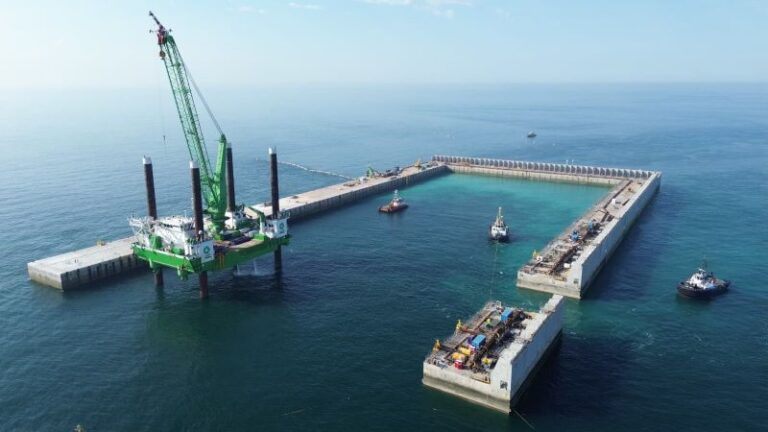
Elia Group has moved further into construction on Princess Elisabeth Island, with 17 of the 23 caissons now installed at the Belgian offshore grid site, 45km from the coast.
The artificial island is being developed as a major connection point for future offshore wind generation in Belgium’s Princess Elisabeth Zone. TM Edison, a consortium of DEME and Jan De Nul, is building the island structure, with the caissons forming the outer walls of the offshore platform. Each caisson weighs around 22,000 tonnes and measures 58 metres long, 28 metres wide, and between 23 and 32 metres high, depending on the storm-wall configuration.
Installation began in April 2025, with the first campaign completed in October 2025 before work resumed this spring. Once complete, the island will provide the physical base for high-voltage infrastructure designed to collect power from offshore wind farms and move it into the Belgian transmission system.
The Princess Elisabeth Zone comprises three sites totalling up to 3.5GW of offshore wind capacity. The first lot, planned around a 700MW offshore wind farm, was launched for tender in 2024, although Belgium’s Council of Ministers later moved the procurement opening into 2026. The island is therefore progressing ahead of the generation assets it will help integrate, reflecting the long lead times now attached to offshore grid infrastructure.
As European offshore wind moves farther from shore and increases in capacity, transmission planning is moving away from isolated radial connections and toward shared infrastructure platforms. That shift places greater emphasis on marine civils, offshore substations, HVDC and HVAC interfaces, export cable systems, protection design, and coordinated landing points. Offshore turbines remain the most visible assets, but the ability to move power efficiently to shore is increasingly shaped by the infrastructure around them.
The island model also moves more electrical infrastructure offshore. Rather than concentrating all major aggregation, conversion, and switching functions on land, future North Sea projects are expected to rely more heavily on offshore hubs, converter platforms, hybrid interconnectors, and shared transmission routes. Those systems require space, access, maintainability, and long-term operational control, all of which are difficult to provide on compact conventional platforms at very high capacities.
Germany’s North Sea converter platform work shows a similar direction of travel, with offshore wind development increasingly bound to high-voltage manufacturing, heavy electrical equipment, and port-side fabrication capacity. Turbine supply remains critical, but converter stations, transformers, switchgear, dynamic controls, and cable systems are now central to the pace at which offshore capacity becomes usable grid capacity.
Princess Elisabeth Island also reflects the practical tension around transmission-first delivery. Grid assets often need to be committed before every downstream generation milestone is fixed, yet waiting until all wind farm procurement decisions are complete can leave generation projects without a viable connection route. Offshore grid planning now requires stronger coordination between regulators, transmission operators, developers, marine contractors, and equipment manufacturers.
The engineering challenge extends well beyond the civil structure. The island must operate as part of a complete transmission chain, connecting offshore equipment to export circuits, onshore substations, protection systems, operational control centres, and market arrangements. Because a shared offshore hub concentrates large volumes of generation into a single network interface, reliability requirements will be particularly demanding.
Artificial islands are expensive and complex, but they can provide access, physical space, and future flexibility that conventional offshore platforms may struggle to match as wind zones grow. They also create the possibility of transmission assets that support interconnection between markets as well as export from individual wind farms to shore.
Construction progress on Princess Elisabeth Island shows how Europe’s offshore power system is being rebuilt around generation, transmission, interconnection, and system operation together. The North Sea is becoming less a collection of individual wind farms and more a networked electrical zone, with offshore grid infrastructure carrying an increasingly large share of the technical burden.