IN Brief:
- newcleo has installed the main vessel and turbine for its 10MWt PRECURSOR demonstration reactor.
- The non-nuclear Brasimone facility will reproduce an integrated operating environment for systems intended for future lead-cooled reactors.
- Construction is scheduled to finish by the end of 2026 before full-scale systems validation begins.
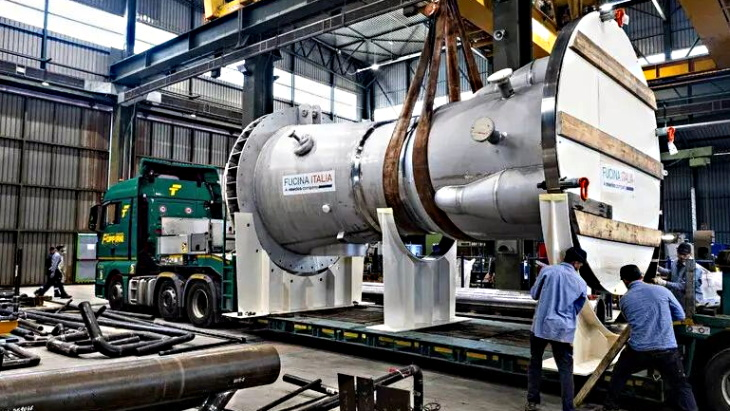
newcleo has installed the main vessel and turbine for its 10MWt PRECURSOR demonstrator at the ENEA Brasimone Research Centre in Italy, moving the facility towards completion and integrated systems testing.
PRECURSOR contains no nuclear fuel and does not produce heat through fission. It is being built to reproduce the thermal, mechanical and power-generation environment around systems intended for newcleo’s future lead-cooled reactors, allowing full-scale equipment to be operated together before equivalent components are incorporated into a licensed nuclear plant.
That allows pumps, vessels, heat-transfer equipment, turbine systems, controls and auxiliary systems to be tested as one plant instead of only as separate components. Construction is scheduled to finish by the end of 2026, after which newcleo plans to begin validation work using the assembled 10MWt installation.
Data from those tests will feed into system performance analysis, safety calculations, materials work and licensing activity around the company’s LFR-AS-200 reactor. The commercial design is a 200MWe lead-cooled fast reactor, developed alongside a fuel strategy based on mixed-oxide fuel manufacturing and the use of recycled nuclear material.
Lead coolant imposes very different operating conditions from the water used in most existing commercial reactors. The metal remains liquid at high temperatures and can support low-pressure primary systems, but it also places demanding requirements on structural materials, chemistry control and component design.
newcleo’s Brasimone research programme includes work on oxygen concentration, corrosion products, impurities and interactions between liquid lead and steels exposed to the coolant. Oxygen has to be controlled carefully because concentrations that are too low can accelerate dissolution of protective oxide layers, while excessive oxygen can create unwanted lead oxide deposits within the system.
The company is testing those behaviours through experimental loops as well as PRECURSOR. Its OTHELLO facility is already operating at Brasimone, providing another source of data on heavy liquid metal systems while the larger demonstrator moves through construction.
PRECURSOR adds the ability to assess how multiple systems behave when connected. Pumps influence coolant flow and pressure losses, heat exchangers set thermal transfer conditions, and turbine equipment converts transferred heat into mechanical and electrical output. Control systems then have to coordinate those elements as temperatures, flows and loads change.
Full-scale operation also exposes interfaces that can be difficult to reproduce through smaller laboratory rigs. Pipework, valves, instrumentation, thermal expansion and equipment response all influence plant behaviour, while start-up and shutdown sequences place different demands on systems from steady operation.
The results will not remove the need for nuclear qualification or licensing of the eventual reactor. PRECURSOR cannot reproduce irradiation effects inside a reactor core or demonstrate the nuclear safety performance of fuel under fission conditions. Its role is to validate the conventional and lead-coolant plant systems around that future nuclear core at a representative engineering scale.
Regulatory work is continuing in parallel. newcleo submitted a Regulatory Engagement Plan to the US Nuclear Regulatory Commission for the LFR-AS-200 in July, followed in August by a separate plan covering its proposed mixed-oxide fuel fabrication facility in South Carolina.
In France, the Nuclear Safety and Radiation Protection Authority has issued an overall satisfactory opinion on proposed safety features for the company’s planned MOX fuel facility, while review activity around the reactor design remains under way. The experimental programme at Brasimone is intended to generate evidence that can support those engineering and regulatory processes.
newcleo is also building manufacturing capability within its own group, including production of major demonstrator components through subsidiaries rather than relying entirely on external fabrication. The company says that approach gives it closer control over design changes, manufacturing quality and the interfaces between plant systems.
The programme has required substantial capital. newcleo reported €25.3 million of tangible capital expenditure during the first half of 2026, up 37% year on year, with spending directed towards technology development and experimental infrastructure.
A business combination with NewHold Investment Corp III completed in September brought approximately $247 million in gross proceeds and was followed by newcleo’s Nasdaq listing. Preliminary unaudited cash and cash equivalents stood at about €233 million at the end of September, after the company had raised more than $1 billion since formation.
Installation of the PRECURSOR vessel and turbine now places two of the demonstrator’s largest components on site as construction approaches its final months. The next programme stage will move from assembly into operation, allowing engineers to compare measured behaviour against the thermal-hydraulic and mechanical models being used elsewhere in the LFR-AS-200 development.
Construction remains scheduled for completion by the end of 2026, after which the 10MWt facility is due to begin full-scale systems validation at Brasimone.