IN Brief:
- H-Power’s LC100dc 100 kW DC fuel-cell generator is operating under a revenue-generating contract at a UK construction project.
- The company expects up to 10,000 kg of green hydrogen consumption and estimates more than 350 tonnes of CO2 savings against an equivalent diesel generator during the initial phase.
- The generator builds on the 30 kW LC30 platform, with applications including construction plant charging and temporary site welfare power.
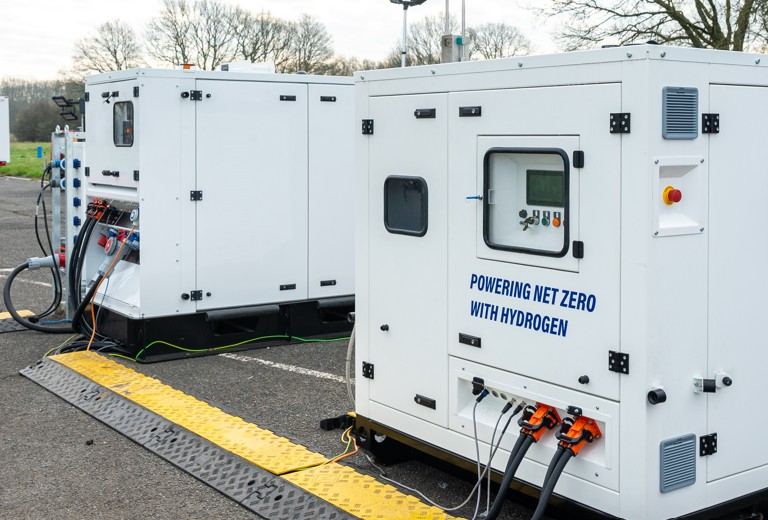
H-Power has put a 100 kW direct-current hydrogen fuel-cell generator into operation at a major UK construction project under its first revenue-generating customer contract for the new unit. The LC100dc extends the company’s temporary power equipment beyond its existing 30 kW platform, with an application intended to replace diesel generation for higher-power site loads.
The company confirmed the deployment on 16 November. During the initial phase it expects to use up to 10,000 kg of green hydrogen and estimates a saving of more than 350 tonnes of carbon dioxide compared with operating a similarly sized diesel generator. The construction project, customer, contract value and operating duration remain undisclosed, and the emissions estimate precedes reported site performance data.
Rated at 100 kW DC, the LC100dc produces direct-current electricity suitable for compatible charging or distribution equipment. Alternating-current loads require conversion and appropriate electrical protection. H-Power has not described the first site’s load architecture or specified whether an inverter, battery or other conversion equipment is installed alongside the generator.
H-Power identifies construction plant charging and larger welfare facilities as applications for this level of temporary generation. Demand can vary considerably between a charging system that draws substantial power intermittently and an accommodation block with a steadier baseline load. The installation must coordinate fuel-cell output and electrical controls with peak demand, while any connected storage or conversion equipment will determine how short load transients are accommodated.
The LC100dc has been developed from H-Power’s LC30 architecture, with shared core components and support infrastructure. According to the manufacturer, it delivers more than three times the 30 kW model’s power at less than half the equipment cost per kilowatt. The comparison concerns the manufacturer’s equipment cost per kilowatt. Fuel delivery, maintenance and utilisation will also affect the full operating cost of the construction installation.
Fuel-cell generators convert chemical energy into electricity through electrochemical reactions. When operated on hydrogen, the stack does not emit carbon dioxide from the hydrogen conversion process at the point of use. The wider emissions position depends on how hydrogen is produced, compressed, transported and supplied, which is why the company’s estimate specifies green hydrogen and compares the deployment with a diesel alternative rather than asserting the project has no lifecycle emissions.
Hydrogen consumption sets practical constraints on temporary installations. Deliveries and on-site storage have to be planned around working hours, access arrangements, safety requirements and available supply capacity. The expected total consumption of up to 10 tonnes needs to be assessed against operating hours and electrical output to establish a site-specific hydrogen requirement. Those measurements, along with the assumptions behind the emissions comparison, have yet to be published.
Temporary construction power has traditionally relied on diesel equipment because it can be transported, installed and refuelled with well-established logistics. A hydrogen unit offers a different operating system, combining fuel handling with electrical controls and stack servicing. The comparison therefore involves more than direct fuel cost: site availability, refuelling arrangements, noise limits and periods of low load can affect whether a system is practical for a particular application.
Commercial demand for H-Power’s smaller generator has been growing through Speedy Hydrogen Solutions, the joint venture with Speedy Hire. In a recent trading update, the company said utilisation had exceeded its internal target and reported a replenishment order for 15 LC30 units. H-Power also reports that users of its smaller units are achieving parity with diesel on a weekly rental-plus-fuel basis. The operating profile of the 100 kW model will determine whether similar economics can be achieved on larger sites.
The larger model provides a potential route into applications requiring more power than the LC30 can supply individually. Reusing a common product platform can reduce the number of bespoke components, simplify operator familiarity and support a more consistent maintenance approach, subject to how the larger stack, cooling system and output electronics are configured. H-Power has not disclosed the LC100dc’s detailed stack design, electrical efficiency or expected maintenance interval.
Alongside its generators, H-Power is developing an ammonia-cracking system intended to produce fuel-cell-grade hydrogen near the point of use. It previously outlined a proposed HY5 supply arrangement with Protium. The LC100dc customer installation has been disclosed separately, without identifying an ammonia-based hydrogen supply system at the construction site.
Operating the LC100dc under a revenue-generating contract gives H-Power its first commercial deployment reference for the larger generator. Running hours, hydrogen deliveries, availability and the behaviour of the site’s DC loads will provide a basis for evaluating subsequent installations. The company has so far disclosed projected consumption and savings rather than a measured operational dataset.
A further deployment would establish whether the larger LC platform can be repeated across different temporary-power applications. H-Power has named no additional LC100dc customers, leaving the initial construction project as the first commercial reference. Its operating data will be central to testing the fuel and emissions assumptions against diesel generation under comparable site conditions.