IN Brief:
- Enel X will become Threefold Energy’s exclusive Capacity Market access and optimisation provider for participating UK sites.
- The first phase covers an estimated 3.5MW of behind-the-meter battery capacity targeted to go live within 12 months.
- VPP Connect will integrate virtually with Threefold’s Optima platform, with potential participation across a portfolio exceeding 100MW.
Enel X has signed a five-year agreement to provide Capacity Market access and optimisation for Threefold Energy’s growing portfolio of commercial behind-the-meter batteries in the UK. The first phase is built around an estimated 3.5MW of capacity that the companies aim to bring live within 12 months.
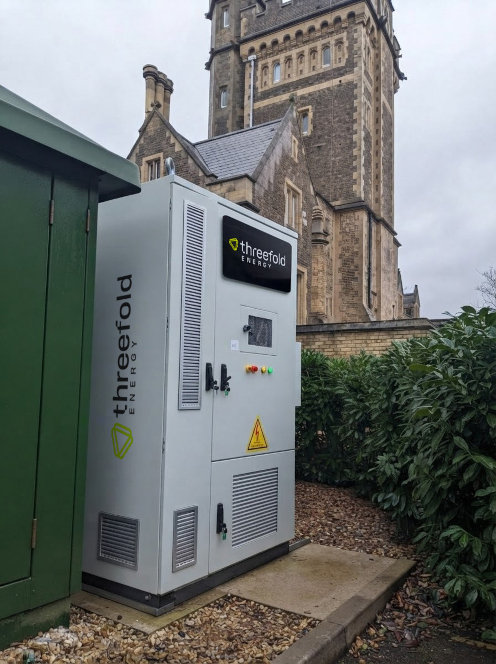
Enel X will act as the exclusive Capacity Market access and optimisation provider for sites covered by the agreement, while Threefold retains its Optima control platform at customer premises. Enel X’s VPP Connect system will integrate virtually with those batteries, avoiding the need for additional hardware at participating sites.
The distinction between site control and market optimisation is important because behind-the-meter batteries operate first around the customer’s own electrical demand. A commercial battery may be reducing peak import, shifting consumption away from expensive periods or preserving capacity for site requirements before any flexibility is offered externally.
Threefold’s Optima platform controls when electricity is drawn, stored and used. By shifting grid import away from expensive periods, a business can alter its electrical load profile without moving the underlying industrial or commercial activity that creates the demand.
VPP Connect adds the external market layer. Eligible batteries can be aggregated into a larger virtual resource and enrolled into grid and energy-market services, allowing capacity distributed across many customer sites to be presented in a form that electricity markets can use.
The first 3.5MW is comparatively small beside utility-scale storage projects, but aggregation changes the relevant unit. A fleet of batteries measured in tens or hundreds of kilowatts at individual premises can provide meaningful system capacity when control, telemetry and availability are coordinated across enough sites.
The companies identify potential to scale participation to 100MW or more as Threefold’s fleet expands. Enel X explicitly describes that figure, and the capacity and term figures in the announcement, as estimates or ambitions rather than commitments, so the immediate contracted development remains the initial portfolio rather than a guaranteed 100MW deployment.
Distributed storage behaves differently from one 100MW battery connected at a single grid point. Each system sits behind an individual customer meter and within a different part of the distribution network, so the flexibility available at any moment depends on the host site’s demand, connection capacity, battery rating and operating priorities.
An aggregator therefore needs a continually updated view of what each asset can provide. Battery state of charge, maximum charge and discharge power, site load, customer requirements, communications status and commitments already made to other services all affect the capacity available for dispatch.
That becomes particularly important where several revenue streams are combined. A battery may reduce a customer’s electricity costs, participate in wholesale optimisation and provide Capacity Market availability, but those services cannot all assume unrestricted access to the same stored energy at the same time.
The commercial task is to allocate the battery between those uses without compromising the original customer case for installing it. If a market dispatch increases the site’s electricity bill or leaves insufficient energy for a contracted customer requirement, the additional grid-service revenue can be offset by losses elsewhere.
Behind-the-meter aggregation also places substantial emphasis on communications. Reliable telemetry, remote controls, metering and cyber-secure interfaces are required if many small assets are expected to behave as one virtual power plant. A failed communications link at one site may be insignificant, but repeated outages across a fleet can reduce the aggregate capacity available to the market.
The Capacity Market introduces a further performance requirement because contracted capacity must be available during system stress events. Aggregated batteries need enough eligible capacity across the fleet to satisfy that obligation even when some customer sites or individual systems are unavailable.
Enel X already participates extensively in UK demand-side flexibility. The company recently secured 480MW of derated demand-side response capacity in the latest T-4 Capacity Market auction, giving the Threefold agreement an established route into a market where distributed loads and batteries are increasingly being aggregated alongside conventional generation.
The five-year partnership gives the companies time to test whether the model can move from a few megawatts to a substantially larger commercial fleet. The engineering challenge is not simply installing more batteries; it is maintaining enough visibility and control across geographically dispersed customer sites for the aggregate capacity to remain predictable while each battery continues serving the business behind its meter.