
IN Brief:
- HOPS has approved the technical power-supply plan for Pantheon AI’s proposed 1GW campus at Topusko.
- The programme includes 280km of transmission lines, a 400kV substation, 500MW of solar, and a 2GW/8GWh battery.
- Construction is targeted for early 2027, with the transmission assets intended to pass into Croatian state ownership.
Pantheon Atlas has secured approval from Croatian transmission system operator HOPS for the technical power-supply plan serving its proposed Pantheon AI data-centre campus at Topusko.
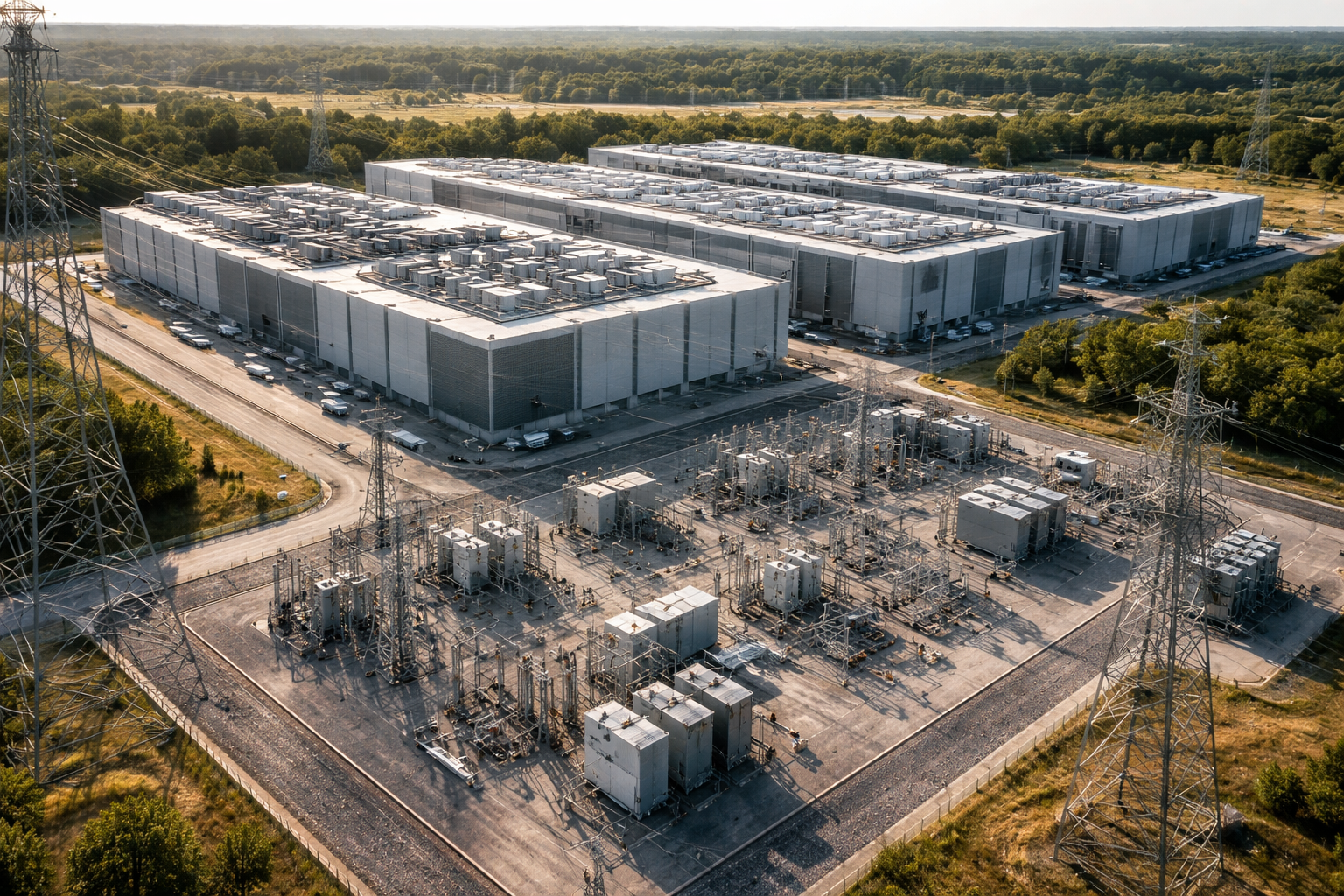
Designed around 1GW of total campus capacity and approximately 800MW of usable information-technology load, the development would sit around 70km south of Zagreb and connect directly to Croatia’s high-voltage transmission system. Its location also places it within reach of cross-border electricity routes serving neighbouring European markets.
More than €500 million of supporting power infrastructure is planned, including approximately 280km of transmission lines, a purpose-built 400kV substation, fibre-optic links, access roads, and associated civil and electrical works. Four independent 400kV connections are intended to provide the redundancy required by a hyperscale computing facility operating continuously.
Once completed, the new transmission assets are expected to pass into Croatian state ownership. Alongside the campus connection, the works are intended to create network headroom for more than 5GW of renewable generation that cannot currently progress because of transmission constraints.
Pantheon AI also incorporates 500MW of onsite solar generation and a battery energy storage system rated at 2,000MW and 8,000MWh. Greenvolt has signed a letter of intent covering development of the solar and storage facilities, while Croatian engineering companies are involved in the substation and transmission design.
Končar is supporting the substation programme, Dalekovod Projekt is leading transmission design, and Ravel is working on the substation itself. Construction is scheduled to begin in early 2027, with full campus operation targeted for the first quarter of 2029.
The initial development is valued at approximately €12 billion, although total investment could exceed €50 billion as computing equipment and supporting infrastructure are installed over successive phases.
A new class of grid connection
With a demand envelope comparable to the output of a large generating station, a 1GW data-centre campus cannot be treated as a conventional commercial connection. The site will require high availability, controlled power quality, substantial redundancy, and coordinated operation across incoming supplies, transformers, switchgear, protection, standby systems, and digital controls.
Four separate 400kV circuits should give HOPS and the campus operator greater flexibility during faults and planned outages, although the arrangement also expands the protection and control challenge. Fault-level studies, reactive-power management, harmonic assessment, dynamic modelling, metering, operational telecommunications, and cyber-secure control interfaces will have to function as one integrated system.
The 8GWh battery will become a major power-system asset in its own right. Its four-hour rating at maximum output could support peak management, renewable balancing, backup provision, and external grid services, although the usable operating range will depend on connection rights, charging limits, reserve obligations, degradation assumptions, and the control hierarchy applied between campus resilience and market dispatch.
At smaller sites, battery systems are already reducing data-centre peak imports by shifting demand away from constrained or expensive periods. Pantheon AI applies the same principle at transmission scale, combining a very large load with generation, storage, and purpose-built high-voltage infrastructure from the outset.
Although 500MW of solar will reduce net imports during suitable daytime conditions, it cannot continuously supply an 800MW information-technology load. The final operating profile will reflect solar availability, battery state of charge, grid conditions, computing demand, cooling loads, power-conversion losses, and any additional contracted generation.
Equipment procurement will shape the programme long before construction reaches site. Large transformers, 400kV switchgear, shunt compensation equipment, protection systems, conductors, and line components are being ordered into a European market already serving grid reinforcement, offshore wind, interconnectors, and industrial electrification.
Long manufacturing lead times will require early technical decisions without restricting the ability to accommodate later changes in computing demand or campus layout. Standardised substation arrangements, reserved production slots, defined interface specifications, and coordinated factory testing should therefore sit near the front of the delivery programme.
The transmission works must also remain aligned with the staged arrival of data halls, solar capacity, and storage. Infrastructure completed too late would constrain campus commissioning, while assets energised well ahead of confirmed demand could remain underused and increase carrying costs.
Because the new lines are expected to release wider renewable capacity, network benefits will depend on more than the energisation of the campus connection. Renewable developers will still require substations, protection studies, land rights, planning approvals, and downstream connection agreements before the additional headroom becomes operational generation.
HOPS approval moves Pantheon AI from an investment proposal towards a defined transmission programme, but the connection agreement, technical limits, ownership boundaries, and construction sequence will determine how effectively the campus, battery, solar array, and national network operate together.
Further project information is available from Pantheon AI.

