IN Brief:
- Ceres has granted an unnamed European energy technology company a non-exclusive licence to manufacture its Endura solid oxide fuel cell platform for the EMEA market.
- The partner intends to establish a dedicated production facility targeting approximately 200 MW of capacity; construction and commercial output have not been confirmed.
- The arrangement combines technology transfer and engineering services with future royalties, targeting distributed power for data centres, utilities and industry.
Ceres Power has signed a manufacturing licence for its Endura solid oxide fuel cell technology with an unnamed European energy technology company, establishing another route for producing distributed generation equipment in the EMEA region. The non-exclusive agreement was confirmed on 16 November and includes technology transfer, engineering support and the prospect of royalties once licensed products enter commercial production.
The licensee intends to establish a dedicated production facility with capacity targeted at approximately 200 MW. Ceres is withholding the company’s identity at its request and has yet to specify the factory’s location, investment or timetable. The capacity figure refers to planned manufacturing output, with commercial production dependent on the partner establishing and validating the facility.
The licence covers the Ceres Endura platform for the Europe, Middle East and Africa market, with a contractual option to extend the licence globally if exercised by 2035. The non-exclusive licence permits Ceres to work with other manufacturers across the territory, while the new partner can extend its own rights globally under the contractual option. Ceres continues to pursue licensing as its route to expanding production without constructing and operating every manufacturing plant itself.
Under that model, the technology developer supplies the cell and stack design, manufacturing knowledge and associated engineering support, while its partners establish production and package equipment for customers. The new agreement provides for upfront licence fees followed by recurring royalty payments when commercial manufacturing begins. The amount of the individual licence fee was not disclosed, and the royalty stream remains contingent on subsequent output.
Initial licence fees are expected to be recognised in Ceres’ 2026 financial year. The company anticipates approximately £60 million of contracted revenue across its business for the year; it has not disclosed the fee attached to this agreement. Royalties will depend on the licensee starting commercial manufacture, leaving the revenue profile linked to factory development and future product output.
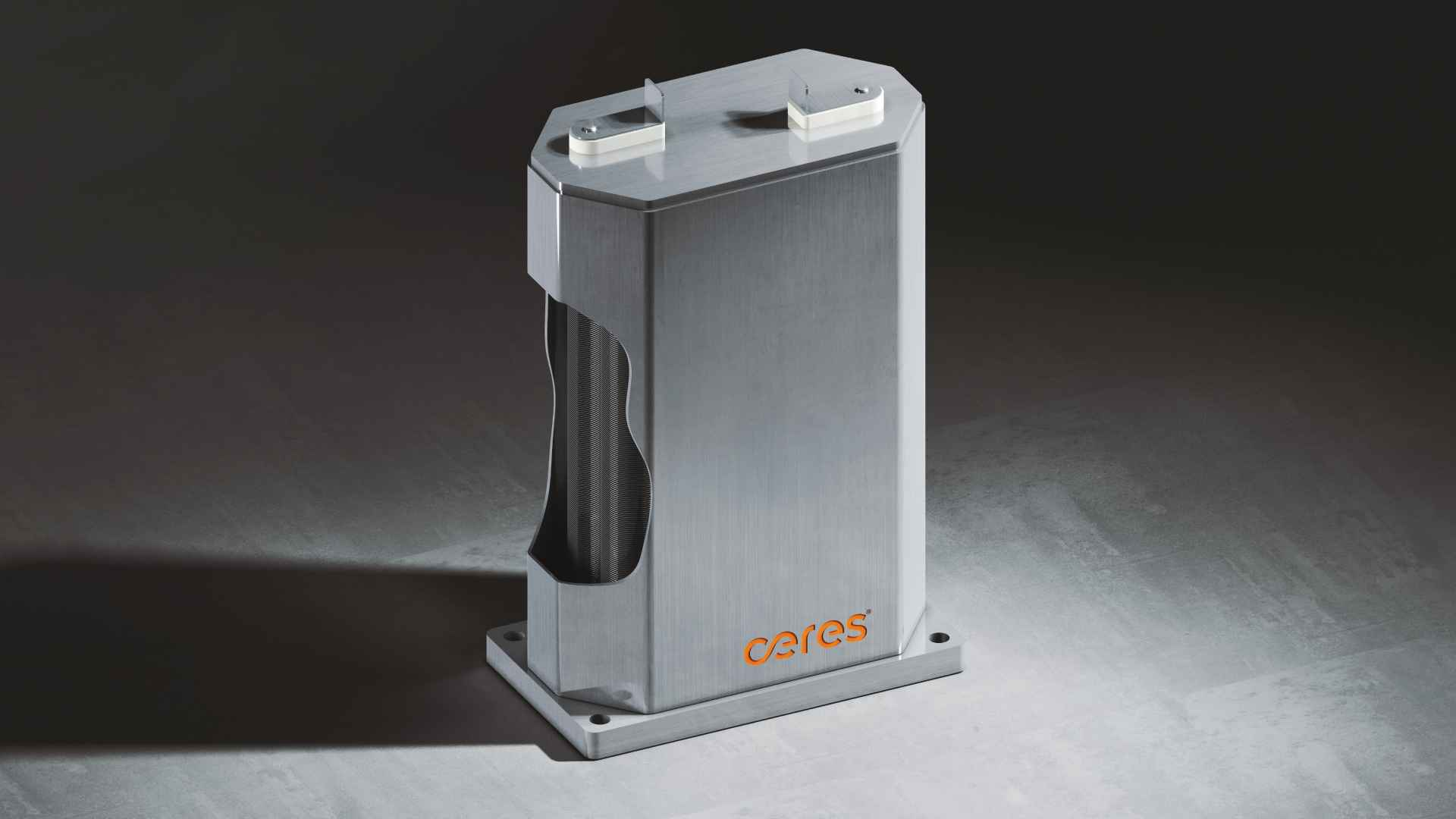
Endura is a steel-supported solid oxide fuel cell platform, launched by Ceres earlier in 2026. Each electrochemical cell is incorporated into a stack, and stacks can then be assembled with fuel processing, thermal management, electrical conversion and control equipment into a complete power system. Unlike combustion-based generation, the fuel cell produces electrical power through electrochemical reactions, although the environmental effect still depends on the fuel used and its upstream emissions.
Ceres describes an operating temperature range of approximately 450–630°C for its steel-supported technology. The steel-supported design is intended to operate at lower temperatures than some conventional ceramic-based SOFC architectures, with implications for materials selection and thermal cycling. Fuel delivery, heat recovery, start-up behaviour and changes in electrical load still require controlled operation across the balance of plant.
The platform is designed for operation on natural gas and potentially other reformed fuels, with the fuel processing equipment determining how hydrogen-rich gases are supplied to the cell. Ceres quotes electrical efficiency exceeding 65% for natural-gas operation and identifies opportunities to recover heat for combined heat and power applications. The efficiency figure is Ceres’ stated platform performance, and actual system performance will depend on the completed installation and its auxiliary equipment.
Distributed generation is attracting attention from data-centre developers whose projects require large, dependable electricity supplies and may face long grid connection schedules. Modular fuel cell equipment could serve on-site loads or form part of an electricity supply arrangement alongside the grid. Its usefulness depends on installed cost, fuel availability, maintenance, electrical integration and the site’s operating requirements, particularly where demand changes rapidly.
Electrical design also extends beyond stacking enough cells to achieve a nameplate power figure. A data-centre installation needs equipment that can supply the required voltage and current, coordinate with protection systems, manage changes in load and integrate with standby or uninterruptible power arrangements where specified. Ceres positions Endura for high-voltage DC applications, while customers will still need to specify the balance of plant and site electrical interface. No named data-centre customer or associated power installation forms part of the disclosed licensing agreement.
Scaling manufacturing to the proposed level will require consistent cell and stack production, quality assurance of electrochemical layers, thermal-cycle testing and integration of associated equipment. Production yields, annual throughput and component supply will shape the rate at which the partner can deliver finished systems. Capital expenditure and the ramp-up schedule have yet to be disclosed.
Ceres has been building a broader manufacturing partner network rather than relying on one production geography. The company previously detailed technology partnerships in Asia and work on Endura stack deployment, while the latest agreement extends its licensed manufacturing presence into Europe. Manufacturing proximity can affect transport, service and lead times for large modular power packages, although no such benefits can yet be quantified for this undisclosed site.
The next milestones will be the licensee’s factory investment, manufacturing validation and first commercial orders. Ceres has established the contractual route for transferring Endura production into Europe, with royalty income following licensed output once manufacturing starts. The location and delivery programme for the planned 200 MW facility remain to be announced.