IN Brief:
- SSEN Transmission says it has completed the UK's first drone installation of dynamic line-rating sensors onto an energised transmission conductor.
- Approximately 32 sensors are planned across two circuits at Kintore, allowing real-time conditions to inform safe line-loading limits.
- Live-line installation avoids a planned circuit outage for the mounting operation, while wider deployment remains dependent on suitable network locations and operating controls.
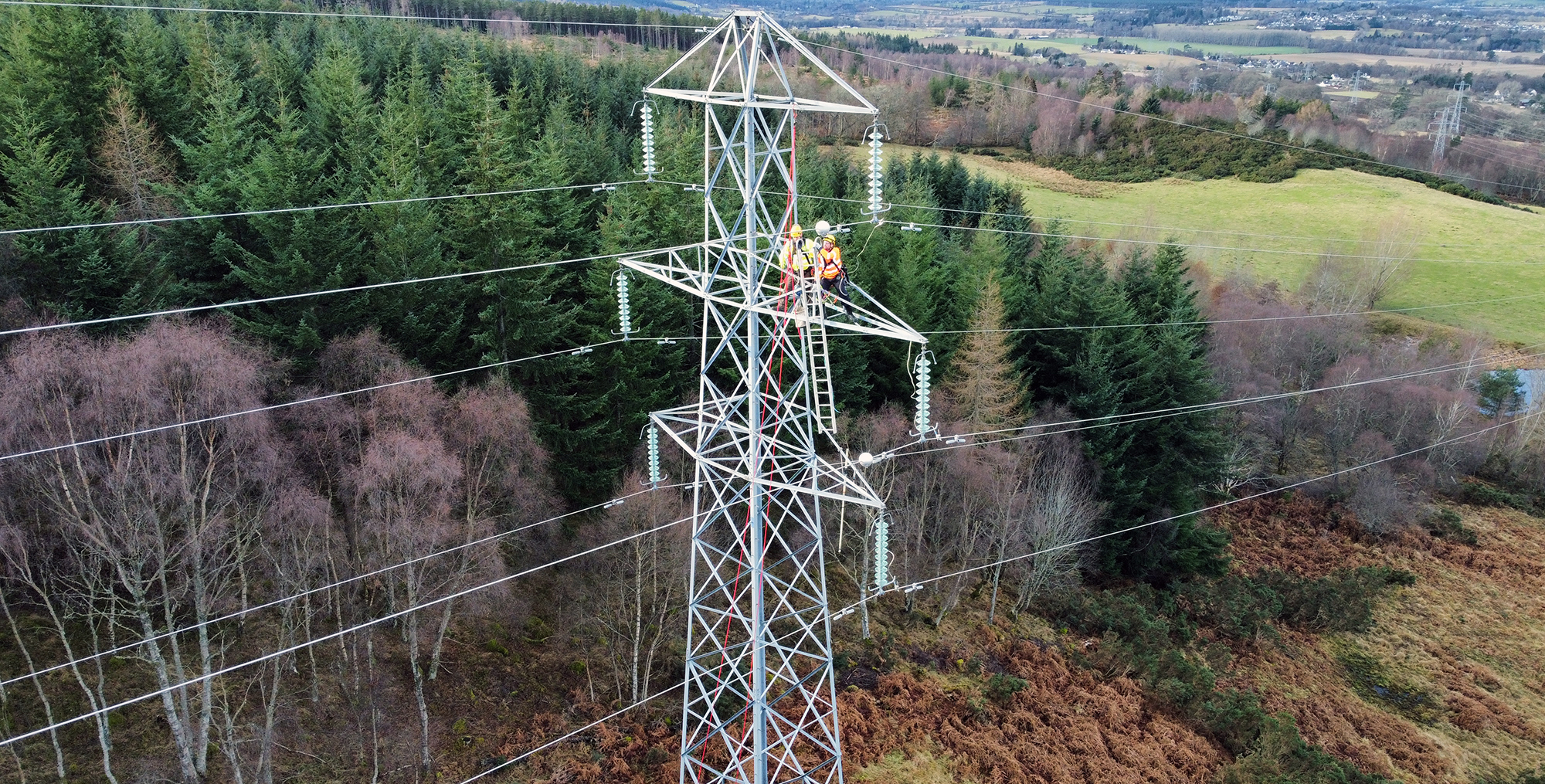
SSEN Transmission has used a drone to attach a dynamic line rating sensor to an energised overhead conductor at Kintore in Aberdeenshire, completing what it describes as the first UK installation of this type without taking the circuit out of service. The trial gives the network operator another method of fitting monitoring equipment while electricity continues to flow through heavily used transmission infrastructure.
During installation, a drone carries the specialist sensor up to the conductor, positions it and remotely clamps it into place before returning to the ground. Conventional fitting methods may require physical access to the line and a scheduled circuit outage, depending on the equipment and site. Retaining the electrical connection during installation removes that particular outage requirement while placing greater emphasis on the approved live-line method, separation distances, weather conditions and control of the aircraft near high-voltage assets.
The first operation forms part of a wider installation planned for Kintore. SSEN Transmission expects to deploy approximately 32 sensors across two circuits, with around 16 on each; the initial successful attachment is the confirmed milestone. The utility has not published a completed sensor count or a Kintore-specific increase in permissible line loading. Equipment installation must be followed by data integration and the operational acceptance of the resulting ratings.
Dynamic line rating uses observed conditions to estimate the safe current-carrying capacity of an overhead circuit. A fixed seasonal rating relies on standard assumptions about conductor temperature and the surrounding weather. When real conditions provide better cooling than those assumptions, the conductor may be able to carry additional current while remaining within its thermal and mechanical operating limits.
The calculation depends particularly on wind speed and direction, ambient temperature and solar radiation. Electrical current heats the conductor resistively; wind and surrounding air remove heat. As conductor temperature changes, so does its sag, which must remain within the permitted clearance envelope above ground and nearby structures. Measurements from the line and surrounding conditions are processed into a rating that can be used in operational decisions, subject to the rest of the network’s restrictions.
Those ratings change with the weather. A period of strong convective cooling can raise the safe current limit above a conservative seasonal assumption, while warmer or calmer conditions can reduce it. Dynamic monitoring therefore improves the information available to the operator rather than changing the physical conductor or guaranteeing additional capacity at every hour. Protection settings, transformers and downstream lines can also constrain how much extra power is transferred.
Scottish transmission circuits are increasingly used to carry renewable electricity towards major demand centres. When a transfer route reaches an operating limit, renewable generators may be instructed to reduce output while replacement energy is obtained elsewhere. Better measurement of the limiting conductor can reduce the occasions on which thermal headroom is underestimated. Voltage stability, other network assets and maintenance outages will still determine the extent of any resulting reduction in constraints.
SSEN Transmission reports that its wider interventions reduced network constraint costs by almost £300 million for electricity consumers in 2025/26. That total covers a range of operational measures and is separate from the new drone-mounted installation at Kintore. Major reinforcement remains necessary to accommodate sustained growth in transfers, with dynamic line rating providing a way to make better use of existing circuits while construction programmes progress.
The utility has already introduced dynamic line rating elsewhere in northern Scotland. In September it brought monitoring into operation on more than 300 kilometres of overhead transmission line between Beauly and Dounreay, describing that route as its first DLR-enabled circuit in the north of Scotland. Kintore extends the deployment programme through a different installation method, rather than introducing the measurement technology to the network for the first time.
Once the remaining Kintore sensors are fitted, their data will need to be validated and incorporated into operational line ratings. Control rooms must be able to distinguish reliable measurements from missing or anomalous information, and the resulting limits must be coordinated with the National Energy System Operator and other equipment ratings. The method of collecting data and the decision to authorise greater power flow are separate stages of the network process.
Niall McDonald, SSEN Transmission project director, said: “Using a drone to install these sensors while the transmission line remains live means we can deploy Dynamic Line Rating technology without taking that circuit out of service for the installation.” The operator expects the technique to make deployment more flexible at suitable locations, where the installation can be carried out safely without booking an outage.
Ofgem chief engineer Martin Queen attended the demonstration and highlighted the difficulty of obtaining outages on a constrained network. SSEN Transmission has not announced a completion date for the full 32-sensor installation or quantified the resulting change in capacity at Kintore. The next engineering milestones are fitting the remaining units, accepting their data into network controls and establishing how frequently those measurements change operating limits in practice.