IN Brief:
- Smulders has won the jacket fabrication subcontract for LanWin beta, part of TenneT’s 2 GW LanWin2 offshore grid connection.
- Steel fabrication is planned in Belgium and Poland, followed by assembly and load-out in the Netherlands.
- Work is expected to begin in early 2027, with foundation load-out targeted for 2030.
Eiffage has secured a contract to fabricate the offshore steel foundation for LanWin beta, the converter platform being developed as part of Germany’s 2 GW LanWin2 electricity transmission connection. The work will be carried out by its Belgian subsidiary Smulders under a subcontract from Dragados Offshore, adding a major structural fabrication package to the North Sea grid programme.
Smulders’ subcontract covers the jacket foundation, with fabrication distributed between plants in Belgium and Poland before final assembly and load-out in the Netherlands. Work is scheduled to start in early 2027, and the completed structure is due to be loaded out in 2030. Dragados Offshore is the direct customer; Eiffage has not disclosed the value of the package.
LanWin beta is the offshore converter platform within TenneT’s LanWin2 high-voltage direct current (HVDC) connection in the German North Sea. The planned transmission rating is 2 GW, compared with approximately 900 MW for an earlier generation of individual offshore links. Handling that volume of wind generation requires larger conversion equipment and supporting infrastructure, even though the jacket itself performs a structural rather than electrical function.
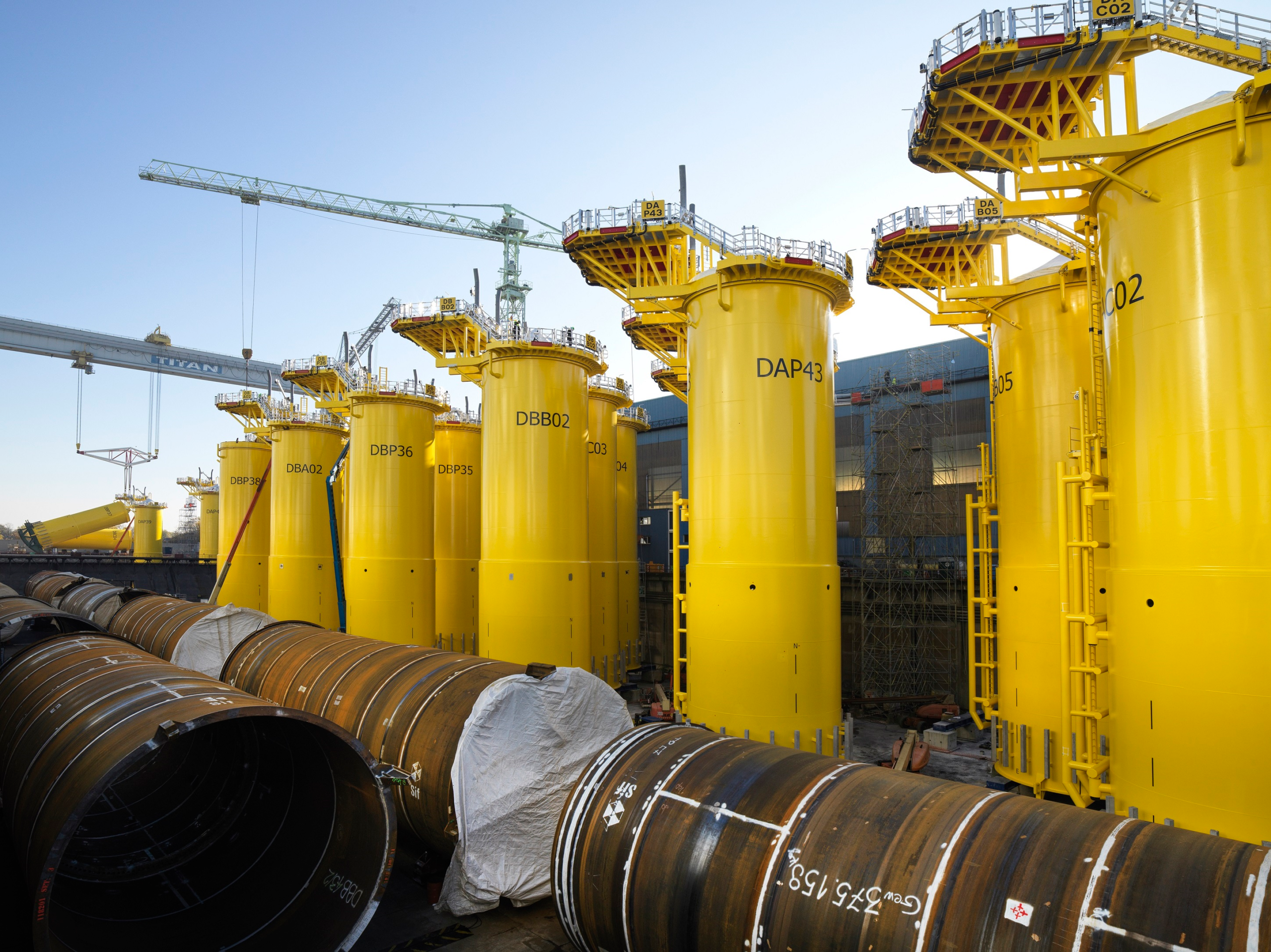
The jacket is the steel support structure beneath the converter topside, carrying the weight of electrical plant while transferring its loads through the offshore foundation. Fabrication depends on dimensional tolerances, welding quality, corrosion protection and the interfaces needed to fit the topside after marine installation. Those interfaces must be coordinated with the separately procured conversion systems, cable terminations and offshore installation programme.
Offshore wind farms generate alternating current, which is collected through the offshore electrical network before being converted for long-distance transmission to the mainland. HVDC systems use converter stations at the offshore and onshore ends to move large quantities of electricity over long cable routes, with the landward equipment converting the power back into alternating current for the transmission grid. For LanWin2, the converter platform is one part of a wider connection that also includes export cables and onshore infrastructure.
Nexans began production of 525 kV HVDC export cables for LanWin2 in October, following an earlier award covering the cable system. That cable manufacturing milestone and Smulders’ foundation contract advance different parts of the same connection. Cable production, platform fabrication, offshore transport and electrical commissioning have to converge before the system can move electricity into the onshore grid.
Dragados Offshore is responsible for the broader platform package alongside Siemens Energy, whose role includes converter technology. The jacket provides the offshore support for that equipment, while the platform topside houses the converter valves, transformers, cooling, controls and auxiliary systems. Each contract has its own manufacture and acceptance processes, but the installed equipment must operate as an integrated transmission station.
Production across several countries allows Smulders to allocate steelwork among its European facilities before bringing the sections together for final assembly in the Netherlands. The completed foundation must then be moved to a suitable port and loaded onto marine transport or an installation vessel. Handling dimensions, lifting points and transport restraints influence fabrication choices well before the structure reaches the North Sea.
The 2030 load-out target concerns the foundation package. A completed jacket still has to be transported, installed and integrated with the converter topside and cables, while commissioning depends on the readiness of both offshore and landward electrical works. Different published programme references give different LanWin2 connection years; Eiffage’s latest disclosure establishes a clear structural delivery target rather than a definitive energisation date.
TenneT’s move from 900 MW offshore links towards 2 GW systems changes the scale of the associated equipment. Greater transfer capacity can consolidate generation from multiple wind farm areas onto a high-capacity export route, but it also concentrates engineering and construction requirements in fewer, larger platforms. Structural design must accommodate the resulting topside weight and environmental loads without compromising access for installation and future maintenance.
Electrical transfer capacity will ultimately be determined by the converter stations, export cables, controls and onshore network interfaces rather than the foundation alone. Offshore wind turbines supply alternating current through collection networks; the converter transfers that power to DC for the long export route, before it is converted back to AC onshore. Losses, thermal ratings, protection arrangements and system availability all affect the power that can be transferred in service.
The new contract adds a converter platform foundation to Smulders’ offshore construction portfolio, where its production facilities already handle large steel structures for marine energy projects. A converter platform requires close alignment between the structural fabrication and high-voltage equipment schedules, including the interfaces used to support, secure and access the topside once it is installed offshore.
The first observable delivery step will be the start of steel fabrication in early 2027, followed by cross-border assembly and the planned 2030 load-out. The work is a substantial part of the offshore connection’s construction sequence, with final electrical completion dependent on the wider LanWin2 programme.