IN Brief:
- Navaris has ordered four N163/6.X and two N175/6.X turbines for the 42MW Lambacher Höh wind farm.
- Nordex will install the machines on 164 metre and 179 metre hybrid towers and provide 20 years of premium service.
- Installation is due to begin in January 2028, with full commissioning scheduled for July.
Nordex Group has secured a 42MW order from Navaris for the Lambacher Höh wind farm in Rhineland-Palatinate, Germany, combining two turbine types from the Delta4000 platform within a six-machine project.
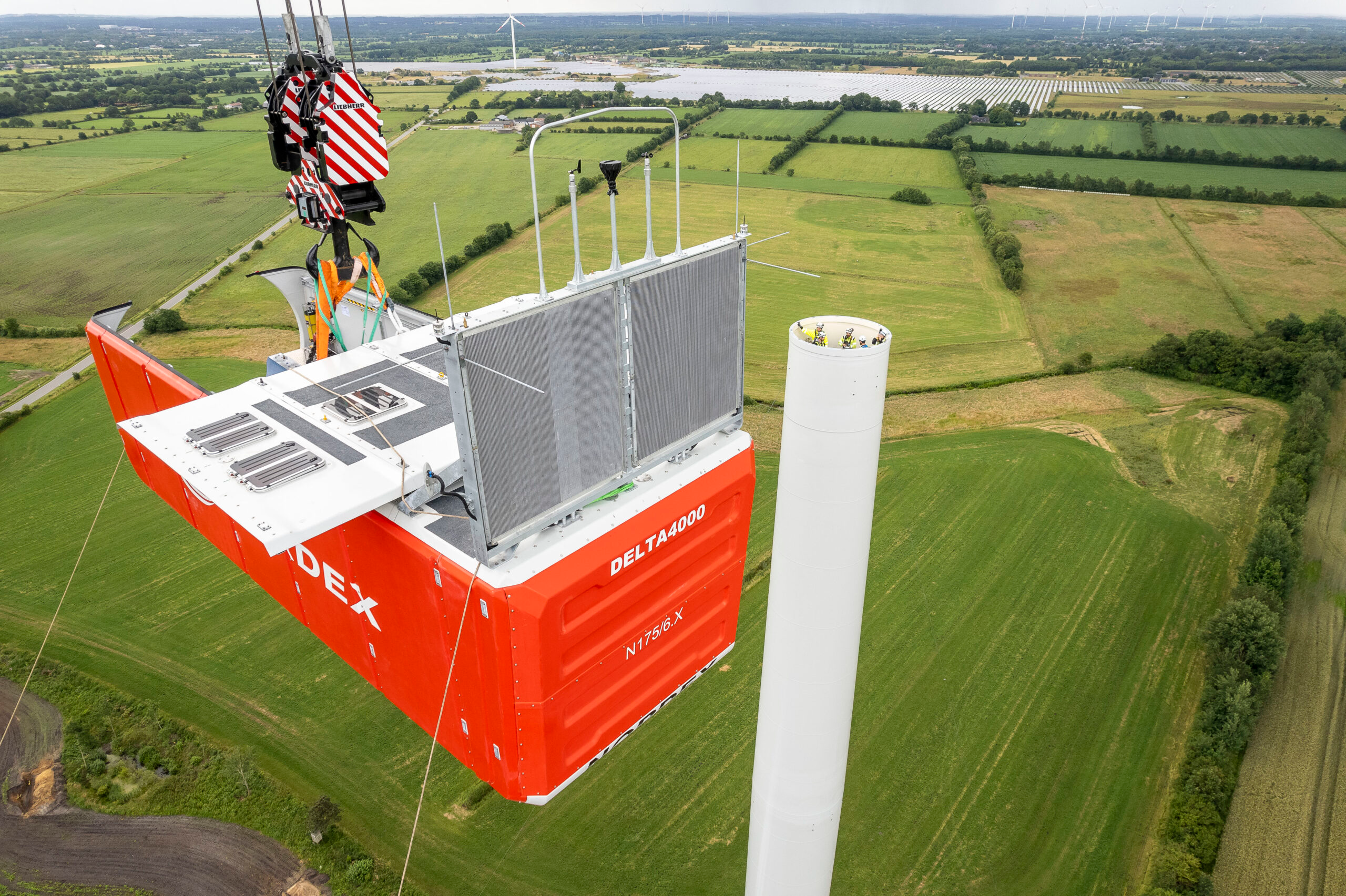
The contract covers four N163/6.X turbines and two N175/6.X machines, together with installation and a 20-year Premium Service agreement. The wind farm will be built south-west of Bitburg, close to the Luxembourg border, with the first turbine scheduled for installation in January 2028 and full commissioning planned for July that year.
Nordex will use different hybrid tower heights across the site. The N163/6.X machines will have hub heights of 164 metres, while the N175/6.X turbines will be installed at 179 metres. The mixed configuration gives the project team scope to match rotor size and hub height to individual turbine positions rather than apply one specification across the entire site.
The order is the fourth German collaboration between Nordex and the developer now operating as Navaris. Navaris is the German renewable energy platform of Qualitas Energy and adopted the name in September 2026. Nordex had already received a 56MW order from the same group in March for another German project in Hesse.
The N163/6.X and N175/6.X occupy different positions within Nordex’s current onshore range. The N163 has become a widely ordered platform in Germany, while the N175 uses a larger 175 metre rotor for lower and medium wind sites. At Lambacher Höh, the larger machine is paired with the taller 179 metre hub height, increasing the swept area and placing the rotor higher above local terrain.
Those gains come with corresponding civil and logistics requirements. Taller towers increase foundation, lifting, transport, and erection demands, while larger rotors affect site access and crane planning. Turbine selection therefore has to balance projected energy yield against permitting conditions, acoustic limits, transport routes, ground conditions, and the practical sequence of construction.
Lambacher Höh arrives during a sustained run of German orders for Nordex. During the first two months of the second quarter, the company secured around 255MW across 14 German projects comprising 39 turbines. Those orders included N149, N163, and N175 machines, with service and maintenance agreements attached to all of them.
More recently, Nordex secured a separate 91MW order for thirteen N163/6.X turbines in Brandenburg. That project also carries a 20-year service agreement and is scheduled to begin commissioning in 2028. Lambacher Höh is materially smaller, but its mixed turbine configuration and separate developer make it a distinct project rather than a repeat of the earlier order.
The service term also extends the commercial relationship well beyond erection. Long-term turbine availability depends on planned maintenance, component replacement, remote monitoring, spare parts, field service, and fault response. A 20-year service agreement therefore ties the supplier to operating performance across a large part of the project’s expected life.
Nordex is continuing to expand the same product platform. On 22 September it introduced the N193/7.X, a 193 metre rotor turbine designed for medium and low wind locations. For Germany, the model is initially planned with a maximum capacity of 6.6MW, while other configurations reach 7.3MW. The N163 and N175 remain active parts of the order pipeline as the newer machine enters the portfolio.
The progression towards larger rotors does not make earlier platforms obsolete immediately. Projects already in development are tied to site studies, permits, grid applications, logistics assessments, commercial assumptions, and supply agreements developed over several years. A newer turbine can therefore sit alongside continuing demand for established machines whose project design and approval path is further advanced.
The electrical balance of plant will have to follow the same site-specific approach. Medium voltage collector circuits, transformer interfaces, protection settings, communications, earthing, and the grid connection all have to accommodate six machines with two turbine configurations while still presenting the wind farm as one controllable generating asset to the network operator.
For Lambacher Höh, the relevant programme is already defined: six turbines, two machine types, hybrid towers, and a six-month installation and commissioning window beginning in January 2028. That timetable will require foundations, internal electrical works, grid connection, transport, turbine erection, testing, and service mobilisation to converge around a relatively small number of machines.
Full commissioning is scheduled for July 2028. Before then, the project has to translate a turbine order into a completed generating asset, with the mixed N163 and N175 configuration adding engineering flexibility at the design stage and additional coordination during delivery.