IN Brief:
- Akaysha Energy’s Waratah Super Battery has entered final commercial operation at 850MW/1,680MWh.
- The battery operates with Transgrid’s System Integrity Protection Scheme to provide rapid support following transmission disturbances.
- Hitachi Energy supplied 288 power conversion systems and two plant controllers for the battery’s grid interface.
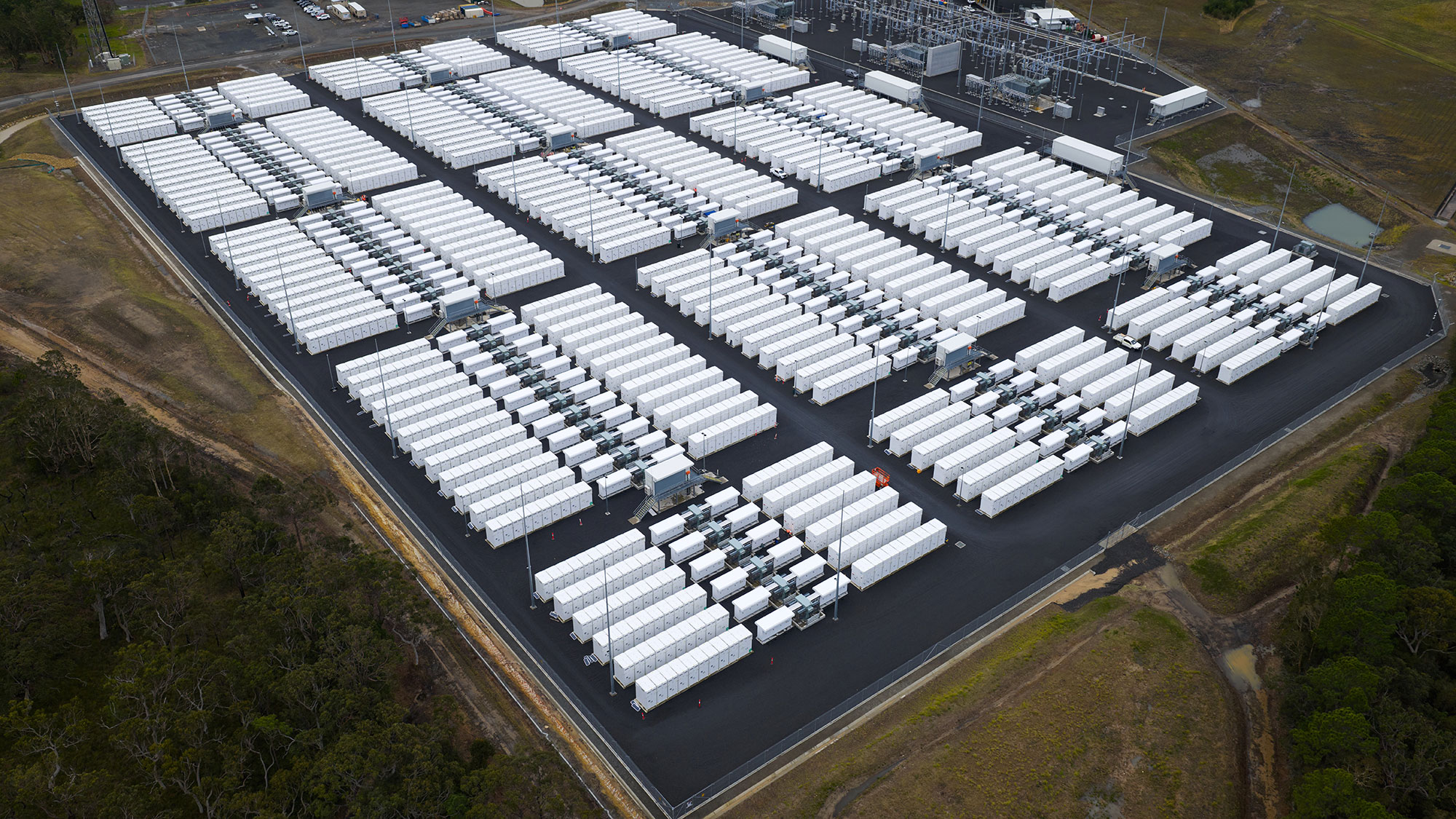
Akaysha Energy has brought the Waratah Super Battery into final commercial operation at its full 850MW/1,680MWh rating, completing the commissioning of a storage system designed to act as part of New South Wales’ transmission protection architecture.
The battery occupies the site of the former Munmorah coal-fired power station and was commissioned by the NSW Government through EnergyCo. Akaysha built, owns, and operates the storage plant, while Transgrid operates the System Integrity Protection Scheme that links the battery to wider network monitoring and control.
At full rated output, Waratah has nearly two hours of stored energy and can deliver 850MW of power. EnergyCo estimates that maximum output is sufficient to supply up to 340,000 NSW households at peak demand, although the project’s principal network role is different from simply supplying a block of electricity for two hours.
The battery is part of a wider protection scheme intended to respond rapidly when specified transmission disturbances occur. Transgrid’s control system monitors network conditions and can trigger the storage system following a major event, providing fast power injection while other elements of the scheme manage flows elsewhere on the network.
EnergyCo says the System Integrity Protection Scheme monitors 36 transmission lines. It is designed to allow existing circuits supplying the Hunter, Sydney, and Illawarra regions to operate at higher usable capacity while retaining a rapid response if an outage or other qualifying contingency suddenly changes the network configuration.
That makes Waratah different from a storage project whose commercial case centres mainly on charging at lower electricity prices and discharging when prices rise. The battery can participate in normal energy and system markets, but a substantial part of its engineering value sits in maintaining sufficient readiness to respond to a network event when instructed.
The project also demonstrates how battery storage can be used as an alternative to waiting for conventional transmission reinforcement to solve every constraint. Fast controllable power cannot replace the energy-transfer capability of a new transmission line, but it can change the amount of existing network capacity that operators can use confidently while longer-term infrastructure is developed.
Waratah is intended to perform that role until the Hunter Transmission Project enters service. The battery therefore sits between two forms of grid investment: an electronic system able to respond in milliseconds or seconds to changing conditions, and major transmission construction intended to increase physical transfer capability over a much longer operating horizon.
Hitachi Energy supplied, installed, and commissioned 288 power conversion systems and two power plant controllers. The power conversion equipment forms the electrical interface between the battery blocks and the AC network, while the plant controllers coordinate the response of the individual systems so the facility behaves as one grid-scale asset.
That control layer is central to the protection function. An 850MW response cannot simply be produced by hundreds of battery units acting independently; commands, protection settings, state-of-charge limits, converter behaviour, and communications have to be coordinated so the plant reaches the requested output without creating unacceptable voltage, frequency, or equipment conditions.
The MW and MWh ratings describe separate limits within the system. The 850MW rating determines the maximum power available for charge or discharge, while 1,680MWh describes the amount of stored energy. Dividing the two gives a nominal full-output duration just below two hours, although operating reserves, state of charge, degradation, auxiliary loads, and network obligations affect the energy actually available for a particular dispatch.
Final commercial operation follows a staged commissioning process. Akaysha reported in June that Waratah was operating at 700MW with its full 1,680MWh energy capacity after one high-voltage transformer returned to service. Subsequent commissioning increased the available power to the final 850MW rating and completed the step from partially commissioned capacity to the contracted operating configuration.
The project attracted more than A$1 billion in private investment and involved approximately 1,000 people through design and construction, including around 170 workers on the battery site at peak construction. The scale reflects more than the battery enclosures themselves: transformers, converters, switchgear, protection, communications, control equipment, civil works, and network augmentation all form part of the operating system.
Commercial operation moves the engineering challenge from commissioning into sustained asset management. Battery cells will age, thermal systems and converters require maintenance, and control software must remain coordinated with the network protection scheme. The facility also needs sufficient state of charge at the appropriate times to perform the contingency role for which it was commissioned.
Waratah’s performance will consequently be measured through both ordinary storage metrics and events that operators hope will be rare. Availability, round-trip efficiency, degradation, and market dispatch will matter during normal operation; during a major transmission disturbance, response speed and dependable delivery of the requested power become the decisive measures.
The battery is now operating at the rating around which that protection scheme was designed. The next phase is less visible than construction or commissioning, but more important to the network: keeping 850MW of rapidly controllable power ready to respond when a transmission fault turns a reserve capability into an operational requirement.