IN Brief:
- All 20 turbines have been installed at the 102MW Stranoch wind farm in Dumfries and Galloway.
- Powersystems UK is progressing the high-voltage electrical works required to connect and commission the site.
- The remaining programme shifts from heavy turbine erection towards energisation, grid compliance, testing, and operational handover.
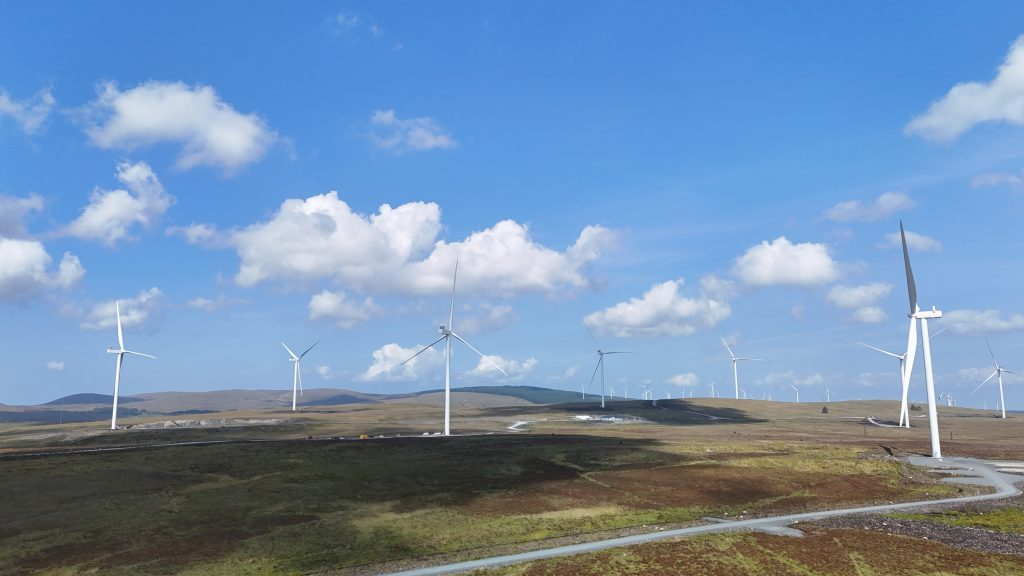
EDF power solutions UK has completed installation of all 20 turbines at its 102MW Stranoch wind farm in Dumfries and Galloway, moving the project into its final electrical construction and commissioning phase.
The milestone follows delivery of 189 major turbine components from the Port of Cairnryan and the subsequent erection programme carried out by Vestas, with Scottish contractor I&H Brown acting as principal contractor. With the main mechanical installation complete, work is concentrating on the electrical infrastructure required to connect the generating plant to the grid.
Powersystems UK is carrying out the high-voltage works, including installation, testing, and commissioning of the site’s electrical infrastructure and control building. The change in activity is substantial: heavy lifting and turbine assembly give way to protection testing, cable and transformer checks, communications integration, control-system commissioning, and staged energisation.
Stranoch is being built between New Luce and Barrhill, with construction having started in May 2024. EDF has used Scottish and local contractors across the programme, including earlier enabling works and civil engineering required before turbine deliveries could begin.
The installed fleet includes an EnVentus V150, which EDF describes as the most powerful wind turbine installed in the UK and one of the first examples of the type deployed in the country. The 20-machine layout gives Stranoch an overall rated capacity of 102MW.
Turbine erection is only one part of bringing a wind farm into service. Each machine must be connected through the site’s collection network before electricity can be exported through the project substation, while transformers, switchgear, protection systems, communications, and supervisory controls have to operate as one coordinated electrical system.
Commissioning normally proceeds in controlled stages because the consequences of a fault change once equipment becomes live. Cable insulation, earthing, protection relays, transformer behaviour, turbine controls, and communications all have to be checked before larger sections of the plant are energised.
Grid compliance then adds another layer. The generating station must demonstrate that it responds correctly to voltage, frequency, reactive-power, and fault conditions at the connection point. Those tests establish whether the complete wind farm behaves within the parameters required by the network rather than simply confirming that individual turbines can produce power.
The final construction period is consequently less visible than the turbine erection programme but no less important. A mechanically complete turbine cannot contribute electricity until auxiliary supplies, converter systems, switchgear, protection, communications, and the export route have been proved.
Reliable data links are also required between individual turbines and the site’s control systems. Operators need continuous access to machine status, alarms, output, temperature, vibration, and other condition information once construction teams give way to routine operations and maintenance.
The commissioning sequence has to coordinate turbine readiness with balance-of-plant availability. Individual machines may be mechanically complete while sections of the collection system remain isolated, so energisation is normally staged to allow faults to be identified and sections proved before the next part of the network is brought live.
For the electrical contractor, that sequence also creates a formal evidence trail. Test sheets, protection settings, cable records, transformer checks, control-system configuration, and energisation permits have to demonstrate that each section is safe and ready before the next operating boundary is crossed. Those records then become part of the technical handover to the long-term operator.
Weather remains relevant after the heavy-lift phase. High winds can still delay external inspection or remedial work, while ground and access conditions affect remaining civil activities. Electrical commissioning is less dependent on crane limits, but equipment availability, defect resolution, and access can still affect the date at which the complete project is ready for acceptance testing.
The move towards energisation also starts the transition from construction responsibility to long-term asset management. Test certificates, maintenance records, software configurations, inspection results, spare-parts inventories, and outstanding defects all have to be transferred into the operational regime alongside the physical equipment.
EDF expects the wind farm to reach full operation in 2027. Completion of the turbine installation removes one of the most conspicuous construction tasks, but the remaining milestones are electrical: energisation, protection proving, grid-code compliance, turbine commissioning, and stable operation of the 20 machines as a single 102MW generating station.