IN Brief:
- Ferrari Hypersail uses a dual-voltage 48V and 800V DC microgrid supplied entirely from onboard renewable energy.
- ABB will support DC integration, power distribution, energy management, storage, and marine electrical-system resilience.
- The project provides a high-stress test environment for DC architectures relevant to shipping, data centres, renewables, and industrial microgrids.
ABB is applying its direct-current engineering expertise to Ferrari Hypersail, supporting the development of a renewable-powered 48V and 800V DC microgrid designed to remain self-sufficient during extended offshore operation.
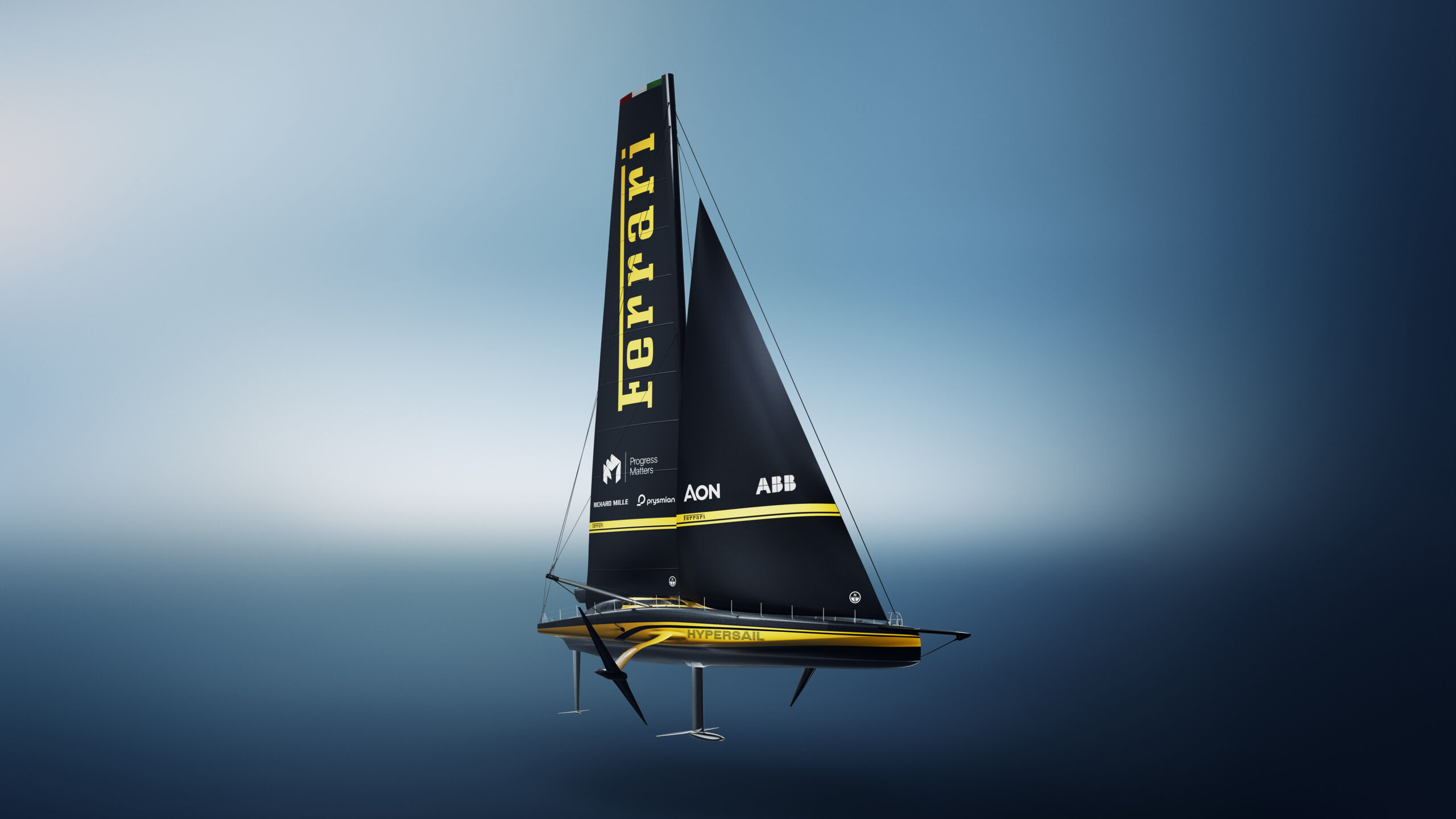
ABB has become Electrification Partner for the 100-foot oceanic full-foiling monohull, providing expertise in DC system integration, energy management, intelligent power distribution, energy storage, and marine electrical systems.
The vessel is designed to operate entirely from renewable energy while supplying navigation, foil controls, safety systems, propulsion, and other onboard loads. That makes its electrical system closer to an islanded microgrid than a conventional marine auxiliary network: generation, storage, distribution, and demand have to remain balanced without relying on a shore connection during operation.
Its architecture uses both 48V and 800V DC. The higher-voltage layer allows substantial power to be distributed at lower current than a lower-voltage equivalent, reducing conductor demands and resistive losses, while 48V remains suitable for smaller control and auxiliary loads. The engineering task is to make those voltage domains operate together without compromising protection, control, or resilience.
ABB brings more than 25 years of direct-current experience to the programme and says its portfolio includes more than 700 DC-related patents. Its role will centre on system integration and the management of renewable generation, storage, and onboard loads under conditions that include salt spray, motion, pressure, low temperatures, and restricted space.
“Ferrari Hypersail gives ABB a unique platform to demonstrate how we are collaborating with partners to push the limits of Direct Current technology,” said Giampiero Frisio, president of ABB’s Electrification business area.
The project is specialised, but the electrical problem has direct parallels with other decentralised power systems. Solar generation, batteries, electronic loads, electric drives, and many modern power-conversion systems operate natively in DC even when they sit behind conventional AC distribution. Every conversion stage adds hardware, control requirements, losses, and potential failure points.
ABB has been making the case for hybrid AC/DC architectures in sectors where power density and onsite energy resources are increasing. A September report produced with Boston Consulting Group identifies 800V DC distribution as an emerging architecture for next-generation AI infrastructure and also points to opportunities in automation-intensive manufacturing, commercial buildings, and systems integrating onsite renewables and storage.
That does not make a racing yacht directly comparable with a data centre or factory. Load profiles, standards, maintenance arrangements, fault levels, cooling, and commercial requirements differ substantially. Hypersail’s value as a test environment lies instead in the severity of its constraints: limited space and weight, no dependable external grid connection while offshore, and little tolerance for interruption to critical systems.
Energy management is central to that challenge. Renewable generation varies with conditions, while essential loads cannot simply be shed whenever available power falls. Storage therefore has to absorb surplus production, support the vessel during generation shortfalls, and maintain sufficient reserve for critical navigation, safety, and control functions.
Enrico Voltolini, project leader of Ferrari Hypersail, said the vessel “has to be self-sufficient for weeks at a time in the most hostile ocean environments on earth”. He described ABB’s electrification expertise as an operational advantage for a system that depends entirely on renewable energy.
That requirement puts resilience on the same footing as efficiency. High-demand systems may need short bursts of power while critical electronics require continuous supply, forcing the control architecture to prioritise loads and manage storage state of charge without undermining vessel safety.
Marine conditions also place unusual demands on electrical hardware. Equipment must tolerate vibration, motion, moisture, salt contamination, temperature variation, and difficult maintenance access. Weight has a direct performance penalty on a foiling yacht, adding pressure on conductors, converters, batteries, protection equipment, and enclosures to deliver high power density without sacrificing robustness.
Protection becomes particularly important at 800V DC. Unlike AC, direct current has no natural current zero-crossing, making fault interruption a different engineering problem. Practical DC systems therefore depend on fast detection, selective isolation, suitable switching technology, and coordinated protection as much as they depend on efficient distribution.
Those questions are increasingly relevant beyond marine applications. ABB’s wider DC work spans data centres, industrial microgrids, power generation, renewable integration, and EV infrastructure, where higher power density and greater use of batteries are changing the balance between AC and DC distribution.
The Hypersail programme gives ABB a compact, mobile system in which renewable generation, storage, power electronics, controls, and critical loads must operate as one islanded network. That does not prove that the same architecture can simply be transferred ashore, but it can expose practical limits around conversion efficiency, fault handling, thermal performance, storage management, component reliability, and control strategy.
The useful output from the partnership will therefore come from operational data rather than the branding around the project. If the electrical system can maintain stable, efficient operation for extended periods offshore, the lessons should help ABB refine how it designs and manages DC architectures in other high-demand environments.
Ferrari Hypersail is an unusual platform for power-system engineering, but the underlying requirement is increasingly familiar: integrate local generation, storage, high-power electronic loads, and intelligent distribution into a resilient electrical system with fewer unnecessary conversion stages. Offshore, the consequences of poor integration are immediate. On land, the same engineering trade-offs are becoming more important as industrial and digital infrastructure demand more power from increasingly constrained networks.