IN Brief:
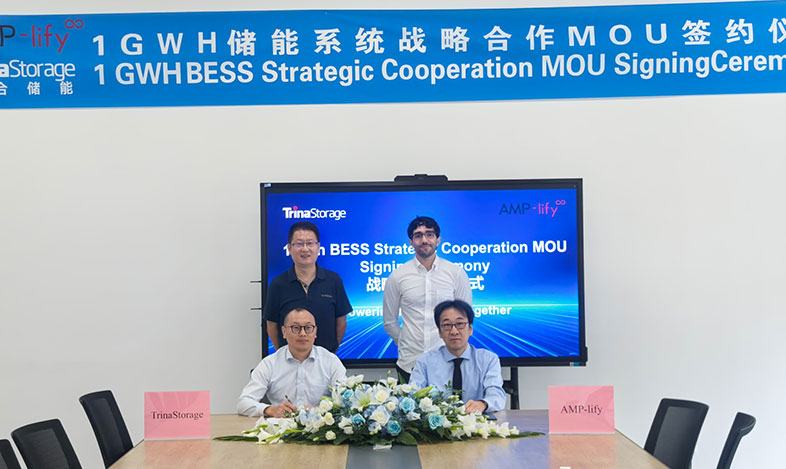
- Trina Storage and AMP-lify have signed an MoU covering approximately 1GWh of Japanese grid-connected BESS projects.
- Elementa 3 provides up to 6.25MWh per container using Trina’s in-house 587Ah cell.
- Local engineering support will address Japanese transport, land, seismic, noise, and other site constraints.
Trina Storage has signed an agreement covering approximately 1GWh of grid-connected battery projects in Japan, extending its Elementa 3 platform into a market where site conditions can have a major influence on storage-system design.
Trina Storage, the energy-storage business of Trinasolar, will supply battery systems and technical support to Japanese clean-energy platform AMP-lify under a memorandum of understanding announced on 14 September. AMP-lify develops, constructs, and operates grid-connected BESS, utility-scale solar, and onshore wind projects across Japan.
The agreement covers approximately 1GWh of AMP-lify’s planned storage projects but does not identify individual sites, order values, or commissioning dates. The figure therefore represents the intended scale of cooperation rather than capacity already financed or under construction.
Trina’s Japanese team will support system configuration, technical consultation, delivery coordination, and after-sales service. That local engineering role is relevant because the project constraints identified by the company go beyond battery chemistry and container capacity to include transport, land availability, seismic conditions, noise, and coastal environments.
For larger utility-scale sites, Elementa 3 uses Trina Storage’s in-house 587Ah lithium iron phosphate cell and provides up to 6.25MWh in a single container. Higher energy density can reduce the number of enclosures and the amount of land needed for a given storage capacity, although the final site footprint also depends on separation distances, transformers, power-conversion equipment, access, and fire-safety requirements.
Trina has also developed the smaller Elementa 3 Flex for the Japanese market. The 1.56MWh unit uses the same 587Ah cell platform, occupies about five square metres, weighs around 13 tonnes, and is designed for standard-truck transport. Trina specifies operating noise of 65dB or below.
Those characteristics address practical development constraints. Narrow roads, road-weight limits, irregular sites, dense neighbouring development, earthquake loading, and restricted land can all affect whether a battery configuration that works elsewhere can be delivered economically in Japan.
Seismic design is particularly important for containerised storage. A BESS combines considerable mass with cell racks, cooling equipment, electrical connections, and power electronics. Foundations, anchoring, enclosure strength, and internal restraint have to operate as a complete mechanical system if the installation is to remain safe during an earthquake.
Coastal sites introduce further requirements around corrosion, ingress protection, temperature management, and maintenance. Noise can also become a planning issue because battery installations contain power-conversion systems, transformers, pumps, fans, and other auxiliaries that operate even though the site has no conventional rotating generator.
Elementa 3’s 6.25MWh container capacity means a 1GWh portfolio would still represent a substantial equipment programme before power-conversion systems, transformers, switchgear, cabling, controls, fire protection, and grid infrastructure are included. The eventual hardware mix will depend on how AMP-lify configures individual sites.
The grid connection is just as important as the battery hardware. Storage projects have to charge and discharge within network limits, meet protection and control requirements, and demonstrate behaviour acceptable to the relevant transmission or distribution operator. A large development pipeline therefore does not automatically translate into operating capacity.
Japan’s energy strategy gives storage a growing system role as the share of renewable generation rises. Batteries can shift electricity between periods, respond to balancing requirements, and reduce the operational impact of variable solar and wind output, but project economics still depend on market access, network constraints, utilisation, and the commercial structure around each asset.
The MoU does not settle those project-specific issues. It is earlier in the development cycle than a firm equipment order, financial close, or notice to proceed, and individual schemes will still depend on land, permits, grid access, financing, contracting, and revenue arrangements.
Its scale nevertheless matters. Approximately 1GWh is large enough to require repeatable procurement, logistics, commissioning, software, and service processes across a portfolio rather than a one-off installation. Standardisation can lower delivery risk, but Japan’s site diversity means the system still has to be adaptable.
That tension between repeatability and site-specific engineering is likely to determine the commercial value of the agreement. Trina Storage is offering a common cell and system platform, while AMP-lify’s individual projects will still have to be configured around transport limits, seismic loading, noise, land constraints, coastal exposure, and grid requirements. The partnership is therefore less a single battery project than a test of whether a standardised BESS platform can be deployed repeatedly across unusually varied Japanese sites.