IN Brief:
- LanWin3 will provide a 2GW, 525kV HVDC connection for offshore wind generation in the German North Sea.
- NSORe will manufacture major platform structures in Rostock and Vlissingen, while Siemens Energy supplies the high-voltage equipment.
- NSORe's combined scope across the LanWin3 and LanWin6 converter platforms is valued at approximately €2.5 billion.
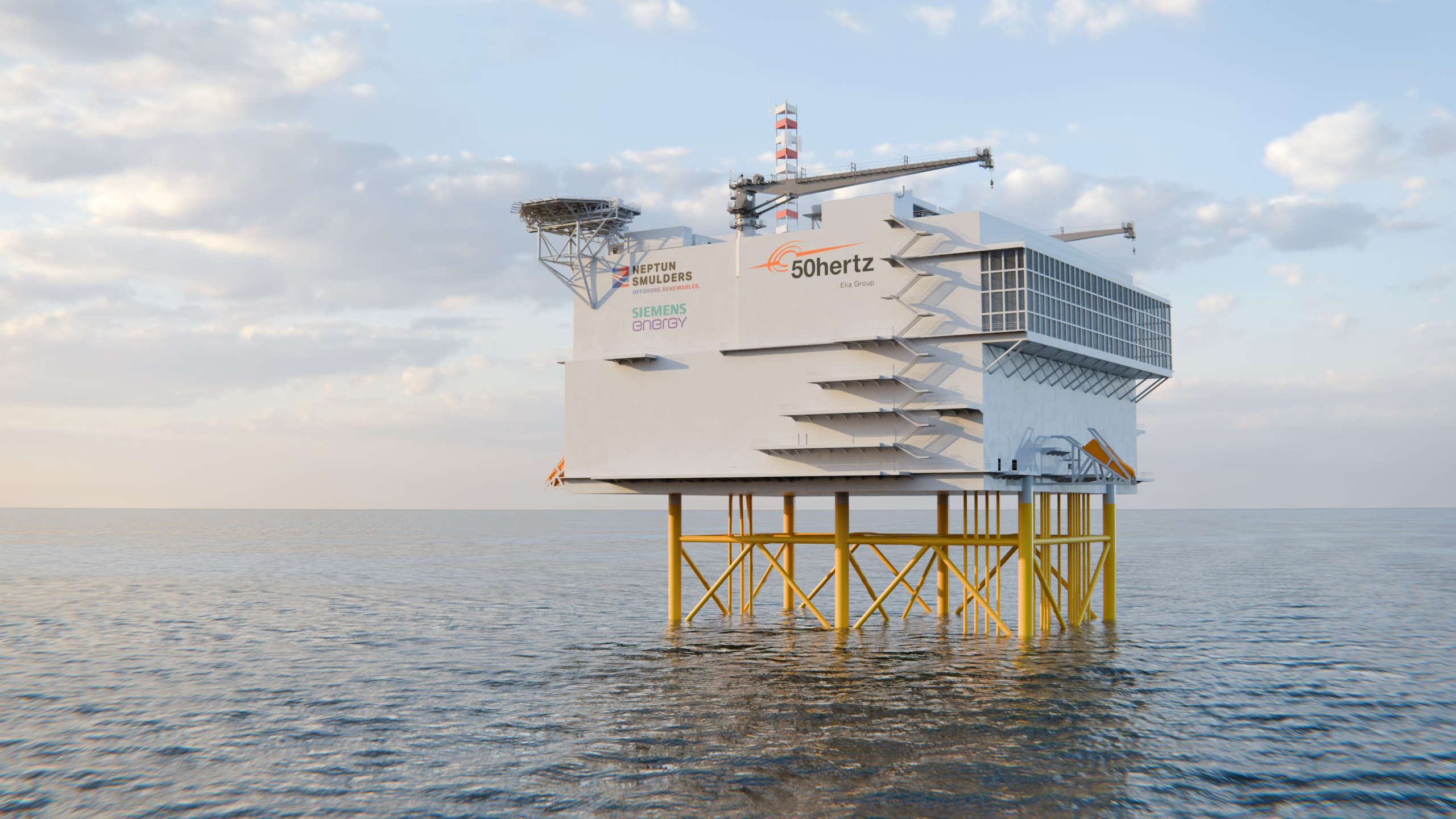
50Hertz and NEPTUN SMULDERS Offshore Renewables have concluded the contract for the LanWin3 offshore converter platform, advancing a 2GW North Sea grid connection whose major structural components will be produced through NSORe facilities in Germany and the Netherlands.
The agreement covers the offshore converter station for LanWin3, with NSORe responsible for turnkey implementation alongside Siemens Energy, which will supply the high-voltage equipment. Key topside components are due to be manufactured at NEPTUN WERFT in Rostock-Warnemünde, while Smulders will manufacture the jacket substructure at its yard in Vlissingen.
The contract follows the June award covering LanWin6. Together, NSORe’s scope across the two converter platforms is valued at around €2.5 billion, with most production and services expected to be carried out in Mecklenburg-Western Pomerania. Siemens Energy had already been commissioned for LanWin3’s high-voltage technology, while the latest agreement relocates the steel-construction and platform scope into the NSORe production network.
LanWin3 will connect 2,000MW of offshore wind capacity from the N-11.1 area of the German North Sea. 50Hertz plans to use 525kV high-voltage direct current transmission, with power converted offshore before being transferred towards the mainland and integrated through the wider NordOstLink infrastructure and a planned multi-terminal hub in Schleswig-Holstein.
The project forms part of Germany’s move towards larger offshore connection systems capable of collecting substantial amounts of generation into fewer high-capacity export routes. Concentrating 2GW on a single connection can reduce the number of platforms and cable systems required per gigawatt, but it also places more capacity behind each converter and increases the consequences of equipment failure or programme delay.
The offshore platform is consequently only one element of a much larger electrical system. The delivery scope includes system design, procurement, construction, installation, and commissioning, while the converter equipment must interface with export cables, transformers, protection systems, controls, cooling, auxiliary power, and the wider HVDC operating architecture.
Offshore access places additional weight on reliability during the design and manufacturing stages. Equipment that can be inspected or replaced relatively easily onshore becomes considerably harder to reach once installed at sea, particularly when maintenance is constrained by weather, vessel availability, and offshore lifting requirements. Factory testing and integrated commissioning therefore determine a substantial part of the eventual operating risk before the platform is energised.
50Hertz is already bringing additional offshore capacity through its network. Windanker recently began exporting through the Ostwind 3 connection, where turbines, an offshore platform, subsea cables, an onshore substation, and protection systems had to be commissioned as one electrical chain before significant generation could reach the transmission system.
LanWin3 is much larger. The connection is rated at 2GW rather than hundreds of megawatts and uses HVDC rather than the 220kV AC architecture employed by Ostwind 3. That difference changes the scale of the converter equipment, cable system, cooling requirements, control systems, and commissioning programme, while increasing the amount of generation dependent on the availability of a single export route.
The move to 525kV also puts insulation coordination, converter interfaces, cable terminations, switching arrangements, and system testing under closer scrutiny. Design changes involving one supplier can propagate into adjacent packages, particularly around transformer ratings, cable interfaces, platform layout, protection, and the auxiliary systems required to keep converter equipment operating.
Multi-terminal operation adds another layer. Traditional HVDC links normally connect two defined ends, while a multi-terminal arrangement is intended to connect several nodes and create a more interconnected transmission structure. That requires tighter coordination of control philosophy, fault response, protection, power-flow management, and maintenance across equipment owned or operated by several parties.
The industrial delivery programme is also notable. Offshore transmission expansion is competing for a finite pool of specialist engineering, fabrication, converter equipment, transformers, cables, installation vessels, and commissioning staff. Awarding LanWin3 and LanWin6 into a common manufacturing network can support repeatability, but the benefit depends on both projects progressing without creating bottlenecks in the same facilities.
For 50Hertz, the contract moves LanWin3 further from procurement into detailed execution. Engineering, fabrication, equipment integration, offshore installation, and commissioning must now progress alongside the cable and onshore infrastructure needed to carry the 2GW connection through NordOstLink.
The completion schedule for the grid link is therefore inseparable from offshore generation delivery. A wind farm can complete turbines and internal electrical systems while remaining unable to export its rated output if the transmission connection is late. LanWin3 places 2GW behind that dependency, making converter-platform delivery a central part of Germany’s offshore wind programme rather than a supporting construction package.