IN Brief:
- Waratah completed a second two-hour System Integrity Protection Scheme test at an average output of around 700MW.
- The battery subsequently charged at 850MW for a short period as commissioning continued.
- The project combines storage, transmission controls, network upgrades, and paired generation to provide rapid corrective action for the NSW grid.
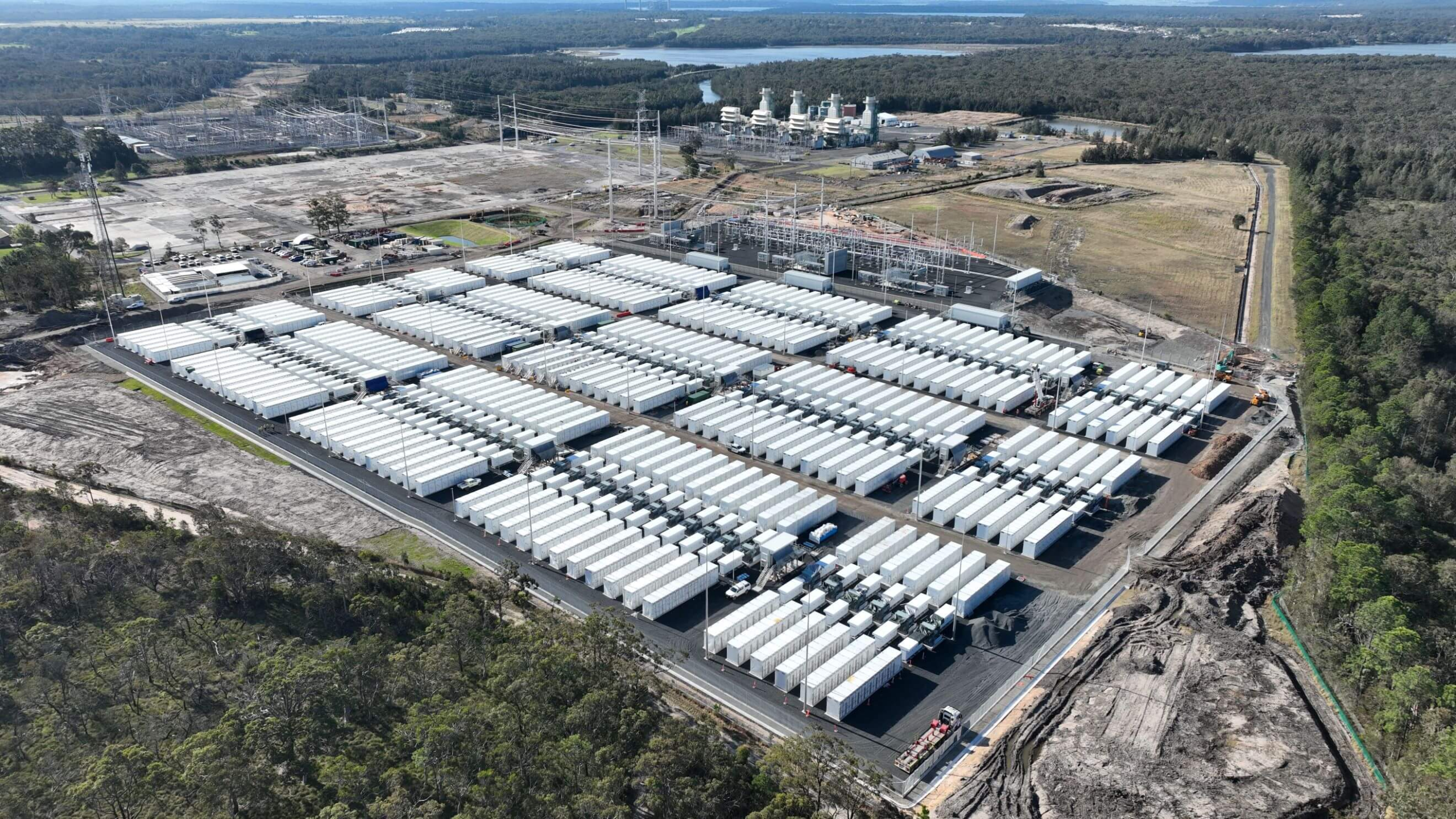
Akaysha Energy‘s Waratah Super Battery has completed a second two-hour test at around 700MW as commissioning continues for its full grid-security role in New South Wales. The battery then briefly charged at its full 850MW power rating, demonstrating both the contracted System Integrity Protection Scheme discharge level and the plant’s maximum charging capability.
The test took place after installation and energisation work associated with the project’s replacement high-voltage transformer. Waratah had already completed an earlier sustained discharge at approximately 700MW and has been progressively restoring its full operating capability during 2026.
The battery’s authoritative project rating is 850MW/1,680MWh. Its contracted System Integrity Protection Scheme service requires at least 700MW of continuous active power and at least 1,400MWh of usable stored energy, leaving additional capacity available around the network-security requirement.
Waratah differs from storage projects developed principally around energy trading because its core role is directly linked to transmission security. The project combines the battery with an overarching control system, transmission-network upgrades, and paired generators to provide rapid corrective action after certain network events.
EnergyCo describes the arrangement as a shock absorber for the NSW electricity system. Under the scheme, a qualifying transmission event can trigger the battery to inject power rapidly while paired generators are instructed to reduce output, limiting the risk that the sudden change in power flows causes another overload elsewhere on the network.
The paired-generation arrangements turn the wider scheme into what EnergyCo calls a virtual transmission line. Rather than providing normal transmission capacity through another physical circuit alone, the system uses rapid controls and stored energy to allow existing network assets to carry more power while maintaining a corrective response if a contingency occurs.
That function places different requirements on the battery from ordinary wholesale-market operation. A system providing network protection must demonstrate not only that it can reach its target power but that it can maintain the required output, receive the correct control signals, coordinate with other assets, and remain available when a serious system event occurs.
The latest commissioning test involved an average discharge of around 700MW for two hours. A brief subsequent charge at 850MW demonstrated the opposite end of the plant’s power range, while verification of the SIPS tests remains an important step before the full contracted service is put in place.
Large power transfers of that scale test far more than battery cells. Inverters, power conversion equipment, high-voltage transformers, switchgear, protection systems, cooling equipment, auxiliary supplies, controls, communications, and the grid connection all have to perform together while hundreds of megawatts move into or out of the installation.
A sustained two-hour discharge also places the thermal and energy-management systems under conditions that a short peak-power test cannot reproduce. State of charge, inverter temperature, transformer loading, cooling performance, and the ability to maintain output all become part of the commissioning evidence.
The battery stands on the site of the former Munmorah coal-fired power station on the NSW Central Coast. Reusing a former generation site provides access to existing transmission infrastructure and industrial land, but the change from synchronous thermal generation to a large inverter-based storage plant requires an entirely different set of control and protection arrangements.
Transgrid is the network operator for the wider project and is responsible for coordinating the scheme, including the control system and network upgrades. Akaysha is responsible for the battery component and its operation, while EnergyCo procured the battery and paired-generation services and oversees delivery.
The battery began partial shock-absorber operation in August 2025. Akaysha confirmed in June 2026 that 700MW and the full 1,680MWh energy capacity were available after one transformer returned to service, while commissioning continued towards the full 850MW power rating and 700MW SIPS obligation.
The second sustained SIPS test therefore marks another step in restoring and proving the complete system rather than the end of commissioning. Test verification and commencement of the full contracted protection service remain the significant next milestones.
For network planners, Waratah is also an unusually large demonstration of storage being used as transmission infrastructure rather than simply connected to it. Conventional lines and substations remain necessary as electricity flows change, but a fast control scheme can alter how closely existing assets are operated to their limits. The success of that approach will depend less on the headline 850MW rating than on whether the battery and its surrounding control system respond predictably on the day the grid actually needs them.