
IN Brief:
- Steel River East will provide 200MW/400MWh of storage using 112 battery units in Newcastle’s Steel River Industrial Estate.
- The approved design connects through 33kV underground cabling beside Ausgrid’s existing 132kV Mayfield West zone substation.
- SCEE Electrical is the delivery partner, with PLUS Grid Storage targeting operation in late 2027.
PLUS Grid Storage has started construction of the Steel River East battery energy storage system in Newcastle, moving its first project from planning into physical delivery. The 200MW/400MWh facility is being built at 1 McIntosh Drive, Mayfield West, within the Steel River Industrial Estate, alongside Ausgrid’s existing Mayfield West zone substation. Construction was formally marked on 14 August, with SCEE Electrical named as delivery partner and operation targeted for late 2027.
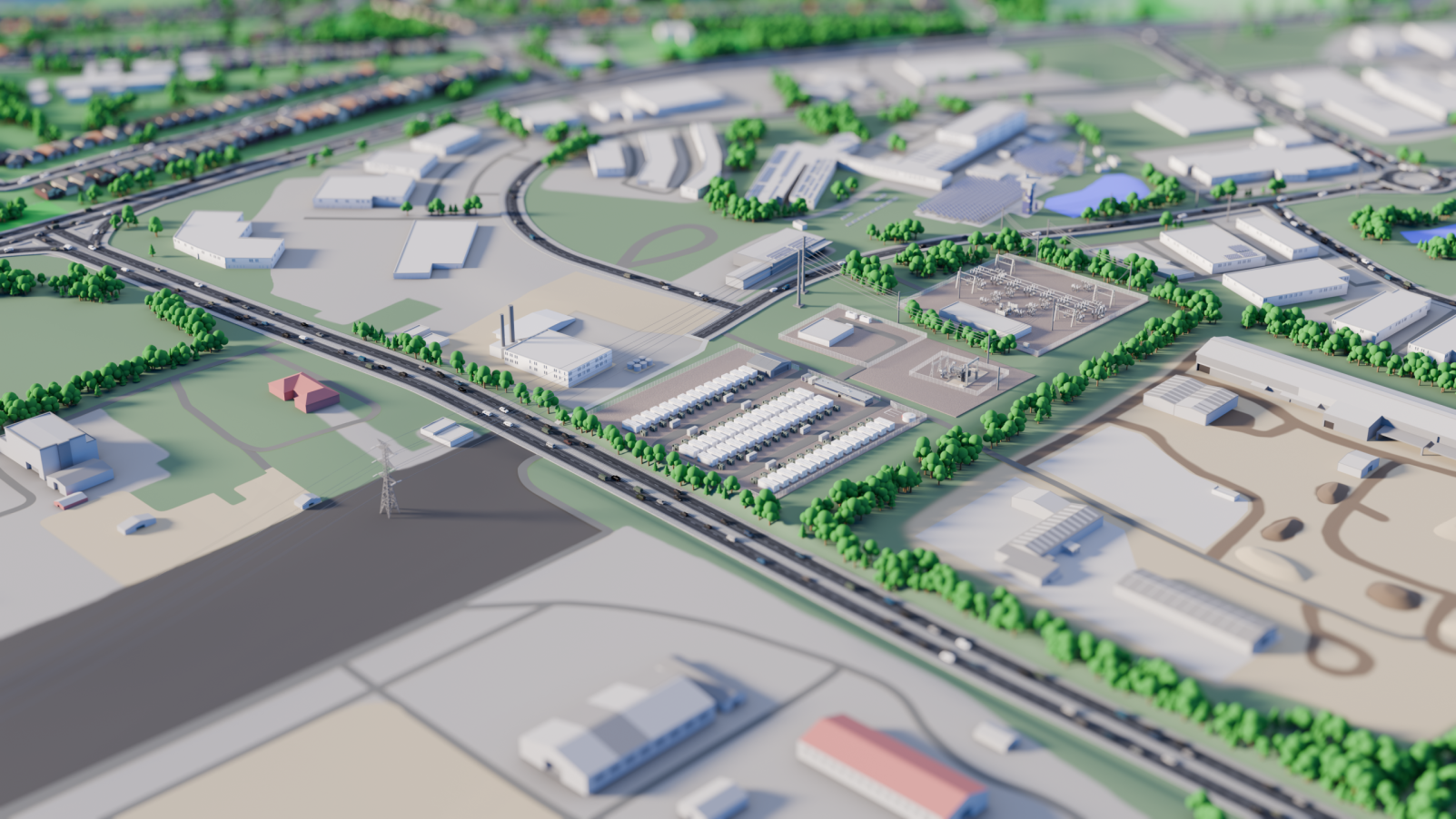
The project is designed as a two-hour battery, capable of delivering its full 200MW output for roughly two hours from a 400MWh usable energy envelope. Planning documents describe 112 containerised battery units, supported by 56 medium-voltage transformers, eight ring main units, a combined switch and control room, an on-site workshop, auxiliary transformers, and the civil and electrical infrastructure needed to connect the system into the local network.
Steel River East sits immediately east of the existing 132kV Mayfield West zone substation on the same industrial lot. The approved design uses 33kV underground cabling between the battery system and the substation infrastructure, allowing the project to inject and absorb power through an established distribution-network connection rather than requiring a completely separate high-voltage site. For a large battery, that proximity reduces the length and complexity of the collector connection, although the interface still has to accommodate protection, control, metering, commissioning, and operational limits across the battery and network systems.
The physical layout reflects the amount of balance-of-plant equipment needed around the battery units themselves. Planning material provides for a prepared site bench of about 14,300m², internal roads, drainage, an earth grid, cable trenches, fire-suppression systems, security fencing, lighting, CCTV, and a workshop. Those systems are not peripheral to delivery: grid-scale storage has to be operated as a high-voltage electrical installation, with thermal management, fire response, access control, communications, and maintenance arrangements designed into the site from the outset.
Steel River East is intended to provide storage and firming capacity to the National Electricity Market, including frequency-control ancillary services. That gives the project a wider operating role than simply moving electricity from one part of the day to another. Batteries can respond rapidly to changes in system conditions, but the commercial and technical value of that response depends on inverter capability, control software, state-of-charge management, connection limits, and the market services for which the asset is registered and available.
Its location on the distribution network is particularly significant. Much of Australia’s recent battery build-out has focused on large transmission-connected projects, often beside major substations or renewable-energy zones. A distribution-connected asset of 200MW sits closer to load and existing local network infrastructure, creating another route for adding flexibility without treating every large battery as a transmission project. It does not remove the need for network reinforcement elsewhere, but it can increase the amount of controllable capacity available within a part of the system already carrying substantial industrial and urban demand.
The two-hour duration also places Steel River East firmly in the mainstream of current utility-scale lithium-ion deployment. At 400MWh, the battery can shift meaningful quantities of electricity between lower- and higher-demand periods, while its 200MW power rating gives it the speed and scale required for shorter-duration grid services. The operating challenge is to allocate that finite energy capacity between market opportunities and system-support functions without exhausting the state of charge when flexibility is most valuable.
The project’s construction start is also a milestone for PLUS Grid Storage itself. The company describes Steel River East as its first project and positions its wider business around distribution-connected batteries intended to strengthen network resilience and support renewable integration. That makes the Newcastle site an early test of whether the model can be delivered at utility scale, including the commercial interfaces between the battery owner, construction contractor, network infrastructure, and electricity-market participation.
SCEE Electrical now has to convert the approved design into an energised plant while working beside existing electrical infrastructure. Civil preparation, foundations, battery deliveries, transformers, medium-voltage cabling, control systems, protection, commissioning, and network testing all have to be sequenced before the battery can operate. The 2027 target leaves a substantial construction and commissioning programme, particularly because large BESS projects are increasingly judged not only by mechanical completion but by how quickly they progress through grid-compliance testing and achieve unrestricted commercial operation.
The underlying project approval also fixes a clear technical baseline against which delivery can be measured. The NSW Planning Portal records the approved system at 200MW/400MWh, while project documentation identifies 112 battery units and the Mayfield West connection arrangement. Those figures make Steel River East large enough to have a measurable system role, but still compact enough to fit within an established industrial estate beside existing distribution infrastructure.
Construction beginning at Steel River East therefore matters less because another battery has broken ground than because the project combines scale, a distribution-network connection, and an existing substation interface in one delivery model. By late 2027, PLUS Grid Storage will have to show that the concept works in practice: 112 battery units, dozens of transformers, and a 33kV collector system operating as one controllable 200MW asset rather than simply occupying a prepared site beside the grid.

