IN Brief:
- SSEN Transmission has started ordering modular substations under frameworks with Hitachi Energy and GE Vernova.
- Fifteen 132kV and 33kV modules representing more than 1GW of renewable connections are due to be ordered by year-end.
- Factory assembly, wiring, and testing are intended to reduce site work before installation and commissioning.
SSEN Transmission has begun placing orders for standardised modular substations under its framework agreements with Hitachi Energy and GE Vernova, moving the programme from supplier selection into physical procurement.
Fifteen modules representing more than 1GW of renewable generation connections are expected to be ordered by the end of 2026, with further units to follow. The equipment is designed for 132kV and 33kV applications and will be used primarily on smaller customer connection projects, including individual wind farms and other renewable developments in the north of Scotland.
The current milestone follows framework agreements awarded to Hitachi Energy UK and GE Vernova in May after a year-long competitive tender. That earlier stage established the standardised design and supplier structure; the latest announcement confirms that project orders are now moving through those frameworks.
SSEN plans to use the modular approach across the majority of its customer connection portfolio, with the first energisations scheduled from autumn 2028. Much of the assembly, wiring, and testing will be completed away from the final project site in controlled factory environments.
Standardisation moves into delivery
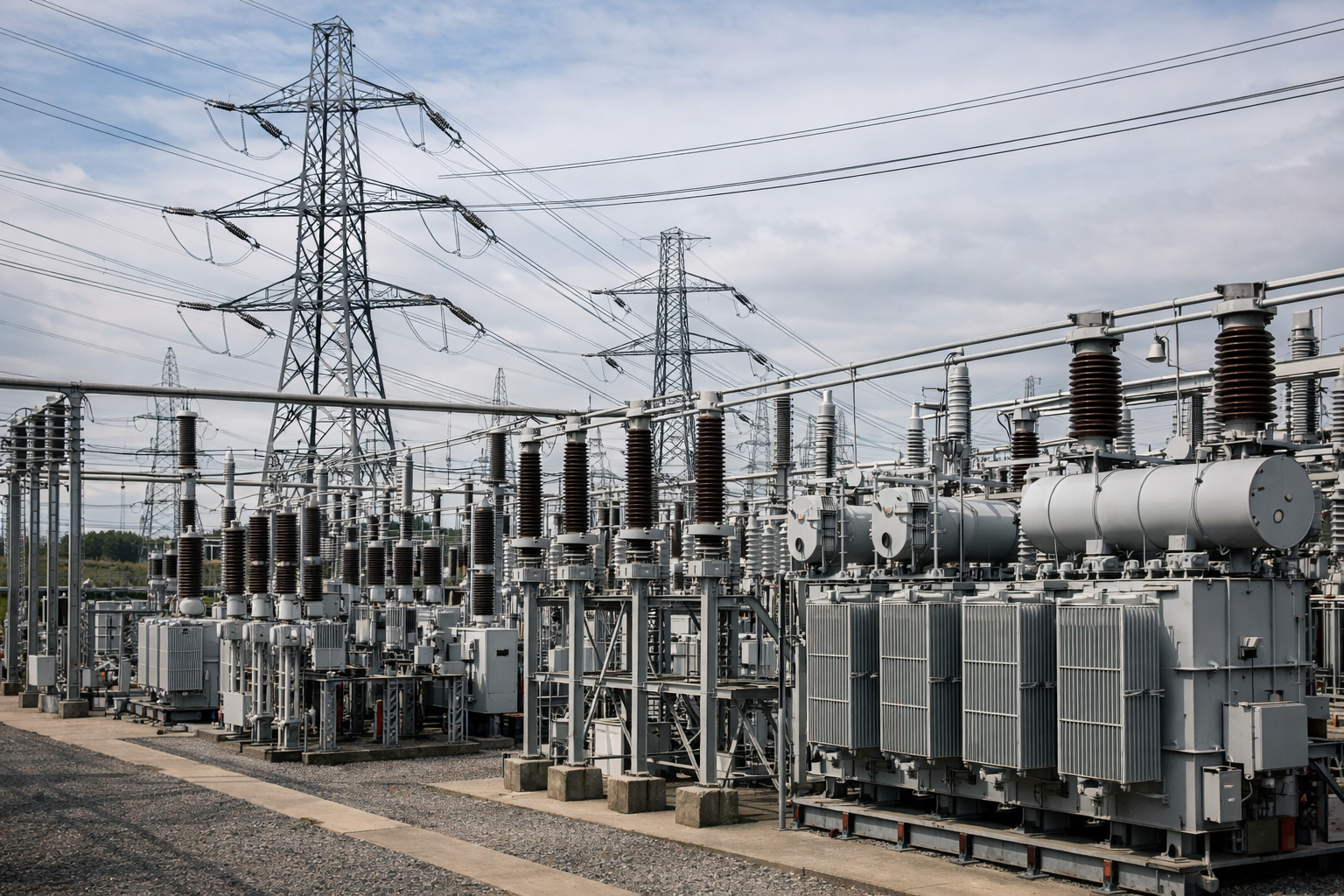
Conventional substations contain large amounts of project-specific engineering and site work. Primary equipment, protection, control, communications, auxiliary systems, cabling, and structural elements are assembled around the requirements of an individual connection, often with substantial testing left until construction is well advanced.
Moving more of that work into a factory changes the delivery sequence. Equipment can be assembled and inspected in a controlled environment before transport, while repeated designs allow the engineering and manufacturing lessons from one module to be carried into later units.
The approach does not remove the need for project-specific work. Connection ratings, earthing, cable interfaces, protection settings, fault levels, civil foundations, access, and communications still depend on the electrical and physical conditions at each site. The value lies in reducing unnecessary variation where the core substation function can be repeated.
That distinction is particularly relevant at 132kV and 33kV. Renewable projects at those voltage levels are large enough to require substantial electrical infrastructure, but many perform broadly similar connection functions. Reusing a qualified architecture can reduce engineering effort compared with developing a fresh substation arrangement for every wind farm or generation project.
Factory testing also moves some technical risk earlier in the programme. Wiring errors, equipment interfaces, control logic, and mechanical problems can be identified before a module reaches a remote construction site, where corrective work is generally slower and more expensive.
Site acceptance testing remains necessary after transport and installation. Protection systems, earthing, communications, cable connections, interlocking, metering, and plant controls still have to be demonstrated against the live network arrangement before energisation.
Transport itself therefore becomes part of the design. Modules have to remain within practical limits for road movement and lifting while retaining enough factory completion to justify the approach. Dimensions, weight, structural stiffness, lifting points, cable interfaces, and the tolerances between module and foundation all have to be controlled.
Hitachi Energy’s equipment includes its SF6-free EconiQ gas-insulated switchgear technology. Eliminating sulphur hexafluoride from new high-voltage equipment reduces exposure to a particularly potent greenhouse gas, while the replacement technology still has to meet the dielectric, switching, reliability, and lifecycle requirements expected from transmission assets.
The modular programme also offers SSEN a different way to manage supply-chain capacity. A pipeline of repeated units provides suppliers with clearer visibility than a succession of bespoke projects, allowing manufacturing slots, engineering resource, and component procurement to be planned around a more predictable series.
That matters as electricity-network investment increases demand for transformers, switchgear, protection systems, specialist engineers, and factory capacity. Lead times for high-voltage equipment can determine a connection schedule long before the final civil works begin.
SSEN is undertaking the programme alongside a much larger transmission investment plan in northern Scotland. The company has cited a £29 billion programme as it expands the network to accommodate new generation and reinforce routes carrying electricity towards demand centres.
Modular customer substations will not solve the larger transmission constraints behind that investment. A standardised 132kV or 33kV connection still depends on sufficient upstream network capacity, and major transmission reinforcements retain their own planning, equipment, and construction programmes.
The modules instead address a more repetitive part of the connection chain. Where the electrical duty is sufficiently similar, reducing bespoke design and site assembly can prevent relatively routine connection infrastructure from becoming an avoidable bottleneck.
The risk is uncontrolled customisation. If every project introduces substantial alterations to the nominal standard, engineering hours and factory complexity can return rapidly while the expected benefits of serial manufacture fall away.
SSEN now has a clearer test of the model. Fifteen modules are moving into the order pipeline, representing more than 1GW of future renewable connections. Manufacturing, transport, installation, and the first energisations from autumn 2028 will show whether standardisation produces the shorter and more repeatable delivery cycle intended when the framework was established.