
IN Brief:
- Siemens Energy and Mitsubishi Electric are developing switching stations and complementary breakers for multi-terminal HVDC networks.
- HeideHub will form part of a planned four-terminal German HVDC network scheduled for operation in 2032.
- Multi-vendor switching technology could reduce reliance on closed supplier architectures as DC networks become more interconnected.
Siemens Energy is developing the switching infrastructure needed to connect multiple high-voltage direct current transmission links into larger DC networks, working with Mitsubishi Electric on switching stations and complementary circuit-breaker technology. The programme is moving beyond conventional point-to-point HVDC towards systems in which several transmission links can meet at common nodes and power can be directed between different routes.
Most operational HVDC schemes still connect one location directly with another, a model well suited to long-distance transmission, subsea interconnectors, and offshore wind connections. A multi-terminal network introduces additional paths, allowing power from several sources to be routed between several destinations rather than remaining tied to one corridor. That flexibility requires switching, protection, and control functions that are more complex than those used on an isolated link.
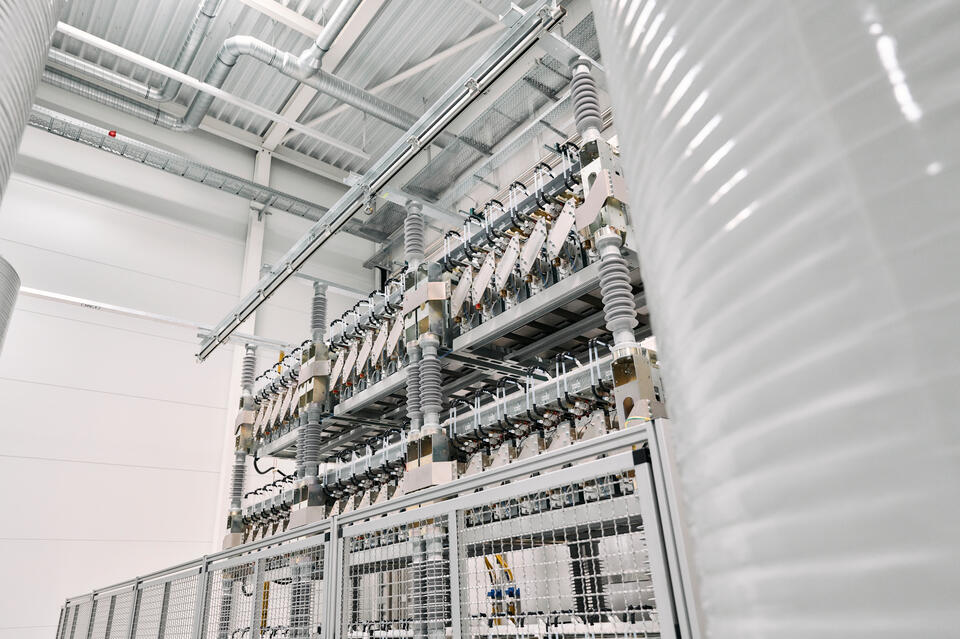
Siemens Energy and Mitsubishi Electric are co-developing DC switching stations designed to coordinate multiple switching units, including circuit breakers, alongside converter stations. The objective is to allow faults to be isolated without unnecessarily interrupting the rest of the DC network, while giving operators greater control over power flows between connected transmission links.
Fault interruption is a central part of the engineering challenge. A DC network needs protection capable of identifying and isolating a fault quickly enough to prevent disturbances spreading through interconnected links, while healthy sections remain available. Adding more terminals also increases the number of possible operating states that the protection and control architecture must recognise, placing greater demands on coordination between converters, breakers, station controls, and network-level systems.
Germany will provide an early transmission-scale application. Siemens Energy has secured initial contracts with TenneT and 50Hertz for two projects expected to include DC circuit breakers within central switching stations. One is HeideHub, where several HVDC links will meet at a common node and renewable electricity will be capable of being routed to different regions.
The projects are planned to form a four-terminal HVDC network scheduled to enter operation in 2032. The arrangement is particularly relevant to Germany’s transmission requirements because substantial quantities of North Sea wind generation have to be transferred towards major load centres further inland. Multi-terminal architecture offers an alternative to treating every future HVDC corridor as an entirely independent end-to-end connection.
Interoperability is another part of the programme. HVDC installations have traditionally been supplied as closely integrated systems in which converters, protection, controls, and associated equipment are engineered around a particular vendor architecture. Siemens Energy and Mitsubishi Electric intend to combine complementary technologies while retaining their respective product portfolios, creating an early test of whether equipment from different suppliers can operate within the same multi-terminal system.
A workable multi-vendor approach would place greater emphasis on common technical requirements. Interfaces between switching stations, breakers, converters, protection systems, and controls need predictable behaviour if transmission operators are to combine equipment without rebuilding the overall design around a single supplier. AC networks benefit from long-established grid codes and standards; equivalent arrangements for multi-terminal DC systems are still developing.
The network value extends beyond supplier choice. HVDC converters allow active control of power flows, making the technology useful where large volumes of electricity need to travel over long distances or through subsea cables. Linking several HVDC routes through switching stations could allow existing transmission capacity to be used more dynamically, particularly when renewable generation changes geographically or one transmission path becomes constrained.
That architecture also fits the direction of offshore grid development. Separate radial connections can be effective when individual wind farms are developed in isolation, but the model becomes less attractive as offshore capacity grows and connection routes overlap. Shared hubs and multi-terminal links can reduce duplication, although the saving in physical infrastructure comes with a higher protection, control, and interoperability burden.
HeideHub will therefore test considerably more than a new circuit breaker. Its four-terminal configuration is intended to demonstrate whether switching stations can turn individual HVDC links into a functioning transmission network while equipment from different manufacturers operates under a common system design. If that can be achieved reliably, multi-terminal HVDC moves from a specialised transmission concept towards infrastructure that can be replicated as European offshore and long-distance electricity networks become more interconnected.

