IN Brief:
- Schneider Electric research surveyed 489 electricians and electrical contractors across the UK and Ireland.
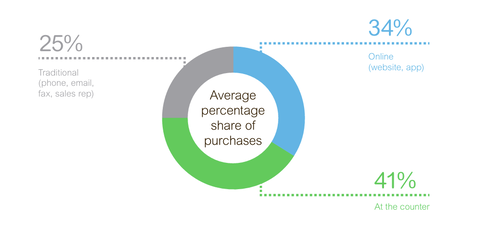
- Trade counters still handle 41% of purchases, while 75% of respondents expect to increase online ordering and quoting over five years.
- Knowledgeable staff, product availability, fast fulfilment, and real-time stock visibility are becoming central to the future counter model.
Schneider Electric has published research on the future of the electrical trade counter, identifying a shift toward multichannel purchasing, faster fulfilment, stronger stock visibility, and more advice-led in-branch service.
The research is based on a survey of 489 electricians and electrical contractors across the UK and Ireland. It shows that trade counters remain the leading channel for electrical product purchases, accounting for 41% of purchases, while buying behaviour moves toward a more blended model across counter, online, email, mobile, and messaging channels.
Seventy-five percent of surveyed electricians and contractors expect to increase their use of online approaches for ordering and quoting over the next five years. Among respondents aged 25 to 34, that figure rises to 84%, pointing to a widening gap between digital-first buyers and those who still place stronger value on face-to-face counter service.
The physical branch retains its role where expertise and convenience are strong. Seventy-one percent of respondents said knowledgeable staff are extremely important when visiting a trade counter, while 53% said they want the same speed and convenience from suppliers that they receive from consumer brands. In-store point-of-sale activity also remains influential, with 76% saying it triggers conversations and relationship building.
Rather than replacing branch purchasing, digital channels are changing what the branch has to provide. Customers expect the same stock information, service quality, and fulfilment reliability regardless of how they order. The counter remains relevant, but it now sits alongside digital quoting, online ordering, mobile communication, and dependable delivery to site.
Schneider Electric identifies six trends shaping the counter of the future: multichannel distribution, generational channel differences, speed and convenience, real-time visibility and fulfilment performance, knowledge and education, and a split between rapid collection and advice-led browsing.
Branch design is likely to reflect that split. Some customers want to collect and leave quickly, while others want to browse, compare products, discuss applications, or see new technology demonstrated. A single counter format may therefore need to support fast collection points, expert advice areas, product displays, digital lookup tools, and demonstration spaces.
The shift is taking place as electrical work becomes more technically layered. Installations increasingly involve EV charging, solar PV, battery storage, smart controls, surge protection, connected equipment, heat pumps, and more complex distribution requirements. Product selection can depend on compatibility, standards, board space, protection type, application environment, installation documentation, and future maintenance requirements.
That makes expertise a more valuable part of the buying process. Contactum’s compact Type 2 surge protection range shows how even a familiar distribution-board category is being reshaped by limited enclosure space, connected loads, EV charging, solar PV, and the routine specification of surge protection. Branch staff who can help navigate those interactions can strengthen the counter’s role beyond transaction processing.
The same dynamic applies to design and documentation. Fusion 360’s expanded electrical and solar design capability reflects rising demand for wiring, distribution, solar PV, lighting, and documentation support. Trade counters and wholesalers sit close to that same technical demand, particularly where installers need rapid access to compliant products and practical application guidance.
Real-time stock visibility is likely to become one of the defining operational requirements. Contractors working against project schedules need to know whether products are available, where they can be collected, and when delivery to site can be relied on. Delays in switchgear, protection devices, boards, cabling, EV charging equipment, or control components can disrupt labour planning and handover dates.
Wholesalers therefore need stronger integration between stock systems, branch operations, e-commerce platforms, and delivery networks. A customer who checks stock online, messages the branch, collects from a counter, and arranges a site delivery is not using separate channels in isolation. They are using one supplier system through several access points.
Training and product education remain part of the physical counter’s advantage. As product research moves online, the branch can still provide value through demonstration, product comparison, and application advice. Digital tools in-branch can support that role by giving staff and customers faster access to specifications, compatibility information, documentation, and training resources.
The trade counter is therefore becoming part collection point, part advice hub, part digital fulfilment node, and part relationship channel. Price remains important, but product availability, speed, confidence, and technical support are becoming harder to separate from the purchasing decision.
Schneider Electric’s Trade Counter of the Future infographic is available through the company’s document download page.
The strongest counter model will connect digital and in-person buying without forcing customers into one route. Stock visibility, accessible expertise, fulfilment speed, and installation-aware service will define how wholesalers compete as trade purchasing continues to fragment across channels.