IN Brief:
- The 30MW EFGL floating offshore wind farm has reached full output in the French Mediterranean.
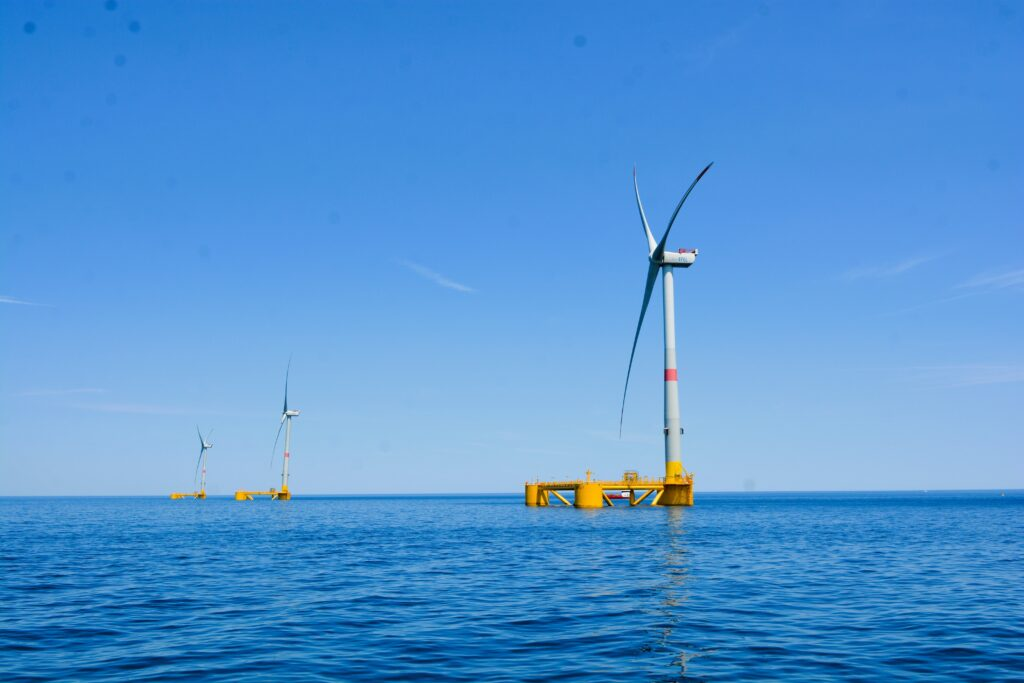
- Three 10MW turbines operate on semi-submersible floating foundations approximately 16km off the Occitanie coast.
- The pilot will provide operational data for larger floating wind projects while generating around 110,000MWh annually.
Ocean Winds has brought the 30MW Éoliennes Flottantes du Golfe du Lion project to full power, placing all three floating turbines into operation off the Occitanie coast in southern France.
Comprising three 10MW turbines installed on semi-submersible foundations approximately 16km offshore, the EFGL pilot exports electricity through a subsea cable connection to the French network. The project therefore provides an operating reference across floating generation, dynamic cabling, offshore electrical systems, and onshore grid delivery.
Annual production is expected to reach approximately 110,000MWh over a planned 20-year operating life. Developed with Banque des Territoires, the project will test technology, installation methods, maintenance requirements, and environmental measures before France advances towards commercial-scale floating wind developments.
Floating foundations allow turbines to operate in water depths where conventional monopiles or jackets become technically difficult or uneconomic. The turbine and tower are mounted on a buoyant structure held in position by mooring lines and anchors, while dynamic cables accommodate the movement created by wind, waves, and currents.
Those movements impose loading conditions that differ substantially from fixed-bottom offshore wind. Mooring systems, cable bend protection, connectors, hull structures, corrosion control, and turbine control strategies must manage repeated motion throughout the project life.
Maintenance planning must also account for equipment below the waterline and for access conditions affecting the complete floating assembly. Depending on the fault and project design, some interventions may require offshore repair, while others may involve disconnecting and towing a unit towards port.
Based at Port-La-Nouvelle, the project’s operations centre supports monitoring, marine access, maintenance, spare-parts management, and offshore coordination. More than 20 local workers are assigned to the facility as the project moves from construction into sustained operation.
Full power begins the long-term test phase
With all three turbines producing at full output, engineers can begin comparing design assumptions against measured platform motion, turbine loading, cable behaviour, availability, power quality, and maintenance demand across seasonal Mediterranean conditions.
Floating wind projects contain tightly coupled mechanical and electrical systems, since a change in turbine thrust affects platform movement and mooring loads, while platform motion influences cable behaviour and maintenance access. Turbine, foundation, mooring, and electrical design must therefore be modelled and operated as an integrated system.
EFGL is Ocean Winds’ second operational floating project globally and its first in France, giving the developer and supply chain a practical reference before commercial arrays require serial production of foundations, anchors, moorings, cables, and port-handling systems.
Moving from three turbines to larger fleets will place far greater pressure on manufacturing repeatability and installation throughput. Commercial projects cannot rely on fabrication and assembly methods suited only to one-off demonstrators, particularly where dozens of complete floating structures must be delivered within narrow weather and port schedules.
Ports will carry a substantial share of that transition. Floating units can be assembled closer to shore and towed to site, reducing dependence on certain heavy offshore installation vessels, although they require deep water, large laydown areas, high-capacity quays, and unrestricted routes for complete turbine structures.
Floating wind enters an industrial phase
The EFGL supply chain was predominantly European, with 99% of direct suppliers based in Europe, 85% located in France or operating from French facilities, and 60% classed as small and medium-sized businesses. That distribution reflects the project’s role in developing regional capability alongside electricity generation.
Artificial marine habitats produced by Ecocean have also been installed around parts of the offshore infrastructure. The Biohut units are intended to provide shelter and habitat, while long-term monitoring will establish how they perform alongside moorings, anchors, vessel activity, and routine maintenance.
Deep water relatively close to France’s Mediterranean coast makes floating technology central to developing the region’s offshore resource. Similar conditions exist in the Celtic Sea, Atlantic markets, and other parts of Europe where fixed-bottom foundations cannot reach the strongest or most accessible wind areas.
Commercialisation nevertheless remains exposed to cost and delivery constraints. Floating foundations require substantial quantities of steel or concrete, mooring systems need specialised installation, dynamic cables remain a critical reliability component, and early projects cannot draw on the same mature serial supply chain as fixed-bottom wind.
Development activity in the Celtic Sea, including the marine-licensed Llŷr project, reflects the broader move from prototypes towards pre-commercial arrays. EFGL contributes operating evidence to a sector where many projects remain in consent, procurement, or early engineering.
Its 30MW capacity is modest beside the commercial developments now planned, but the resulting operating data will influence foundation design, cable specifications, maintenance intervals, port strategy, and risk allocation. Those lessons will shape whether floating wind can progress from technically successful pilots into repeatable industrial delivery.